
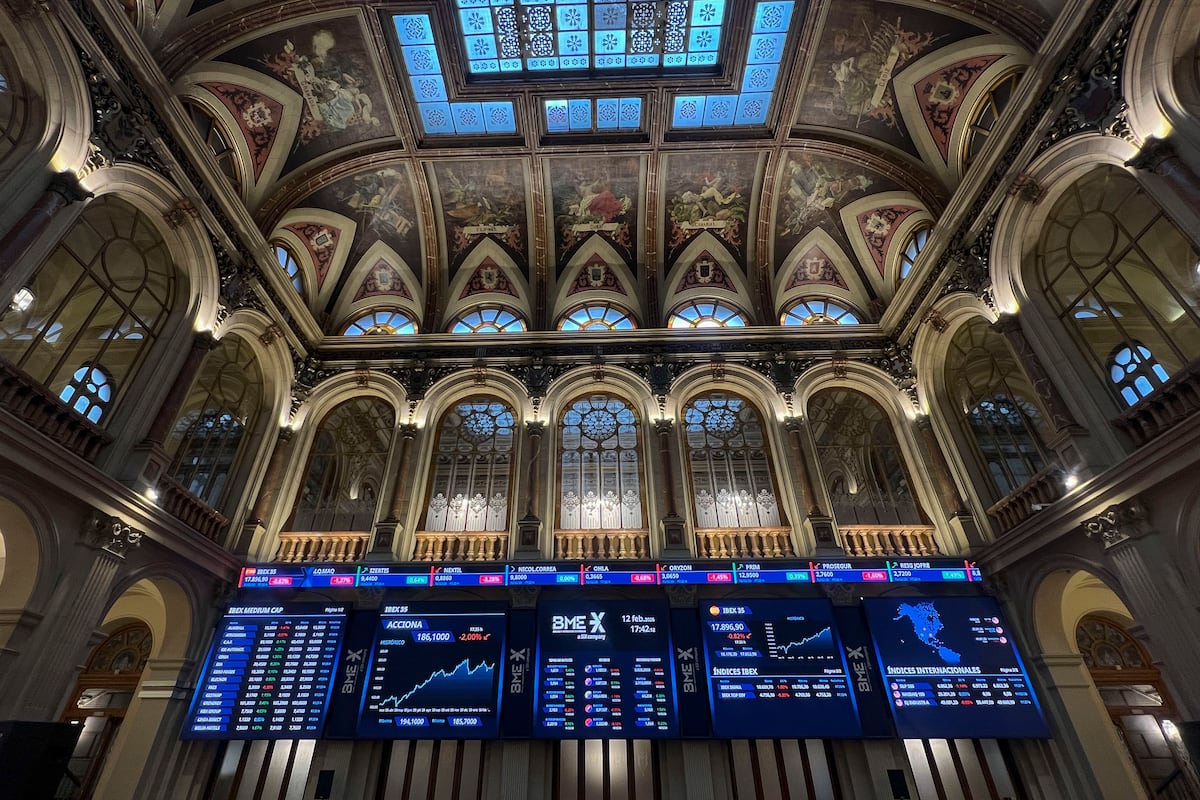
Renewed concerns over artificial intelligence valuations are dampening risk appetite, contributing to a decline in European markets. The IBEX 35 fell as much as 1.7% to a low of 17,581 points amid heightened fears surrounding corporate investment in artificial intelligence. Still, positive inflation data from the United States provided a boost to global equity markets, limiting the Spanish benchmark’s losses to 1.3%.
The IBEX 35 is down approximately 1.5% for the week, as technology stocks struggle following the release of January’s U.S. Consumer Price Index, which came in lower than expected. The data has increased the likelihood of interest rate cuts by the Federal Reserve, easing some of the turbulence caused by uncertainty surrounding the returns on technology investments, which have announced substantial investments to develop AI. As the European session nears its close, the Nasdaq, S&P 500, and Dow Jones are posting gains between 0.1% and 0.3%. Investors are weighing whether AI represents a promising future business or a bottomless pit of investment.
Experts at MacroYield noted in a report that “in recent weeks, the fear of disruption from AI has been added, and that this technology could displace other more traditional companies.” The analysis points to the software sector as being among the first to feel the impact, starting in November 2025, and warns that the downturn has accelerated recently with announcements from companies like Anthropic and OpenAI, which are calling into question the business strategy of these firms.
Cisco shares plunged 12% overnight after the network hardware manufacturer issued a weaker-than-expected forecast for the current quarter. The stock is showing little movement today, even as the so-called “Magnificent Seven” – a group of leading U.S. Technology companies – are facing scrutiny.
Despite recent corrections, market sentiment suggests a breather is due after a strong performance in 2025, when the IBEX 35 gained nearly 50%, becoming one of the best-performing indexes globally. The broader European market presents a mixed picture. The German DAX and French CAC are up around 0.3%, while the FTSE 100 is down 0.4% and the Italian MIB is down 1.8%.
Fears that recently announced tariffs from the Trump administration would have knock-on effects on early-year inflation have been allayed. The U.S. Consumer Price Index (CPI) rose 0.2% month-over-month and 2.4% year-over-year in January, both figures coming in below consensus estimates. The reaction was immediate, with gains in equity markets and declines in debt yields.
The yield on the 10-year U.S. Treasury note fell to 4.07% from 4.2% at the start of the week, driven by increased demand for existing issues ahead of anticipated cuts to new rates. The market is speculating that the Federal Reserve could cut rates up to three times this year, from the current range of 3.5% to 3.75%. There is even a possibility that Jerome Powell will implement cuts in April, just before he steps down from his responsibilities in favor of Kevin Warsh.
Recent market corrections have been driven by a rotation towards more defensive stocks away from cyclical sectors like banking. Steelmakers Acerinox and AcerlorMittal are among the biggest decliners, down around 5%, due to fears that the Trump administration may roll back planned tariffs on steel and aluminum amid supply concerns. These two companies had benefited from the more protectionist environment. A reversal of that trend could lead to lower selling prices and reduced margins due to competition from Chinese steel.
Banks are also lagging, with CaixaBank down nearly 5% and Bankinter, BBVA, and Santander down more than 2%. The sector is correcting across Europe without specific catalysts, with analysts attributing the declines to profit-taking after months of strong returns. Société Générale is down 6% and BNP Paribas is down nearly 3%. Spanish banks are also falling, with Sabadell and Unicaja down close to 2%.
Mapfre is among the top performers. The Spanish insurer reported record profits of over €1 billion in 2025, a 19.6% increase. Some analysts have questioned the company’s growth potential, particularly due to its strong presence in Latin America, where currency depreciation has been a headwind. However, today’s market reaction is more positive, with shares up 1.4%.
In currency markets, the euro is stable around $1.186 despite expectations of further interest rate cuts in the United States, with European debt relaxed. The Spanish 10-year bond yields 3.14%, while the German Bund yields 2.76%. In commodities, Brent crude oil is little changed, anchored at $67 per barrel, while gold is up 2% and has regained $5,000 per ounce, and silver is trading around 78,000 units of the greenback after rising 4%.
Bolsas – Divisas – Deuda – Tipos de interés – Materias primas
