
Ancient ‘Band of Holes’ in Peru May Have Been Accounting System, New Research Suggests
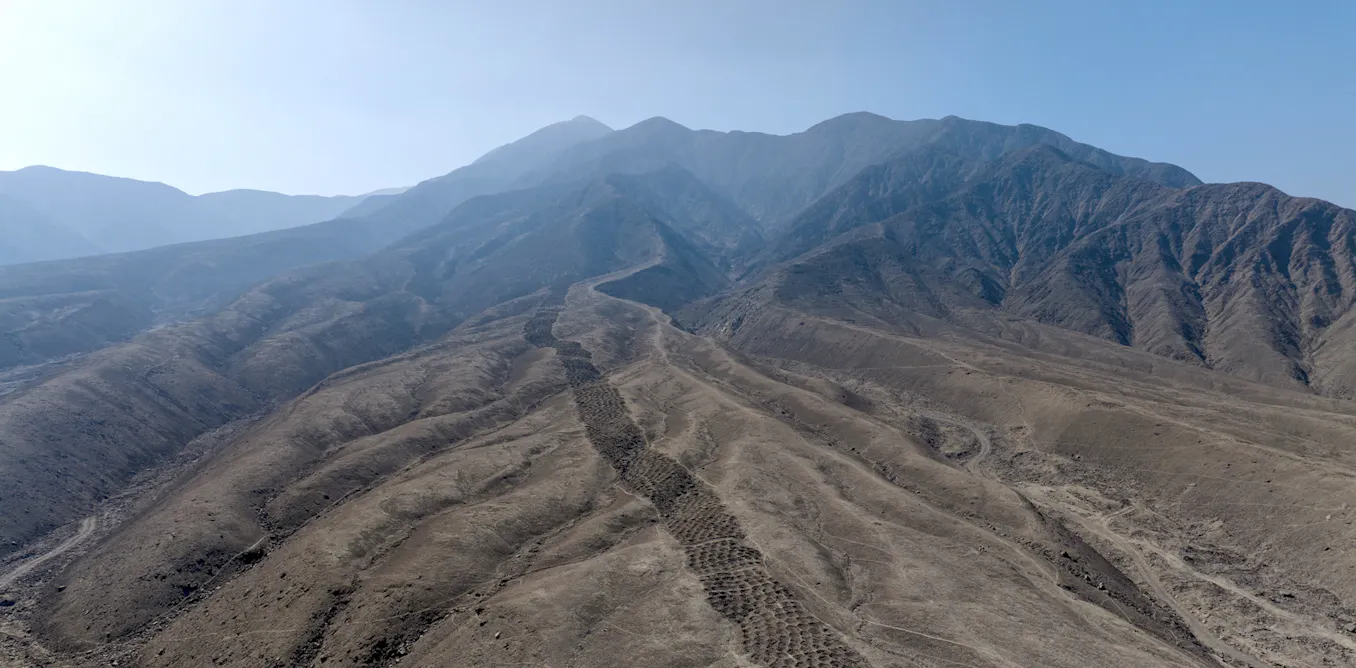
An international team of archaeologists has proposed a new theory for the purpose of Monte Sierpe, a mysterious 1.5-kilometer-long site in southern Peru consisting of over 5,200 precisely aligned holes, suggesting it functioned as an Indigenous system of accounting and exchange centuries before the arrival of Europeans.
The site, discovered in 1931 during aerial photography expeditions of the Andes, has long baffled researchers. New research, published today in the journal Antiquity, details drone mapping and sediment analysis revealing a “segmented” organization of approximately 60 sections of holes, some separated by empty spaces, and numerical patterns within those sections. Sediment samples identified ancient pollens of maize, bulrush, and willow, indicating the deposition of plants, potentially transported in woven baskets.
Crucially, the organization of Monte Sierpe parallels the structure of a local Inca knotted-string record-keeping device known as a khipu, recovered near Pisco. The 60 sections of holes correspond to the approximately 80 groups of cords found on the khipu, leading researchers to believe Monte Sierpe may have played a significant role in Indigenous accounting practices. This discovery offers potential insight into how complex societies functioned in the Andes without traditional currency or writing. The Inca Empire, known for its administrative prowess, relied on innovative methods to manage resources and populations.
Researchers hypothesize that Monte Sierpe initially served as a barter marketplace, with the holes representing units of exchange, before evolving into a large-scale accounting device under the Inca Empire (1400–1532 AD) for collecting tribute. The team found no evidence supporting theories of defensive structures, water collection, or fog capture. Officials stated further investigation is planned to fully understand the site’s evolution and its role within the broader Andean cultural landscape.
