
🖍
Canadian air travel could face renewed disruptions in 2026 as labor negotiations heat up across the industry.
Porter Airlines flight dispatchers are threatening a strike as early as January 20, after voting unanimously in favor of a strike mandate. Simultaneously, contract negotiations are looming with pilots at WestJet, and with mechanics and baggage handlers at Air Canada, all set to expire at the end of March.
These developments follow a year of significant travel disruptions. Air Canada flight attendant strikes and a strike by WestJet mechanics grounded flights for both major Canadian carriers earlier this year, and potential walkouts by WestJet pilots and Air Transat pilots also created operational challenges.
The series of labor actions has prompted travelers to question whether the coming year will bring more stability to Canadian aviation, or if booking flights will continue to require caution. The Canadian airline industry, like its counterparts globally, is navigating a complex landscape of rising costs and shifting labor dynamics.
Porter Airlines could see a work stoppage as soon as January 20, with its dispatchers having secured a unanimous strike mandate. The airline is also currently negotiating contracts with its pilots and cabin crew. Meanwhile, collective agreements with WestJet pilots, as well as Air Canada’s mechanics and baggage handlers, are all scheduled to expire at the end of March.
Outside of Porter, no work stoppages are currently planned in the immediate future due to mandated conciliation and cooling-off periods.
A Porter Airlines plane on the tarmac.
Photo : The Canadian Press / Adrian Wyld
Experts anticipate continued labor unrest, fueled by gains made by U.S. airline workers and a more interventionist approach from the federal government. The potential for further disruptions adds another layer of uncertainty to the travel sector as it continues to recover from the pandemic.
Long-term collective agreements, lasting up to 10 years, have provided a degree of stability in the aviation sector over the past decade. However, as these contracts expire, unions are seeking significant increases to account for the cost of living and match wage gains seen at U.S. airlines.
“One of the issues that is certainly exacerbating the situation is the length of these contracts,” says Geraint Harvey, a professor of labor relations at Western University.
The rising cost of living and union successes south of the border have created high expectations among aviation personnel, but fierce competition has led management to take a firm stance on certain demands. Financial losses stemming from the COVID-19 pandemic have also made companies more reluctant to make concessions.
“We are seeing the tail end of the COVID crisis, and I don’t think it’s over yet,” Harvey said.
Air Canada flight attendants struck in August. The previous year, WestJet mechanics picketed, disrupting operations. In early December, a work stoppage at Air Transat grounded aircraft.
Federal Interventions
The increasing use of back-to-work directives from the federal government has, ironically, created new impasses at the bargaining table, as employers bet that staff would be ordered back to work within hours of a strike being launched.
These directives rely on Section 107 of the Canada Labour Code, which allows the Minister of Labour to take the measures it considers appropriate to promote good labour relations and to create conditions favourable to the settlement of disagreements or disputes
. This can include ending a work stoppage through binding arbitration.
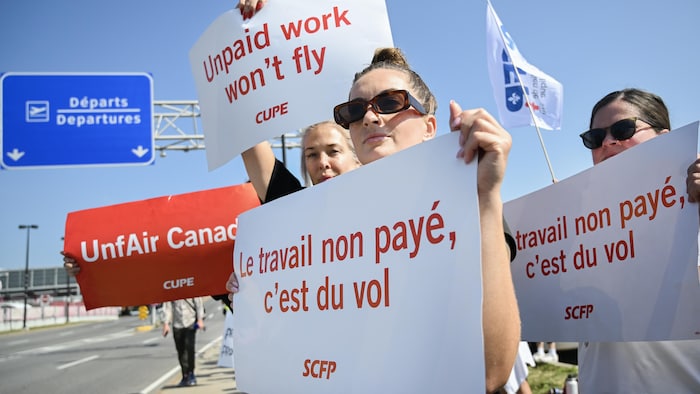
Air Canada flight attendants picket outside Montreal-Trudeau International Airport on Saturday, August 16, 2025.
Photo : The Canadian Press / Graham Hughes
Used sparingly since its creation in 1984, this provision has been invoked eight times by the government since June 2024, according to the Canadian Centre for Policy Alternatives.
John Gradek, a lecturer at McGill University’s School of Continuing Studies and an aviation management expert, criticizes airlines for relying too heavily on the federal government to break bargaining impasses, expecting their staff to return to work hours after initiating a strike.
This escalation has led to a rupture
in the bargaining process in the transportation sector, Gradek argues.
It appears that management is really not interested in bargaining. They’ve essentially run out the clock, waiting for the 107 to kick in and resolve the problem. In my opinion, the very concept of bargaining in the transportation sector has been neutralized by the systematic resort by the employer side to Article 107
, he said.
