
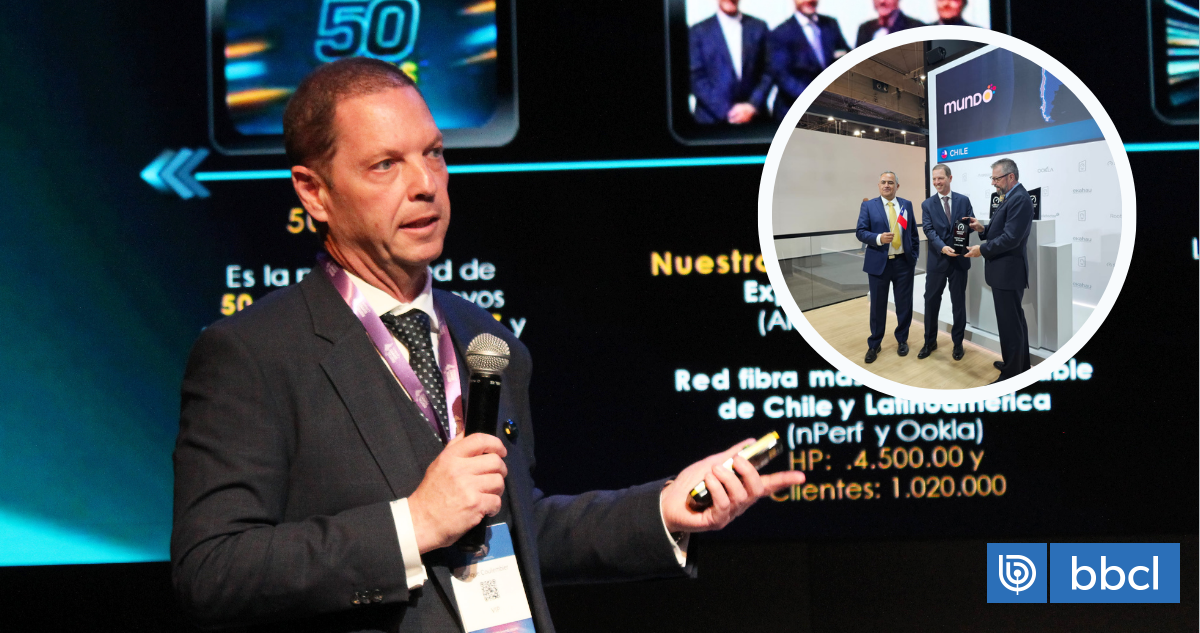
Chile has officially been recognized as having the world’s fastest fixed internet network. As previously reported, Chilean operator Mundo Telecomunicaciones was awarded this title in Ookla’s Speedtest Awards, and received the recognition first in Madrid, Spain, and then in Barcelona.
In a conversation with BioBioChile, Mundo CEO Enrique Coulembier discussed the significance of this achievement for a company originating outside of the capital, questioned the viability of 5G technology, and emphasized the importance of bridging the digital divide within the country.
Question: This recognition was first presented in Madrid at Digital Summit Latam and now in Barcelona, at a world-class event like Mobile World Congress. What does it mean for a regional Chilean company to receive this type of validation on a global stage?
Coulembier: “I’ve been in Chile since 2015. I was born in Argentina, but I’ve spent over 28 years of my professional life in Spain. To see a mindset in Chile, where the country is highly centralized in Santiago, I believe this is a clear example that Chile is not just Santiago, as a constructive criticism.”
“That a company from the regions, a little company that was born in Curanilahue, has deployed throughout the country, connected the most rural sectors of Chile, and reached where It’s today, is a source of pride for us. It also serves as an example that things can be done not only from the center of Chile.”
Q: Chile has been demonstrating strong fixed-line speeds for years, but now it has reached first place globally with Mundo. Is this a corporate achievement or a turning point for the Chilean industry?
Coulembier: “I think it’s both. It’s a corporate achievement, a sacrifice and effort made by the Mundo team, which has been ongoing for many years. Achieving this isn’t simply turning on a tap for speed; it’s about developing robust networks, making significant investments in transmission, interconnecting cities with well-maintained networks, and ensuring our customers see that effort in their service. We’ve not only won these awards, but we’re also winning the Procalidad awards in Chile for service excellence.”
“As a country, this presents a significant challenge because now we need to maintain this level and finish connecting the country. We need to leverage this to endeavor to move beyond Chile being an exporter of minerals and fruit, and turn into an exporter of software and a hub for data storage. Chile has the ideal conditions: electricity in the north, affordable land, sunshine for generating cheap energy. The only thing missing was connectivity, and we are providing that.”
“That means data centers that previously would have gone to large cities, where they faced high costs and environmental concerns, could now consider locations in more remote areas of the country. This would also help to decentralize the focus away from Santiago, by incentivizing and supporting private companies to establish data centers outside of major urban areas, fostering national development.”
“I believe this is an opportunity for Chile to become a hub for South America.”
Q: Lourenço Lanfranchi, Ookla’s director for Latin America, recently stated in an interview with BioBioChile that a key factor in Chile’s strong performance is the significant investment in fiber optics. However, many countries invest in fiber and don’t reach first place. What did Mundo do differently from other operators in Latin America and globally?
Coulembier: “I always say that we built this company without money. We’ve had two or three investment funds, and now we’re with a very large fund, and everyone says ‘now they have backing,’ but we continue to manage and administer the company – with this large fund, Digital Bridge, which manages over $125 billion – as we did from the very beginning.”
“We are very efficient. We have a very transversal structure. We think carefully before making investments and about the type of equipment we deploy. With that efficiency, or that mindset, or that strength in making these investments, we make it as efficient as possible. I think that’s the secret: spending money wisely.”
Q: How much of this achievement is due to infrastructure, and how much to management model?
Coulembier: “I think it’s fifty-fifty. The infrastructure is super critical in how it’s developed and installed, but management is also super relevant. Having a committed team, a team that seeks challenges, is very important to us – our field technicians, our sales team. We work for them. We are the tools for the people who are in the sun, the people who get wet when installing a service, and also our last line of defense when a customer gets upset, because sometimes – and I hope it’s by chance – when we make a mistake, it’s not the company that makes it, it’s the people. The company *is* the people.”
“When we receive constructive criticism, it’s usually someone who forgot something or missed something. Those first lines of defense have to be strong, because they are the last defense for dealing with a customer who is a little angry because their service failed or they didn’t receive proper instruction on one of our products. Those people have to be happy because they defend our company at the last bastion of service.”
“With that said, everything that comes next is an opportunity. I’m talking about the commitment of our structure and our colleagues, while other companies in Chile are criticizing the industry, saying it has invested a lot and isn’t getting help, and their workers are being laid off. Just recently, we saw a press release where Movistar (after being recently acquired by Millicom) just laid off 30% of its workforce. I believe their workforce was around 3,500, meaning they’re laying off over 1,000 workers. WOM just went through a restructuring under Chapter 11, and Claro and its merger with Liberty disappeared from Chile (acquired by América Móvil). How can those workers be focused on growing or improving their companies when all of this is happening?”
“In contrast, in our company, everyone is focused on the new challenges ahead. I’ve been able to convey that every challenge is an opportunity not to be bored.”
Q: In your presentation at the Digital Summit in Madrid, you highlighted that Mundo is the only operator in municipalities like San Fabián de Alico (Ñuble Region). How much did the decision to focus on regions and municipalities outside of major urban centers contribute to this result?
Coulembier: “We have a very strong DNA in trying to help, and especially the places that have responded and been loyal as customers, which are the regions in general. We realized that people with lower incomes value it much more when a company treats them properly, without discrimination. But we also noticed that those are the people who pay best, those are the people who respond best, and we also ended up seeing that it was a commercial opportunity because we were alone, because no one wanted to go.”
“We ended up going to places where others didn’t aim for to or couldn’t, but I think it’s more that they didn’t want to go. In fact, I received an award for best executive in Latin America (by Conecta Latam) in Panama, and when I finished my speech, many people from large companies – Liberty, Claro, América Móvil – came to invite me to their executive meetings to convince their executives to attack zones that are of lower social strata, which they consider unviable for developing the business.”
“For me, it’s the opposite. Those people live and enjoy having connectivity. In other sectors, they can go to the movies, have the opportunity to go to an event, a theater, a restaurant, but in the more rural sectors – which are often taken as lower social strata, and I think they aren’t – people have connectivity to communicate with their families, to live, to have fun, for everything.”
Q: Millicom entered Chile after acquiring Movistar. How does this change the competitive landscape?
Coulembier: “I think it will help us. I get along well with everyone. We all integrate Chile Telcos (Chilean Telecommunications Association). The entry of Millicom will require all of us to continue being efficient and improve the customer experience. I’m happy that a new operator with so much experience has entered, with experience in Europe. Honestly, for Mundo, this sets increasingly higher challenges.”
Q: Do you think there are too many operators in the internet market?
Coulembier: “No. I told you that I’ve had my professional experience in Spain, I’ve had my own networks in Spain until very recently, the consolidation in Spain took more than a year, but even so, there are still five overlapping fiber networks in some cities, 15 operators. There’s a model of entrepreneurship that has emerged, and we’re trying to instill that in Chile as well.”
“It’s ironic. When others say there are too many operators, we’re encouraging local entrepreneurship and encouraging entrepreneurs to create their own fiber brand because they have acquaintances, because they’re dedicated to a sector like electricity, and they have people who trust them. We encourage them to develop a brand, we provide all the rest, we provide the infrastructure, we give them the form to sell, and they create their own entrepreneurial business. Competition is always good. It teaches us all to improve. No one is perfect. And I think we learn every day with all of this.”
Note from the editor: While Coulembier did not refer to anyone specifically, in a recent interview Marcelo Benítez, CEO of Millicom, said he believed Chile could not sustain four operators.
Q: How much room does the fiber market have to continue growing in Chile? In that sense, how do you envision that scenario with the future deployment of technologies like 6G?
Coulembier: “I’m a total detractor of 5G, but not because the technology isn’t good. The large vendors – manufacturers of technology – are the ones who incentivize the market to try to sell more and more new products. They’ve gotten governments, private companies, everyone, to believe that 5G is the best thing there is, and large companies have gone into debt, invested a lot of money in this technology to replace the same use that a technology had three or four years ago, which is 4G.”
“4G didn’t generate enough revenue to be profitable, and now you’re introducing 5G? Nothing has changed. In fact, 5G isn’t developed as it should be because for 5G to be truly viable, there would have to be devices, data would have to be generated in homes, and that antenna would have to be as close as possible to where the data is generated.”
“If we look at the Chilean market today, the infrastructure has changed from a tower that had 4G and 3G to adding a new 5G antenna. Nothing has changed. That’s the reality.”
“So, what’s coming next? A large challenge. Chile, as we talked about with San Fabián de Alico, is the only operator in that location and doesn’t exceed 45% penetration. Chile, at the national level – including the large urban areas that raise the averages – has an average connectivity of 73%. Developed countries that don’t have as much fiber optic as Chile have 95%. Does that seem logical? We have the fastest network in the world, but Chile has 73% penetration and San Fabián de Alico in the middle of the mountains doesn’t exceed 45%.”
Note from the editor: According to the latest Census, Chile has 6,596,527 households, of which – according to a recent Subtel report – 4,796,680 have internet access, equivalent to 72.7%.
Q: In this new stage, is the challenge to grow more or to maintain quality?
Coulembier: “It’s not more important to grow than to maintain service, to maintain existing customers. It doesn’t make sense to lose customers and try to get them back on the other side, because it’s not viable for me or any company. I’m convinced that quality goes hand in hand with having many customers and ensuring that those customers never think about punishing the current company to go with others. We have to first take care of our existing customers, thank them, and contain them to continue growing.”
“What’s happening is that the market is only leading us to grow in residential (housing). Our investment focus this year will be on B2B (Business to Business), in the corporate sector. We’ve won contracts with Minsal (Ministry of Health), Junji (National Kindergarten Board), the Public Defender’s Office. Our goal is to demonstrate that the residential model can be replicated in a corporate and government model, so that the latter can invest less, because we are very efficient, and profitable. This will allow them to invest in other things, such as promoting the digitization of the elderly, people in rural areas, and understanding that connectivity is very important, not only for studying but for entertainment and connecting with the world.”
“Q: Do you think public policies are lacking to consolidate Chile’s leadership in internet?
Coulembier: “Many public policies are lacking. I think that’s what the government is missing. Chile is a country with a very inhospitable territory for deploying any infrastructure. There are still very remote places in Chile that no company will want to go to, and no matter how crazy we get, we won’t be able to reach them.”
“With this change of government, I think now would be the ideal time to first land, put our feet on the ground, demand that all companies share their information about where they have networks, and once they know where there are networks, towers, coverage, fiber lighting, then invest the money well where it doesn’t exist. In Spain, after 10 years of supporting digitization, they are doing what are called white zones. They are giving subsidies to the best bidder. These are subsidies like Chile’s FDT (Telecommunications Development Fund), where the private company bids for public funds, but based on where there is less coverage and where it really doesn’t exist. They require the private company to guarantee a minimum level of connectivity, in speed and capacity, to provide that service, now connecting a small rural town of 15 homes.”
“Today – as the geopolitical situation is and with remote work – people are moving to the countryside. Also, in Europe, and I think it’s happening in Chile too, there’s a big shortage of housing, which makes it more expensive to rent or buy. This is about helping people who can’t afford that housing to go to the middle of the mountain – as they say in Chile – and be able to telework from there.”
Q: How do you imagine the Chilean digital ecosystem in five years? And in that scenario, what role do you want Mundo to play?
Coulembier: “I imagine it in a certain way, and if it’s not like that, I don’t think I’ll be at Mundo anymore. I imagine Mundo leading, not in size as the largest company in the segment, but I would like us to be recognized for leading the country’s technology, bridging the digital divide throughout the country. I would like to be able to narrow that gap from 73% to 95% that developed countries have, and for no one to complain that they live on top of a mountain and don’t have connectivity.”
“We feel fully involved. We were the ones who connected that little boy who wrote a letter to former President Sebastián Piñera saying he didn’t have connectivity and had a grade of 7.0. I remember seeing the news in Chile from Spain and we ran out without measuring if it was profitable or not, we ran to connect that boy, who was then called by Piñera himself to give him the news.”
“Whether it’s the right or the left, we work for the people, we work to make the government look good or to make the private company look good. We work to connect a country, because we’ve realized that connecting a country is very profitable for us.”
