
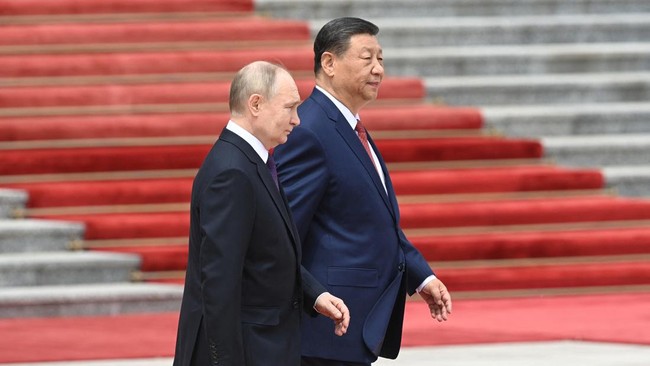
Jakarta, CNBC Indonesia – China and Russia have voiced strong condemnation following a joint military operation by the United States and Israel against Iran on Saturday. The attack, which reportedly resulted in the death of Iran’s Supreme Leader Ayatollah Ali Khamenei, has prompted calls for de-escalation from both Beijing and Moscow, signaling growing international concern over the escalating conflict in the Middle East.
China’s Foreign Ministry expressed “deep concern” over the U.S.-Israel strike, urging an immediate ceasefire. According to a statement released by the ministry, “the sovereignty, security, and territorial integrity of Iran must be respected.” This comes as regional tensions surge following the unprecedented military action.
Chinese Foreign Minister Wang Yi condemned the attack in a phone conversation with his Russian counterpart, calling it unacceptable, particularly given the targeting of a national leader and the potential for regime change, AFP reported. “Especially the blatant killing of a country’s leader and instigating regime change,” Wang Yi said.
Moscow echoed these sentiments, with its Foreign Ministry stating that the “aggressive actions” violated international law and fundamental principles of the United Nations Charter. The ministry added that the strikes were “disrupting stability in the entire region.”
Despite the strong rhetoric, observers note that both Russia and China have stopped short of offering concrete support to Tehran. This cautious approach highlights the complex geopolitical dynamics at play and the limited extent of their strategic partnerships with Iran.
“I don’t spot the Chinese government taking any concrete steps to support Tehran,” said Gabriel Wildau, Managing Director of Teneo, a firm specializing in China. “Maintaining détente with the U.S. Remains a strategic priority for Chinese leadership.”
This stance is particularly relevant as U.S. President Donald Trump and Chinese President Xi Jinping are scheduled to meet later this month, if plans hold. Beijing may be seeking concessions on issues such as Taiwan and trade in exchange for a more measured response regarding Iran, according to Ahmed Aboudouh, a researcher at Chatham House, a London-based policy think tank.
A social media account linked to Chinese state media, widely considered a mouthpiece for Beijing, Niutanqin, wrote that “Iran has no true allies,” adding that even close partners will prioritize their own national interests over assisting Tehran in a crisis.
China’s restraint in offering military support to Iran is not unprecedented. Last year, Chatham House reported, Beijing criticized U.S. And Israeli attacks against Iran but did not provide material assistance to Tehran. Prior to the 2015 nuclear deal, China likewise supported UN-led economic sanctions against Iran and has been slow to invest in the Iranian economy.
Following the detention of Venezuelan President Nicolas Maduro by the U.S. On January 3, China similarly condemned “the blatant use of force” and urged Washington to “stop violating the sovereignty of other countries.” However, its response was largely limited to verbal condemnation.
“China’s reaction to U.S. Interventions in Venezuela and Iran demonstrates that its strategic partnerships are far from military alliances or even guarantees of military support in the face of an existential threat from U.S. Aggression,” Wildau said.
Russia
Iran has become a key strategic, military, economic, and trade partner for Moscow in the Middle East in recent years. Since the start of its full-scale invasion of Ukraine in 2022, Iran has been a significant supplier of drones and military missiles to Russia.
Russia will be concerned about losing another foothold in the Middle East. The collapse of the Iranian regime would follow the loss of another regional ally, Syria, after the fall of the Bashar al-Assad regime in December 2024.
While the Russian Foreign Ministry condemned the attack on Iran, neither the Kremlin nor President Vladimir Putin have publicly addressed the situation.
“The prolonged war in Ukraine has eroded Russia’s ability to project power beyond its borders,” said Matt Gerken, head of geopolitical strategy at BCA Research. “With its military stretched and its economy under constant pressure from Western sanctions, Moscow’s influence in the Middle East will likely diminish.”
Russia also needs to monitor its crude oil prices, which help fund its war effort through sales to China and India.
Yesterday, oil prices rose more than 8% as market participants worried that conflict in Iran could cause a major disruption to global supplies. Several countries within the OPEC+ group, including Russia, announced on Sunday that they would increase production by 206,000 barrels per day starting in April.
“Putin will be happy, because anything that raises oil prices benefits him,” said Ellen Wald, President of Transversal Consulting. “He can certainly say: if you can’t get oil from the Gulf, hey, we have plenty of supply.”
“I think he’s happy with the situation, even though once this is over, Trump will probably turn his attention to Putin next.”
In general, Russia often takes a “wait and see” approach to global affairs that do not directly impact its interests. When protests erupted in Iran in late December, Russia did not offer assistance.
Now, Russia may stand back and observe whether the regime can withstand the military strikes from the U.S. And Israel. However, Stanford Professor and former U.S. Ambassador to Russia Michael McFaul said there is no guarantee that U.S. And Israeli airstrikes alone will be enough to cause regime change.
Iran Will Fall?
McFaul said that historically, airstrikes have not led to the overthrow of regimes. He stated he could not think of a single successful case, even with military interventions involving ground troops.
“Right now, we are bombing military targets – weapon systems aimed at us and our partners and allies – we are not eliminating the instruments and weapons used to suppress the Iranian people,” he said.
“So far, it is still very unclear how the current military campaign will lead to the regime change that President Trump has promised to the Iranian people,” he added.
