
Italian smokers will see a gradual increase in the cost of cigarettes, along with other tobacco and vaping products, beginning January 16, 2026, as new tariffs outlined in the 2026 Budget Law take effect. The phased increases-which will extend to 2028-are anticipated to generate important revenue for the state, estimated at over €1.47 billion over the three-year period, according to government forecasts. This report details the specifics of the tax adjustments, including initial price changes already published by the Agency of Customs and Monopolies (ADM), and their broader implications for consumers and the tobacco industry.
Consumers will begin to see higher prices on cigarettes starting January 16, 2026, as updated tariffs linked to new regulations outlined in the 2026 Budget Law take effect. The initial tariff adjustments mark the beginning of a phased approach, with the budget law outlining excise tax increases on processed tobacco products through 2028, also impacting electronic cigarettes and tobacco products for inhalation without combustion.
Cigarette Price Increases Begin January 16, 2026
Table of Contents
- Cigarette Price Increases Begin January 16, 2026
- Examples of Price Changes in the Initial Round
- How Cigarette Excise Taxes Work and Changes with the Budget Law
- Minimum Simplified Tax Burden Explained
- Impact on Roll-Your-Own Tobacco and Cigars
- Heated Tobacco: Initial List vs. Overall Rule
- E-Cigarettes: Coefficient Increases
- Expected Revenue for the State
The key date is January 16, 2026, when select products will undergo tariff modifications already published on the price lists of the Agency of Customs and Monopolies (ADM). The ADM has communicated that “products listed on the agency’s website will be subject to tariff changes effective January 16, 2026.”
The updates will be rolled out in stages, beginning with a first round of price list adjustments for products from a major group, with further updates for other brands expected in the following days.
While not a primary focus, the Italian Society of Environmental Medicine (SIMA), through its president Alessandro Miani, has advocated for broader tax increases on harmful products. “If the goal is to increase taxes on goods detrimental to health, a more comprehensive approach should be considered, encompassing a wide range of potentially harmful products,” Miani stated. “Many other countries have successfully applied the ‘sin tax’ to various products, from strong alcohol to sugary drinks, which has both reduced consumption and increased public revenue to cover associated healthcare costs.”
Examples of Price Changes in the Initial Round
To illustrate the impact, some retail prices are already appearing on the ADM’s price lists with the initial adjustments (examples):
- Marlboro Gold KS (20): 6.80
- Marlboro KS (20): 6.80
- Philip Morris Filter Kings (20): 5.80
- Chesterfield Original KS (20): 5.80
- Merit SSL (20): 6.50
Initial increases are expected to reach up to 30 cents per pack, with some packs priced at 6.80.
How Cigarette Excise Taxes Work and Changes with the Budget Law
The Budget Law impacts an excise tax on cigarettes comprised of two components:
- a specific component (a fixed amount linked to quantity);
- an ad valorem component (a percentage based on the selling price).
Under this framework, the Budget Law increases the fixed specific amount per 1,000 cigarettes according to a three-year progression:
- 32 euros for 2026;
- 35.50 euros for 2027;
- 38.50 euros from 2028.
This progression is central to the anticipated price increases, representing a series of steps rather than a single adjustment. The changes are expected to have a ripple effect on tobacco company earnings and consumer spending.
Minimum Simplified Tax Burden Explained
An important, though less immediately apparent, element is the adjustment of the minimum tax burden (excise tax + VAT) on cigarettes.
This is being set directly to:
- 216 euros per 1,000 cigarettes in 2026;
- 221 euros in 2027;
- 227 euros from 2028.
Average estimates per pack, based on the evolving tax structure, are approximately 15 cents in 2026, around 25 cents in 2027, and about 40 cents from 2028.
Altroconsumo, using similar calculations, provides an example to illustrate the impact: a pack currently priced at 5.50 would rise to 5.65 in 2026, then 5.75 in 2027, and 5.90 in 2028, assuming the full tax increase is passed on to consumers.
Impact on Roll-Your-Own Tobacco and Cigars
The Budget Law also increases minimum amounts for other categories of processed tobacco. Specifically:
- Cigarettes (small cigars): 47 €/kg conv. in 2026, 49 in 2027, 51 from 2028.
- Roll-your-own tobacco: 161.50 €/kg conv. in 2026, 165.50 in 2027, 169.50 from 2028.
These figures are significant as they affect products that many consumers view as alternatives to packaged cigarettes.
Heated Tobacco: Initial List vs. Overall Rule
It’s crucial to distinguish between the initial application of price lists and the overall regulation.
Some heated tobacco products (such as Terea, Glo, Ploom) are not included in this first round of adjustments.
However, the Budget Law does address excise taxes on tobacco for inhalation without combustion, setting percentages at 40.50% for 2026, 41% for 2027, and 42% from 2028. This represents a reduction in the tax burden compared to the previously planned 42% from January 1, 2026.
In essence, even if a product isn’t on the “first list” of changes, the overall three-year regulation applies to more categories.
E-Cigarettes: Coefficient Increases
The Budget Law extends beyond traditional tobacco products. Increases to coefficients for e-cigarettes are as follows:
- Liquids with nicotine: 18% in 2026, 20% in 2027, 22% from 2028.
- Liquids without nicotine: 13% in 2026, 15% in 2027, 17% from 2028.
This follows a progressive pattern, representing a phased approach rather than a one-time adjustment.
Expected Revenue for the State
Based on parliamentary documents quantifying the impact of the tax adjustments, the expected revenue for the state is:
- 213 million in 2026;
- 465.8 million in 2027;
- 796.9 million in 2028.
Other figures appear in public debate, but these numbers represent the most reliable official estimates. Assoutenti, however, provides a broader estimate for the three-year period. President Gabriele Melluso stated: “According to government forecasts, the increase in cigarette and tobacco prices will generate additional revenue of 1.47 billion euros over the three-year period: 213 million euros for the year 2026, 465.8 million for the year 2027, and 796.9 million for the year 2028.”
How to Track the Increases
Focus Italia Oggi – Artificial Intelligence, the rules
Law n. 132/2025 point by point, between effective provisions and rules to be implemented, with the operational implications
Focus Italia Oggi – Artificial Intelligence, the rules
To understand what is increasing and when, the most reliable approach is to cross-reference:
- the regulatory framework (Budget Law and official documents);
- ADM price lists and operational communications;
- journalistic reports explaining which products are included in each round of adjustments.
(reproduction reserved)
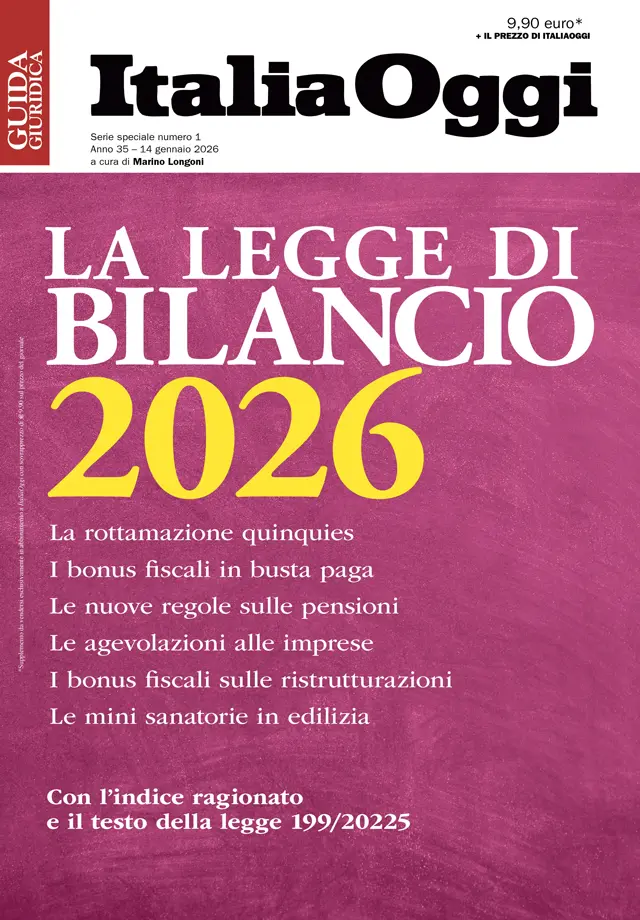
The 2026 budget law
The complete text of the 2026 budget law with the index of contents clause by clause: the fifth scrapping, tax bonuses in the paycheck, the new rules on pensions,…
