
Italian cryptocurrency holders face a new annual tax obligation-the “imposta di bollo sul valore delle cripto attività” (IVACA)-effective for the 2023 tax year,assessed on holdings as of December 31st,2023,adn due in 2024. This 0.2% wealth tax applies to all crypto assets held directly by individuals, regardless of profit or loss, and is in addition to potential capital gains taxes. While centralized exchanges will automatically withhold the tax on behalf of users, those holding crypto in private wallets are responsible for self-assessment and payment. Recent regulatory changes also signal a future increase in capital gains taxes for crypto trading, prompting some investors to explore choice strategies like futures trading or exchange-traded funds.This article details the intricacies of the crypto stamp duty, outlining who is affected, how to calculate and pay the tax, and where to declare it on your Italian tax return.
Italian cryptocurrency investors are facing a year-end deadline to calculate and prepare for a new tax obligation: the “stamp duty” on crypto holdings.
As December 31st approaches, many investors in the crypto world are reminded of a significant tax requirement. Italian tax authorities require all taxpayers to assess their crypto asset holdings by the end of the year, upon which the stamp duty will be applied. This new levy is prompting investors to review their portfolios and understand their obligations.
Not sure what the stamp duty is? Do you have funds in DeFi and are unsure how to declare them? Concerned about making mistakes and incurring penalties? This article explains everything you need to know.
Understanding the Crypto Stamp Duty
Table of Contents
Officially defined as the “imposta di bollo sul valore delle cripto attività” (IVACA), this is an annual wealth tax. All crypto holders are legally obligated to calculate the euro value of their assets as of December 31st.
An tax rate of 0.2% is applied to the resulting amount, regardless of whether investments are profitable or experiencing losses. This tax applies to anyone operating in the crypto space, including those using decentralized markets, with penalties for non-compliance. However, those investing in crypto through ETFs or traditional assets are exempt, as they do not fall under the category of “crypto assets.”
Click here for a $500 asset promotion on Etoro: Consider this option to avoid the stamp duty and the potential 33% tax rate on capital gains starting in 2026. Remember that ETFs and futures will remain at 26%, while spot trading will increase by 7 percentage points.
Distinction Between Crypto Holdings on Exchanges and Private Wallets
The application of the crypto stamp duty differs depending on where an investor holds their assets. Those using centralized exchanges benefit from a streamlined process, while those with private wallets have more direct responsibility.
CEX: Investors using exchanges like Bitget, Bybit, or Kraken enjoy a convenience. In these cases, the broker acts as a substitute taxpayer, withholding the corresponding amount of the tax from your account and remitting it to the tax authorities. Users don’t need to take any action; they will see 0.2% of their crypto assets deducted on December 31st, following formal notification.
WALLET: The situation is different for those holding crypto directly in their private wallets (Ledger, MetaMask, Rabby, Phantom, etc.). In this case, users are responsible for calculating and paying the tax to the authorities within the established timeframe. Note that December 31st is the calculation date, but payment can be made later.
We also remind you that CEXs offer the opportunity to trade futures to remain in the 26% tax regime for capital gains. This is another reason to learn these instruments and take advantage of the promotion mentioned earlier.
How and When to Pay the Crypto Stamp Duty
Italian regulations stipulate that the crypto stamp duty must be paid by June 30th of the following year (June 2026 in this case). Exchanges typically withhold and remit the tax on December 31st or in the early days of the new year, for practical reasons.
If you hold crypto in a wallet, you can wait and pay by the summer deadline. However, you must calculate the amount yourself, considering all holdings, including assets in staking and liquidity pools in DeFi, and then make the payment.
How do you pay the stamp duty independently? You must download the F24 form directly from the Italian Revenue Agency website. Once you have completed the personal details, fill in the Erario section as follows:
-Tax Code: enter “1727”
-Installment / Region / Prov. / Month ref.: leave blank
-Reference Year: “2025”
-Debit amounts paid: the amount (in euros) calculated at 0.2% of the balance as of December 31st.
-Credit amounts offset: leave blank unless in specific cases.
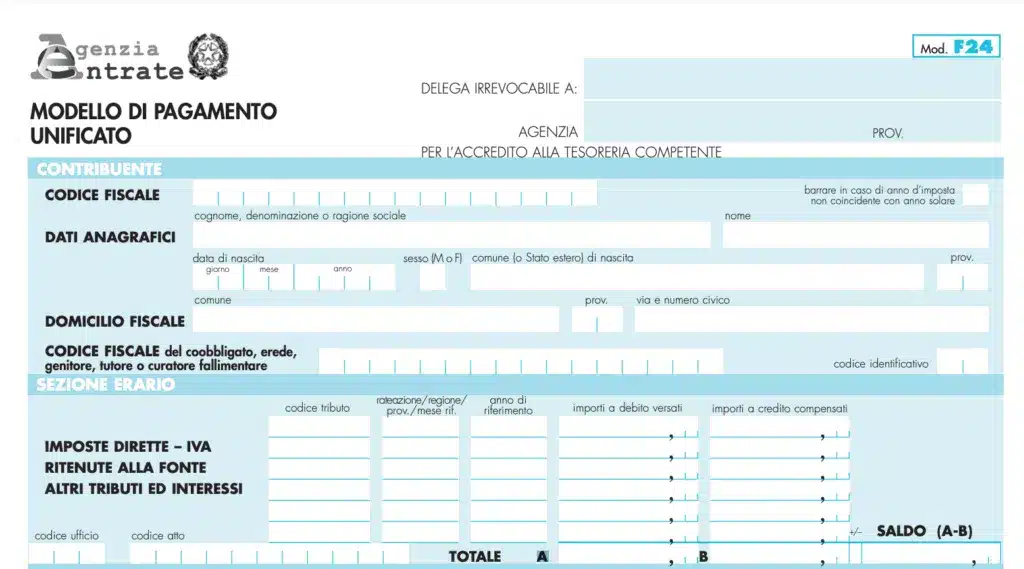
IMPORTANT: You are not required to pay any tax if it is less than 12 euros (for private wallets only). If the tax exceeds 51.56 euros, you must also pay advance payments for the following year. In this case, it is probably advisable to consult an accountant.
Declaration in the Relevant Sections
So far, we have discussed the PAYMENT of the stamp duty, specifying that exchanges take care of it on behalf of the user, while with wallets the responsibility lies with the taxpayer. However, we haven’t mentioned that, based on the total value held as of December 31st, there is also a reporting obligation.
Therefore, the values indicated on the F24 form, or those paid by the exchange, or both in cases where operations are carried out on both CEXs and independently, must then be reported in quadro RW or W, depending on the tax model used (Personal Income Tax Return or 730). The deadline for the declaration is set to November 30th of the following year for quadro RW, and September 30th for those completing quadro W.
Those paying close attention will notice that chronologically, taxes are paid by June 30th, and then what has been paid is subsequently declared. That’s how it works.
How do you complete the various sections? We are a little ahead of schedule for completion, and will provide a more detailed explanation later. In the meantime, we anticipate that for quadro RW you need to fill in row RW8 in column 1, while for quadro W row w8 in column 7.
