
As Google and Bing increasingly integrate artificial intelligence into their search results with AI-powered summaries, DuckDuckGo is charting a different course. The privacy-focused search engine has launched a “No AI Search” experience, offering users a return to traditional search results prioritizing direct access to source material .This move comes as concerns mount over the accuracy and potential impact of AI-generated content on critical thinking and independent research.
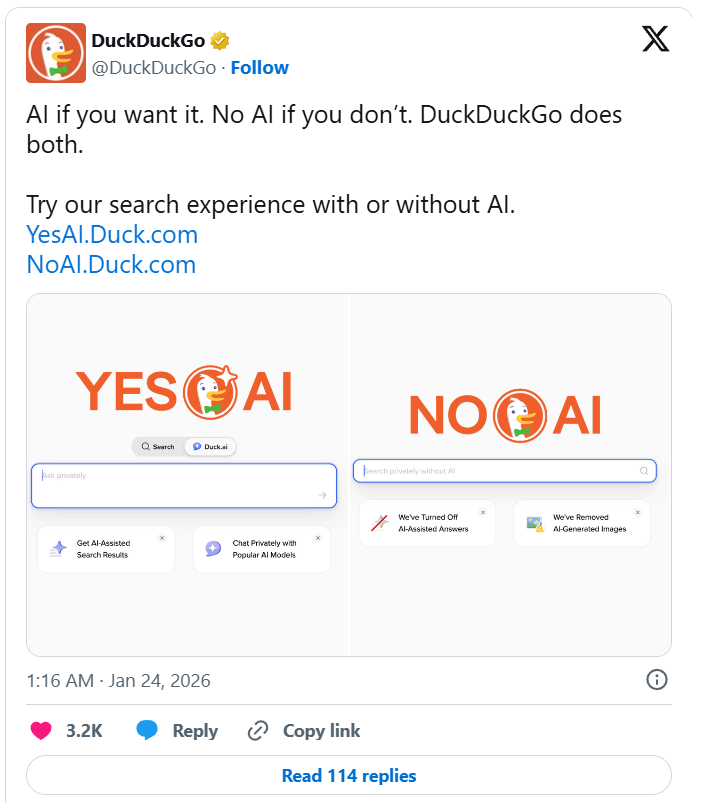
DuckDuckGo has launched a new search experience explicitly designed “without AI,” as Google and Bing increasingly integrate AI-powered summaries into their results. The privacy-focused search engine is emphasizing simplicity, user privacy, and direct access to original source material.
The internet search landscape is undergoing rapid transformation as major providers introduce AI to instantly summarize answers for users. Both Google Search and Bing are prioritizing “AI Summaries” and synthesized results.
However, DuckDuckGo is taking a different approach, offering a No AI Search page accessible via a specific URL. This provides a traditional search experience, free from AI summaries, language model-generated responses, and AI-created images or results. This move comes as some users express concerns about the potential for AI to replace critical thinking and independent research.
Why is DuckDuckGo taking this approach?
DuckDuckGo has consistently prioritized Privacy and believes some users are becoming saturated with AI “summarizing in place of thinking,” particularly when conducting research, following news, or seeking in-depth information from original sources.
While DuckDuckGo relies heavily on core search results from Bing, it also maintains its own crawling system, DuckDuckBot, along with specialized sources like Wikipedia and other databases. This allows it to deliver direct link results without AI synthesis.
How DuckDuckGo Compares to Google and Bing
Google has dominated the search engine market for years. According to Statcounter data from December 2025, Google holds a 90.82% market share, while Bing accounts for 4.03%, and DuckDuckGo has a modest 0.78% share.
Currently, Google is aggressively pushing AI Summaries, and Bing is following suit. While AI can deliver faster answers, questions remain regarding accuracy and the potential devaluation of original websites. The integration of AI into search is raising questions about the future of content creation and discovery.
DuckDuckGo argues that “clicking through to read” still holds value, and some users are willing to trade speed for clarity and data reliability. This is particularly true for professionals in fields like:
• Writers, journalists, and researchers
• Users who prefer not to rely on AI-generated summaries
• Privacy-conscious individuals
• Those who require comprehensive source attribution
Despite its small market share—less than 1%—the launch of No AI Search could become a niche offering that appeals to users in an era of AI overload. It represents a distinct market direction that may resonate with those seeking a more traditional search experience.
