
In a groundbreaking discovery,astronomers have successfully measured the mass of a free-floating planet – one not orbiting a star – for the first time [[1]].Located roughly 9,785 light-years away,this celestial body is approximately 22% the mass of Jupiter and was identified using the gravitational microlensing affect,offering a new avenue for understanding planetary formation and the prevalence of these elusive,wandering planets.The findings, made possible by simultaneous observations from both ground-based telescopes and the Gaia space observatory, represent a critically important advancement in the study of objects beyond our solar system.

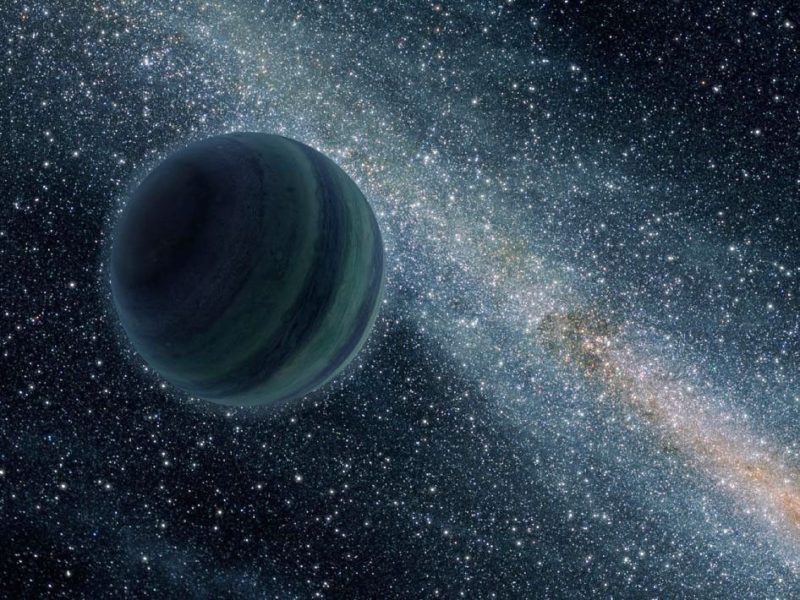
Astronomers have, for the first time, directly measured the mass of a free-floating planet – a planet not orbiting a star – using the gravitational microlensing effect. The planet, located approximately 9,785 light-years from the galactic center, has a mass roughly 21.9% that of Jupiter. This breakthrough offers a new window into understanding planetary formation and the prevalence of these elusive celestial bodies.
For years, the prevailing theory suggested planets primarily orbit stars. However, increasing observational evidence indicates that some planets are ejected from their star systems during formation, becoming solitary wanderers drifting through the galaxy. These unbound planets are known as free-floating planets, and are notoriously difficult to detect due to their faintness. They are typically discovered through the subtle bending of light from background stars caused by the planet’s gravity – a phenomenon called gravitational microlensing.
A key challenge in studying these planets has been accurately determining their mass, relying heavily on statistical models of planetary populations. The new research overcomes this limitation by capturing a rare and short-lived microlensing event observed simultaneously by multiple large ground-based telescopes and the Gaia space observatory.
The simultaneous observations from ground and space-based telescopes allowed researchers to measure the parallax – the apparent shift in the background star’s position – caused by the microlensing effect. By combining this data with models of light sources and gravitational lenses, the team successfully calculated both the planet’s mass and its location within the Milky Way. This represents a significant step forward in characterizing these difficult-to-observe objects.
Researchers believe the findings suggest the planet likely formed within a protoplanetary disk, similar to typical planet formation, rather than originating as a brown dwarf. It was subsequently ejected from its system through gravitational interactions with other developing planets. This discovery provides valuable insights into the dynamics of planetary systems and the processes that lead to the creation of free-floating planets.



科技新知,時時更新
jQuery(document).ready(function(){
jQuery('iframe').each(function(i){ var $this = jQuery(this); if ( $this.attr('data-src') ) { var data_src = $this.attr('data-src'); data_src += '&v=' + (new Date()).getTime(); $this.attr('data-src', data_src); } });
setIframe();
//lazy-iframe jQuery(window).scroll(function(){ setIframe(); }); });
