
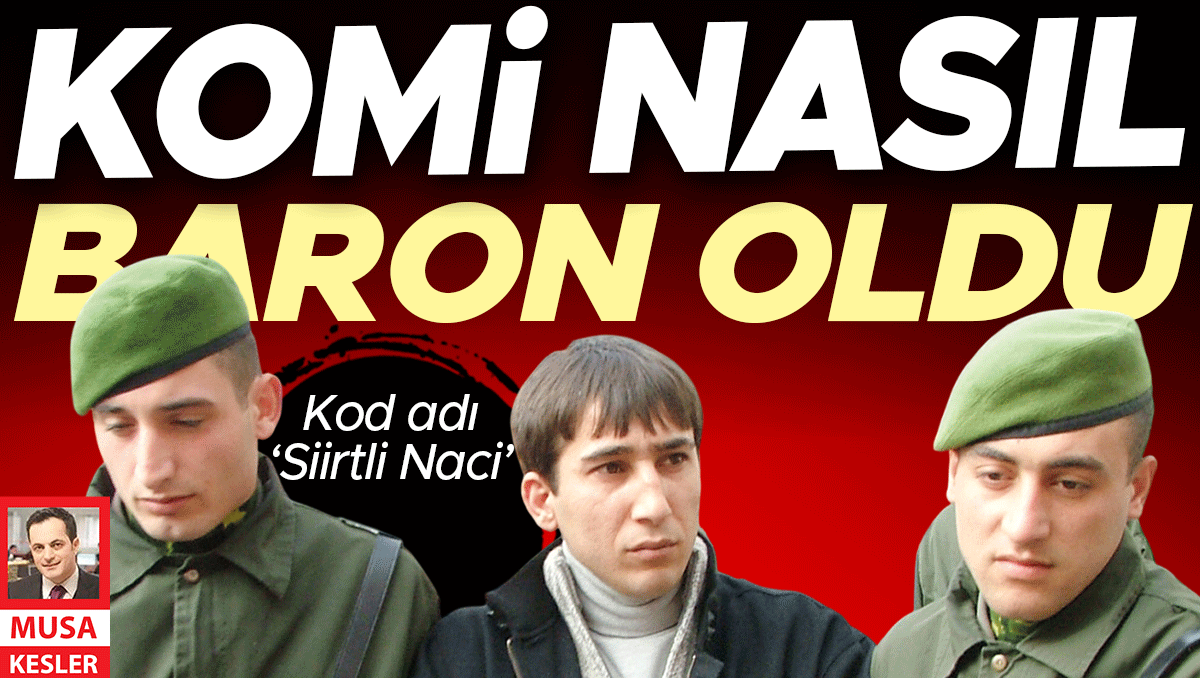
From Street Hustler to International Drug Lord: The Rise of Turkey’s ‘Speedy Naci’
ISTANBUL — A former kebab shop busboy from southeastern Turkey has become one of Europe’s most wanted fugitives, accused of orchestrating a sprawling international drug trafficking network that stretches from the streets of Istanbul to the ports of Western Europe.
Naci Yılmaz, known in criminal circles as “Siirtli Naci” or “Speedy Naci,” has spent decades transforming himself from a petty thief in Istanbul’s bustling Fatih district into a shadowy kingpin linked to murders, extortion, and multi-ton heroin shipments. Now in his late 40s, Yılmaz remains at large, wanted by Interpol and Turkish authorities on charges that paint a portrait of a ruthless underworld figure who built his empire on violence and intimidation.
The Making of a Crime Boss
Born in 1977 in Kurtalan, a tiny town in Turkey’s Siirt province, Yılmaz moved with his family to Istanbul in the 1990s. He started as a low-level worker in Kadınlar Pazarı, a crowded market area in Fatih known for its kebab restaurants. According to court documents and police records, his early criminal activities were small-scale—pickpocketing, petty theft, and working as a lookout for local thieves.
But Yılmaz quickly distinguished himself. In one early incident reported by Turkish media, he chased down and captured a pickpocket who had snatched a wallet from a shopkeeper. The act earned him local notoriety, but it likewise marked the beginning of his descent into organized crime. Within years, he had assembled his own crew, recruiting young men—some still in their teens—to carry out robberies, muggings, and extortion schemes across Istanbul’s historic districts.
The group became recognizable by a distinctive tattoo: three dots on their forearms, symbolizing the code of silence—”I saw nothing, I heard nothing, I know nothing.” This mantra would later define Yılmaz’s operations as he expanded into more lucrative and dangerous ventures.
Extortion, Violence, and Expansion
By the early 2000s, Yılmaz’s crew had established control over parts of Fatih and neighboring Eminönü, shaking down shopkeepers, street vendors, and even tourists. Those who resisted faced brutal consequences—arson, beatings, or worse. ATMs and late-night revelers became prime targets, with Yılmaz’s men robbing patrons outside nightclubs and bars in Aksaray, a district known for its vibrant but often lawless nightlife.
His reach soon extended beyond Istanbul. Authorities linked him to a murder in Eskişehir, a city hundreds of miles away, where rival gangs clashed over territory. Yılmaz’s alliances were fluid; he oscillated between cooperation and conflict with other underworld figures, including Fırat Delibaş, a notorious crime boss in Istanbul’s Tarlabaşı neighborhood. At times, they were allies; at others, bitter enemies locked in violent turf wars.
In January 2004, Turkish police launched a sweeping operation targeting Yılmaz and his organization. Nearly 50 of his associates were arrested, but Yılmaz himself slipped through the cracks, evading capture and disappearing from public view—at least temporarily.
From Local Thug to Global Trafficker
Yılmaz resurfaced years later, this time as a key player in Europe’s heroin trade. By the 2010s, his name appeared in connection with large-scale drug shipments moving from Turkey to Western Europe. Investigators described him as a “baron” within the narcotics underworld, coordinating smuggling routes that funneled tons of heroin across borders.
One of the most high-profile cases linking Yılmaz to international drug trafficking occurred in 2013, when one of his associates, Akif Özkan, was gunned down at Istanbul’s Atatürk Airport. The killing, which took place in the international departures terminal, sent shockwaves through Turkey’s law enforcement agencies and underscored the reach of Yılmaz’s network. Authorities believe the murder was tied to a dispute over a drug shipment, though the case remains unsolved.
Today, Yılmaz is a fugitive with a red notice issued by Interpol, meaning he is wanted for extradition by multiple countries. Despite his global notoriety, he has managed to evade capture, earning the nickname “Speedy Naci” for his ability to stay one step ahead of the law. His operations are believed to span several European countries, though details of his current whereabouts remain scarce.
A Life Defined by Crime
Yılmaz’s story is a stark example of how local street crime can evolve into transnational organized crime. What began as petty theft in Istanbul’s back alleys has grown into a criminal enterprise with alleged ties to some of Europe’s most lucrative illegal markets. His rise reflects broader trends in global drug trafficking, where traditional smuggling routes have adapted to law enforcement crackdowns, often relying on corrupt officials and sophisticated logistics networks.

For years, Yılmaz operated in the shadows, his name whispered in police reports and underworld circles. But as his empire grew, so did his infamy. Turkish media has dubbed him “the kebab shop boy who became a drug lord,” a moniker that underscores the dramatic arc of his criminal career. Yet despite his notoriety, Yılmaz remains a ghost—his face plastered on wanted posters, his name invoked in courtrooms, but his actual location unknown.
As authorities continue their hunt, one thing is clear: Naci Yılmaz’s journey from a small-town busboy to an international fugitive is far from over.
