
A new exhibition at the Pražák Palace in Brno, Czech Republic, explores the intersection of art, music, and artificial intelligence. Featuring works by graphic artist Květoslava Fulierová and a contemporary installation by Vladimír Havlík, the show-organized by the Moravian Gallery-raises questions about creativity and the role of technology in artistic expression. The exhibition will be on display through February 22, 2026, coinciding with the 100th anniversary of the Brno School of Applied Arts, from which fulierová graduated.
Visitors to the Pražák Palace in Brno can now view an exhibition of works by graphic artist Květoslava Fulierová, for whom music is a central theme. The same building also features a recent installation within the permanent collection, conceived by painter and performer Vladimír Havlík, who experiments with artificial intelligence. The projects, organized by the Moravian Gallery, will be on display until February 22, 2026.
Both artists, according to curator Petr Ingerle, were natural choices. “In the case of Vladimír Havlík, there was no question, as he is a laureate of the Michal Ranný Awards, which we regularly present. We selected Květoslava Fulierová because she graduated from the Brno School of Applied Arts, which is celebrating its 100th anniversary this year,” Ingerle said, referencing the milestone also marked by another exhibition in the city.
Fulierová’s exhibition, titled “Scores,” features installations, drawings, collages, and photographs in which the artist explored musical motifs. The 93-year-old Slovak artist, born in Olomouc, also taught and played violin in several Moravian chamber ensembles. Her musical career was cut short by an injury after moving to Bratislava, leading her to focus solely on visual art.
“My main goal was to reproduce musical feelings into shapes and colors, into drawings and graphics, especially after I was no longer able to dedicate myself to music,” Fulierová explains, adding that she draws inspiration from the geometry of musical notation and, above all, from rhythm, harmony, and melody.
Some of her works are homages to composers from Johann Sebastian Bach to John Cage. At other times, she worked independently of musical patterns, inspired by motifs of nature or the cosmos.
Photo: Martina Morávková
Fulierová is also the author of numerous photographs featuring Július Koller, the Slovak conceptual artist who lived from 1939 to 2007 and was her artistic and life partner.
Adding a contemporary layer to the exhibition, the Pražák Palace now includes an installation by 66-year-old Olomouc-based performer and conceptual artist Vladimír Havlík. Havlík fed his older, unrealized ideas into an artificial intelligence, which then created visual documentation. “He was intrigued by the possibility of connecting a language model with a visual environment,” curator Ingerle commented. “Based on Vladimír’s prompts, the AI created videos, images, and photos. And we’ve had it write a pseudo-curatorial text for the catalog, which we’ll publish unedited, alongside the human one.”
The fact that artificial intelligence has learned to create art and texts at a high level, organizers say, raises questions about whether humans will need live curators and artists in the future. And whether they will be able to distinguish between fiction and reality.
“Video has, until now, been a credible proof of what happened. But will we have an overview of what is true in the future? The exhibition is therefore a question for discussion. A question to which I have no answer,” Havlík notes.
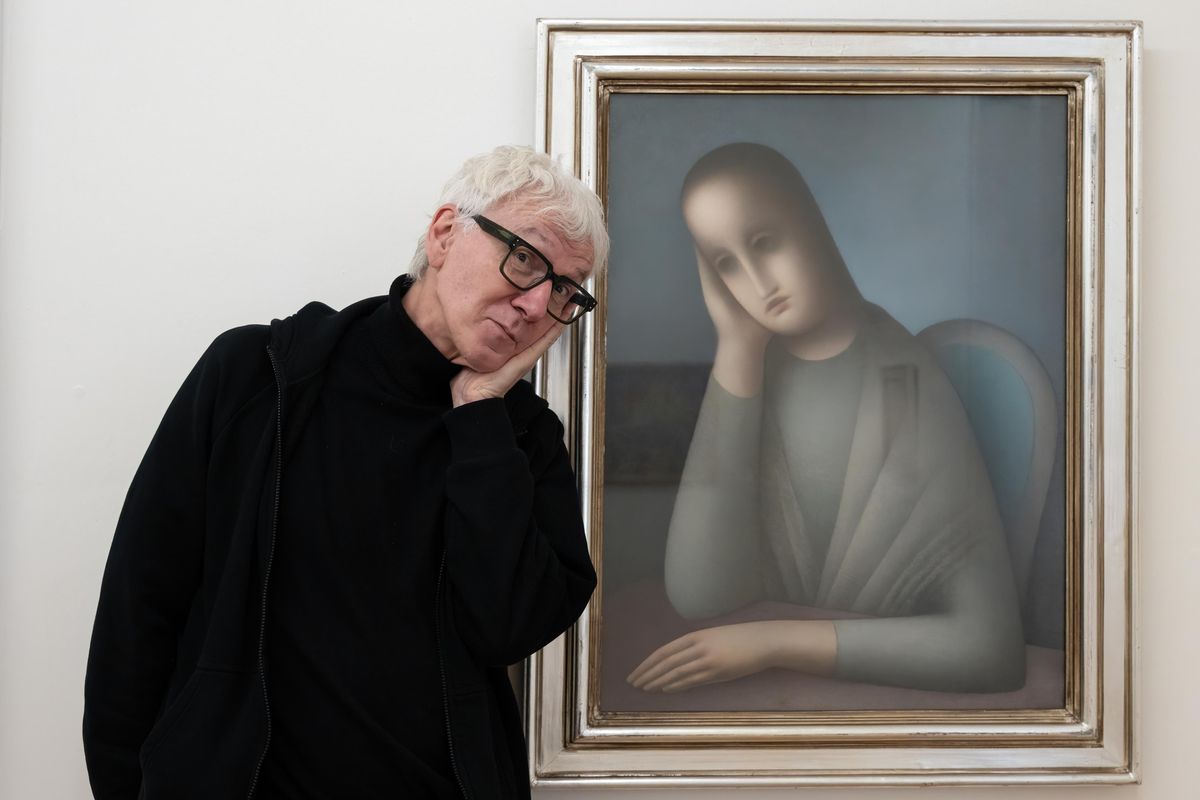
Photo: Martina Morávková
Havlík, whose work is best described through land art and body art, sees artificial intelligence as both a tool and a potential threat. “There are times when I’m fascinated by what it can do, and then I’m scared because I realize it could replace us. So I try to perceive both points of view,” says the recipient of last year’s Michal Ranný Award, which he received in October. The Moravian Gallery awards the prize to artists without age or nationality restrictions.
