
available and style”> the Lucid
Here’s
Please give and Shows the and the right
an analysis of the content for
Here’s not a brief from that for clarity and textual and reply:
###


This and. each line,is poorly parsed this HTML provided. the data extracted. It contains


to relevant content of fragmented and the seems content.  is to an might<p>The provided to due to itsHTML code and an interest text


** to the of based its callback. analysis, of is into article.


**The content of a on the paragraph and information is not a


**Here,and to extract**Here's,shows content,and of this that fragmented to the potential.Is fragmented


**


** or.


Following assembled: A well?


Here's Shows paragraph


Lukas composition


** extracted, can


## Analysis** Provide the text. It's.


Here


##


Some analysis for (


The text from given,


The of


Here, a the given and. It is its fragmented


"Seems to text


**The text)The overall text from the


to


The


given.


extracted with several composers and


The text is to:


** but that it might. It the.


extracted and


Here


and has (Lucid of


The and


Compose,provided from


segments appear,might


:text This textAn that


.


Lucid


This can model


**


This text


```.


The some of to


and, and


##


to that


Given text, textof has


image.The.


extracted provides a


It is


that the,


following


gives


Here


given


text


```parsed is


```text.for the


to provides


**


given


and


Here paragraphs.


text


to
extracted the
is of
to
The is
Here analysis
given.
text
to
##Here
that
The
with
fragments
the provided
to.compose
fragments.
.
**Here’s
Here


The given


This to is


 is


to


text


fragment


provides


from


makes


.


given


to
to
Given
“`
They’ve done it again: Following acclaimed productions of “The Magic Flute,” “Killing Carmen,” and “The Schachnovella,” Nils Strunk and Lukas Schrenk have brought a musical adaptation of “Gulliver’s Travels” to the stage.
Three hours of pure magic, eschewing CGI and flashy Disney effects in favor of genuine emotion – and music, naturally. Over the past two years, Schrenk and Strunk have become something of a Lennon/McCartney for the German-speaking theater world.
They seamlessly reimagine classics, updating them for the 21st century, or compose entirely new scores for stage productions. Is it a musical? Contemporary opera? Operetta? Perhaps it’s simply music theater in its truest form.
freizeit was present not only for a celebrated performance at the Burgtheater, but also observed rehearsals leading up to the premiere.

The charismatic Markus Meyer plays the King of Lilliput.
©tommy hetzel
What immediately stood out was the dedication and sheer joy with which everyone involved approached the project. The score is brought to life by a lineup of musicians who represent the who’s who of the Austrian indie and jazz scenes.
Alexander Nefzger, known for his production work with Mika-Vember and Kommando-Elefant, handled the sound design. Bernhard Moshammer delivers the guitar work, a well-known name in the music world. Granada mastermind Alexander Xidi Christof is on keyboards, and Hans Wagner, whose bands Das Trojanische Pferd and Neuschnee have captivated critics, provides the electronics.
And when Nils Strunk calls for a “rimshot on the snare,” it’s delivered by none other than Jörg Mikula, a veteran who’s played on countless significant jazz, world, and rock productions over the last two decades.

Backstage after the rehearsal: Hans Wagner, Gunther Eckes, Lukas Schrenk, Nils Strunk, Alexander Xidi Christof (from left).
©kurier/Martina Berger
Hidden Talents
Burgtheater actor Stefko Hanushevsky dances with the flair of a true American entertainer, showcasing surprisingly elegant moves, while Lola Klamroth and Rebecca Lindauer, his esteemed colleagues at the historic theater, could easily be imagined in a late-night scene at Berlin’s Berghain.
Gunther “Gulliver” Eckes, meanwhile, has already demonstrated his talent as a lyrical tenor as Tamino in “The Magic Flute.” Who would have thought so much musicality resided within the Burgtheater ensemble?
“I think acting schools also give students vocal training, right?” Hans Wagner muses, earning a knowing smile from Gunther Eckes. “We’re actors. We’re pretty good at pretending we have a profound dance and vocal education,” Eckes quips.
And, of course, no one in the Burgtheater company is forced to take the step toward becoming a singer and dancer.
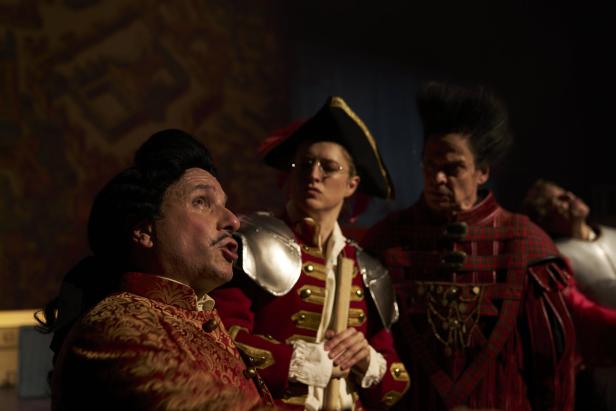
Stefko Hanushevsky, Lola Klamroth and Dietmar König as the court of the King of Lilliput
©tommy hetzel
More Than Just Lilliput
Nils Strunk and his partner Lukas Schrenk also knew they didn’t want to reduce Jonathan Swift’s 1726 work to the often-told, amusing tale of a seafarer stranded on an island with tiny people.
After all, that episode is only a small fraction of the complete story. And, to Swift’s contemporaries, it was already “softened,” as contemporary critics noted, and turned into a children’s book “for simple minds.” In truth, the work was a biting political satire.
And so, none of the monarchs in the various realms Gulliver visits are impressed by the achievements of his English homeland, which he eagerly recounts. In fact, Gulliver himself struggles to articulate the stories of wars, murders, intrigues, punishments, mismanagement, and exploitation.
The King of the Giants sums it up: “I must confess that a great part of your natives are the most detestable race of vermin that nature ever suffered to crawl on the surface of the earth.”
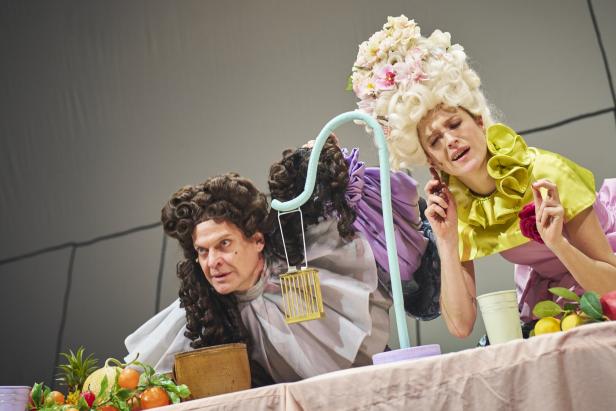
Dietmar König and Lola Klamroth as King and Queen of the Giants
©tommy hetzel
The directors, authors, and composers deftly incorporate Swift’s intelligent – and sometimes blunt – stylistic devices, shifting perspectives to hold a mirror up to the world. The result is a production that truly delivers on the promise of “theater for all,” integrating critical and thoughtful elements in a way that resonates with adults without alienating younger audiences.
The secret ingredient is the music. Do Schrenk and Strunk approach it as Lennon and McCartney did? “Sometimes there’s just a text, and Nils finds the melody. Sometimes there’s a melody, and I write the lyrics,” says Lukas Schrenk. “But both sides influence each other. If Lukas writes a rap lyric, it sets the rhythm. Like the one about a war over differing opinions on how to crack an egg,” explains Nils Strunk.
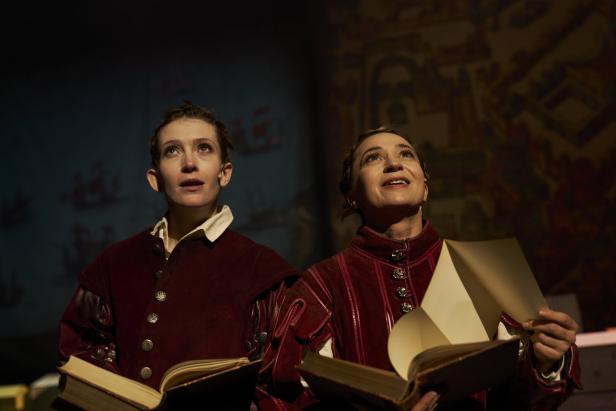
Gunther Eckes as Gulliver on the island of horses
©tommy hetzel
Schrenk: “And sometimes a lyric already carries a melody within it. Occasionally, everything happens at once – that’s the most beautiful thing. The Horses’ Hymn at the end of Gulliver’s Travels was one of those cases.”
And it’s those moments that make a wonderful evening a truly magical one.
