
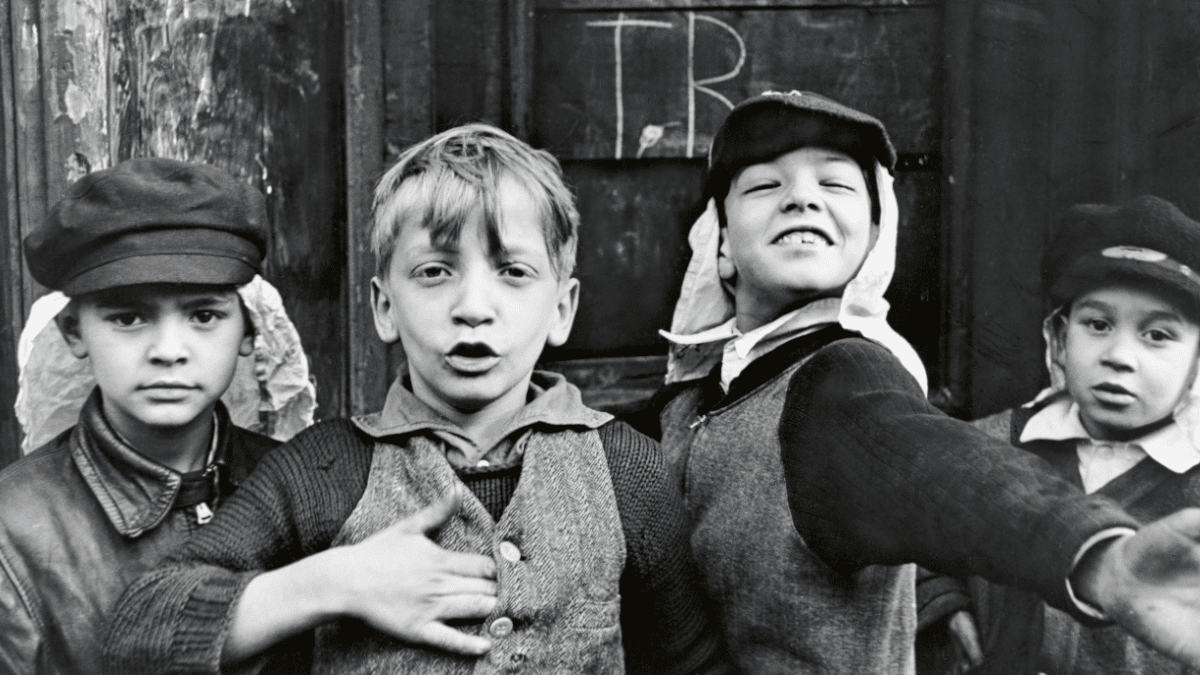
A young girl dances alone in the middle of the asphalt, arms outstretched, while a boy watches, unsure whether to join her or hold back. Men lean against mailboxes, women look out windows, and children draw with chalk on crumbling walls. Nothing seems extraordinary, and yet, everything is. Helen Levitt transformed these fleeting moments into powerful photographs.
Now, the Fundación Mapfre has brought together, in Madrid following its run in Barcelona, the first comprehensive exhibition organized from her complete perform and recently accessible archives. The show, on view at the Sala Recoletos until May 17, 2026, offers a journey through nine sections and nearly 200 photographs, including previously unseen works, her 1941 project in Mexico City, and a significant representation of her little-known color photography, which disappeared for years after a theft from her apartment.
PUBLICIDAD
Born in Brooklyn in 1913 to a Russian-Jewish family, Levitt left high school early and trained as a photography apprentice in a Bronx studio. She purchased her first camera in 1934 and soon joined the New York Film and Photo League. Her encounter with Henri Cartier-Bresson in 1935 proved pivotal; she then worked independently, and between 1938 and 1942, she captured many of the images that established her as a leading photographer of the 20th century. With her Leica camera slung around her neck, light and unobtrusive, she walked the streets of Harlem and the Lower East Side, letting the city reveal itself before her lens.
The Beauty of the Neighborhood
Her focus wasn’t the grand metropolis in its monumental form, nor the gleaming, sterile city of skyscrapers. She was interested in working-class and immigrant neighborhoods, the stoops of homes, the sidewalks where adults conversed and children claimed the space. In 1937, while working as an art teacher at a public school in East Harlem as part of the federal art support program during the Great Depression, she began noticing the chalk drawings children were illegally making on walls and floors, documenting them for years, sometimes even photographing the artists themselves.
These early images hinted at a tension between documentary and art. The solitary figures of the Great Depression had an almost documentary feel, but other scenes defied straightforward interpretation. Her photos depict real street scenes, but don’t inform you what to think about them—you see what happens, not what it means. Late in 1937 or early 1938, Levitt sought advice from another contemporary master of photography, Walker Evans, who encouraged her work and introduced her to his circle. Her use of a viewfinder that allowed her to look in one direction while the camera pointed another facilitated this oblique capture of spontaneity.
More Than a ‘Photographer of Children’
In 1941, she traveled to Mexico City for five months. While she continued to practice street photography there, the tone shifted—the playfulness diminished, replaced by scenes of greater social hardship. It was her only trip abroad. Upon returning to New York, she resumed her familiar territory, but her perspective had sharpened.
This new, more nuanced gaze, attentive to melancholy and the distance between people, was recognized in 1946 by James Agee, a writer and critic who had collaborated with Walker Evans on Let Us Now Praise Famous Men (1941), the book documenting the lives of farm families during the Great Depression. Agee envisioned a book featuring her images and wrote an extensive essay to accompany them. His aim was to dispel the label that had stuck to the photographer after her first solo exhibition at the MoMA in 1943, titled Helen Levitt: Photographs of Children. Agee argued she was far more than just a photographer of children. He saw melancholy, distance, and a keen awareness of urban loneliness in those neighborhood scenes, describing her work as “a unified vision of the world, an uninsistent but irrefutable manifesto.” The book wasn’t published until 1965, after numerous delays and Agee’s premature death.
There’s a resonance with Hopper in those isolated figures amidst the city, in the minimal distance between two people sharing a subway bench or a sidewalk. But Levitt doesn’t construct static interiors or calculated scenes; she works outdoors, in broad daylight, in the moment. Her photographs rely on a dry realism, without dramatization, and a blend of gentle irony and tenderness that never overwhelms the viewer. The scenes remain open-ended—they show, but don’t explain.
Poet of New York
In 1959, she received a Guggenheim Fellowship to experiment with new possibilities in color photography. She used slide film at a time when color was still rare in artistic photography and the material was expensive. In 1970, a thief broke into her apartment and stole a hatbox containing much of that work. She started over. In 1974, the MoMA projected forty of her slides for three weeks, and over time, Levitt printed many of them using dye transfer, intensifying the reds of clothing or the texture of skin without losing naturalism.
She also returned to the New York subway, a space she had frequented decades earlier. There, she focused on motionless passengers, on glances that met or avoided each other, on compact gestures captured under the harsh light of the cars. From the mid-1970s to the early 1990s, she worked intermittently, until age and emphysema curtailed her activity. She died in 2009.
The exhibition in Madrid includes, in addition to the photographs, the film In the Street, directed with Janice Loeb and James Agee, and a projection of her color slides. The collection offers insight into why she was for years considered the “unofficial poet laureate” of New York. Not because she sought any grand narrative, but because she knew how to look where no one else did—at the smallest gesture, the pause between two words, the chalk drawing that the rain will wash away tomorrow.
