
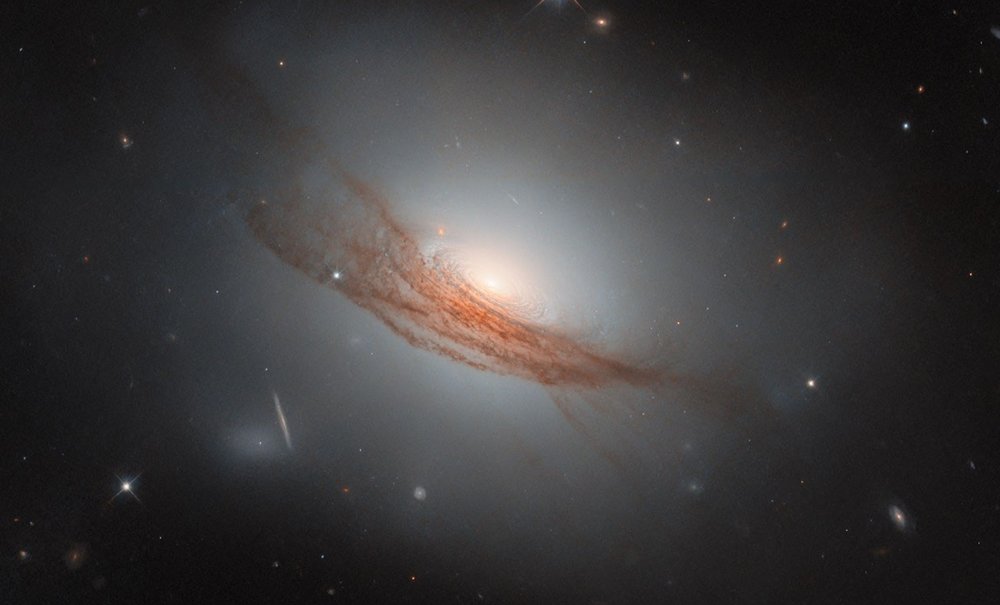

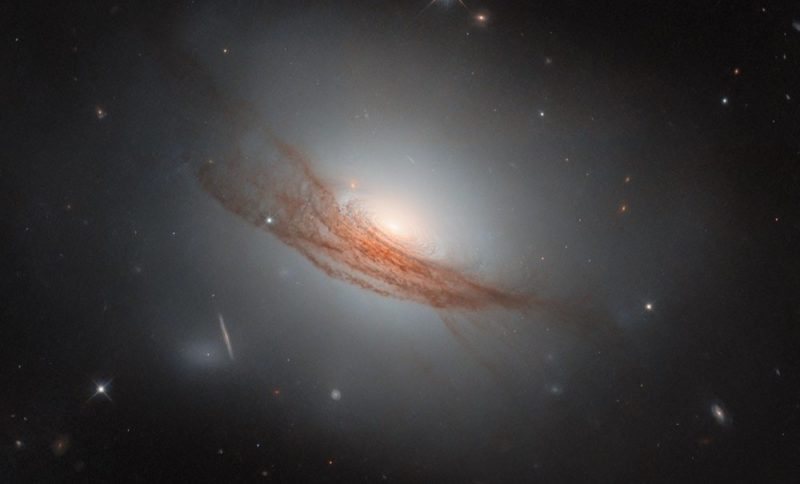
NASA’s Hubble Space Telescope has recently released a striking image of a rare galaxy, designated NGC 7722. Located approximately 187 million light-years away in the Pegasus constellation, this galaxy presents a unique combination of characteristics typically found in spiral and elliptical galaxies.
Lenticular galaxies are an intermediate type between spiral and elliptical galaxies, and are less common than either. Their classification can be challenging due to their often-blurred appearance, making it difficult to determine if they are spirals, ellipticals, or something in between. NGC 7722, as shown in the featured image, exemplifies this ambiguity, lacking the distinct spiral arms of a spiral galaxy but possessing a luminous central bulge and a halo extending outward, similar to an elliptical galaxy. However, unlike typical elliptical galaxies, it retains a visible disk of stars rotating around its bright core.
Perhaps the most notable feature of NGC 7722 is the prominent, dark red dust lane that encircles the disk and halo. This feature isn’t unusual for lenticular galaxies, and astronomers believe it’s a result of past mergers with other galaxies – a common occurrence in the evolution of these types of galaxies. While the exact formation mechanisms of lenticular galaxies remain a topic of ongoing research, galactic mergers and gravitational interactions are thought to play a significant role in reshaping galaxies and introducing new dust.
Despite not being as actively star-forming as spiral galaxies, NGC 7722 still exhibits dynamic activity. A supernova, designated SN 2020SSF, was observed within the galaxy in 2020. Researchers have identified SN 2020SSF as a Type Ia supernova, which occurs when a white dwarf star in a binary system accretes enough mass from its companion star to develop into unstable and explode. These supernovae are remarkably consistent in their energy output and brightness, allowing astronomers to calculate distances to galaxies by comparing their observed brightness to their intrinsic luminosity. Accurate understanding of Type Ia supernova formation is crucial, as they are a key tool for measuring cosmic distances.



科技新知,時時更新
