

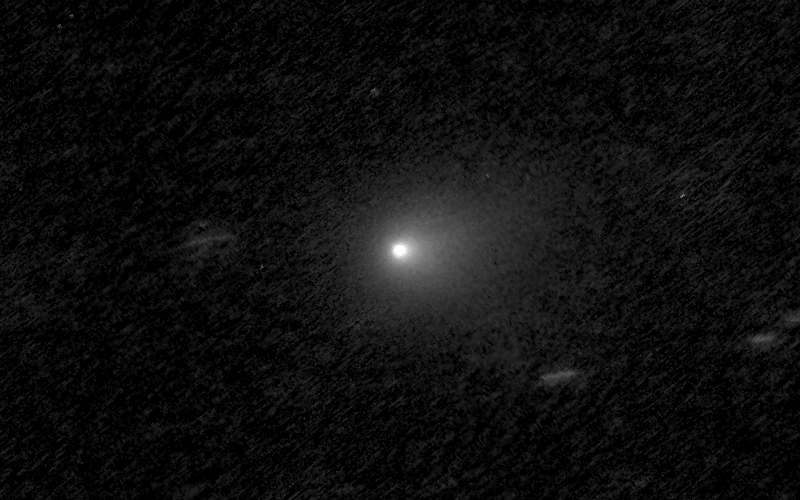
For millennia, a fragment of ice and dust has journeyed alone through interstellar space. Last summer, this traveler entered our solar system and was designated 3I/ATLAS, becoming the third confirmed interstellar comet observed to date.
Researchers at Auburn University, pointing NASA’s Neil Gehrels Swift Observatory at the comet, have made a remarkable discovery: the first detection of hydroxyl (OH) gas emanating from the comet – a clear signature of water. The Neil Gehrels Swift Observatory can detect faint ultraviolet light, something ground-based telescopes often miss because it’s blocked by Earth’s atmosphere.
Identifying water through its ultraviolet byproduct, hydroxyl, is a crucial step in understanding the behavior of interstellar comets and how they change over time. Water is a primary indicator of activity in comets formed within our solar system, allowing scientists to determine how sunlight triggers the release of other gases and to compare the composition of frozen materials within the comet’s nucleus. Detecting the same water signature in 3I/ATLAS means astronomers can now evaluate it using the same standards applied to comets originating within our solar system, opening new avenues for studying the similarities and differences between planetary systems throughout the galaxy.
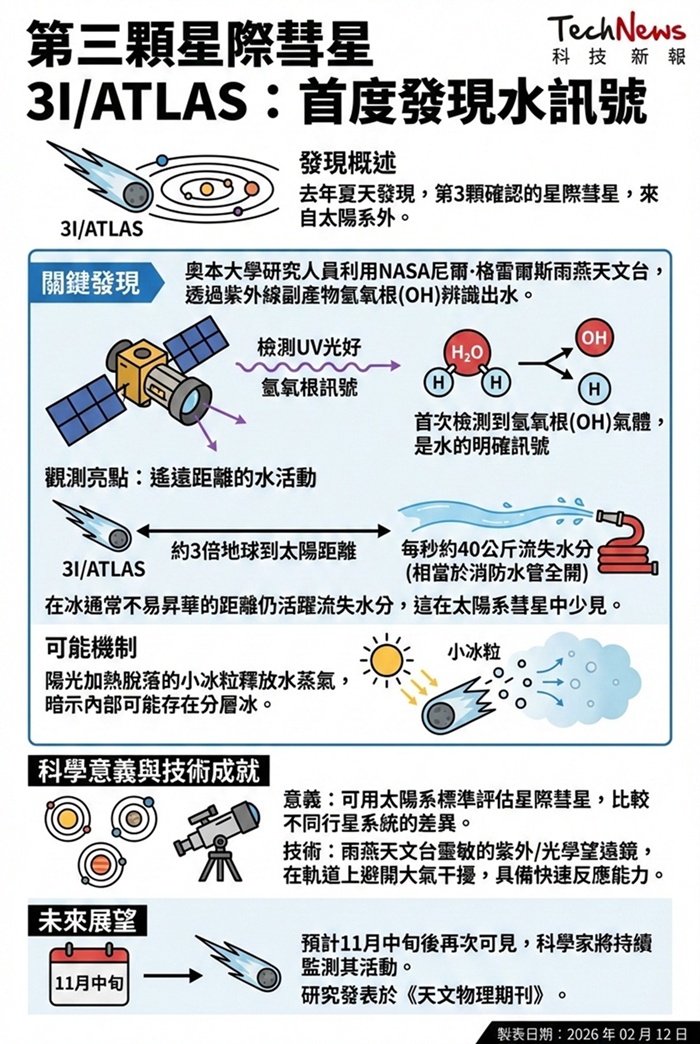
What makes 3I/ATLAS particularly noteworthy is the distance at which water activity has been observed. The Neil Gehrels Swift Observatory detected hydroxyl when the comet was approximately three times the Earth-Sun distance, far beyond the range where surface ice typically sublimates directly into water vapor. At this distance, the comet is still losing water at a rate of about 40 kilograms per second – equivalent to a fully opened fire hose. Most comets within our solar system are relatively inactive at such distances.
The strong ultraviolet signal suggests other processes may be at play. One possibility is that sunlight is heating small ice grains ejected from the comet’s nucleus. As these particles warm, they may release water vapor and replenish the surrounding gas cloud. Only a handful of distant comets exhibit this extended water source, suggesting the comet’s interior may contain layered ices, preserving clues about how and where the celestial body originally formed.
So far, each interstellar comet discovered has revealed differences in the chemical makeup of other planetary systems. These visitors demonstrate that the materials composing comets – particularly volatile ices – can vary significantly between different star systems. These differences provide insights into how temperature, radiation and chemical composition shape the materials that ultimately form planets, and potentially influence the emergence of conditions suitable for life.
The ability to detect this faint ultraviolet signal is itself a technological achievement. The Neil Gehrels Swift Observatory is equipped with a relatively small 30-centimeter telescope, but its orbital position allows it to observe ultraviolet wavelengths largely absorbed by Earth’s atmosphere. Without atmospheric and sky brightness interference, the observatory’s ultraviolet/optical telescope achieves sensitivity comparable to a 4-meter class ground-based telescope. Its rapid response capability also allowed the Auburn team to observe 3I/ATLAS within weeks of its discovery, before it became too faint or moved too close to the sun for safe observation.
“When we detect water, even just its faint ultraviolet echo in OH, coming from an interstellar comet, we are reading a message from another planetary system,” said Dennis Bodewits, a physics professor at Auburn University. He added that each interstellar comet discovered so far has been a surprise, rewriting our understanding of how planets and comets form around stars.
3I/ATLAS has now faded and is temporarily unobservable, but is expected to become visible again after mid-November. This return will provide scientists with another opportunity to monitor how its activity changes as it approaches the sun. The hydroxyl detection has been detailed in , providing the first definitive evidence of an interstellar comet releasing water even when far from the sun.
(首圖來源:Processing by Nrco0e. Images taken by David Jewitt/NASA/ESA/Space Telescope Science Institute (STScI)., Public domain, via Wikimedia Commons)
延伸閱讀:



科技新知,時時更新
