
Escalating tensions between Iran and the United States, coupled with widespread unrest within Iran, are raising concerns about regional stability and potential impacts to global energy markets. Following threats of military action from Washington and a recent 12-day war with Israel in June 2025 [[1]], Iranian officials say the country is prepared for war while simultaneously signaling openness to negotiations. The situation is further intricate by ongoing protests sparked by economic grievances and the death of Mahsa Amini in 2022, which have been met with a violent crackdown by the government and a near-total internet blackout [[1]].
Iran’s foreign minister stated Monday that the country is prepared for war, but also open to negotiation, amid escalating tensions following repeated threats of military intervention from the United States. The situation reflects a volatile moment in the region, with potential global implications for energy markets and international security.
The Iranian government is attempting to reassert control following days of widespread protests in Tehran and other major cities, calling for counter-demonstrations Monday in support of the Islamic Republic. These demonstrations represent one of the most significant challenges to the country’s authority since its establishment in 1979.
Since January 8, Iran has been experiencing a total internet shutdown, which human rights advocates say is intended to conceal the extent of the government’s crackdown.
The Norway-based non-governmental organization (NGO) Iran Human Rights (IHR) reported Sunday that it has confirmed at least 192 deaths of protesters since the movement began on December 28, warning that the actual number could be significantly higher. The NGO has denounced the situation as a massacre
.
Unverified reports indicate that at least several hundred, and potentially more than 2,000 people, have been killed
, IHR emphasized, also reporting over 2,600 arrests.
The People’s Mujahedin of Iran (MEK), an organization banned in Iran, claims that sources inside the country indicate more than 3,000 people have been killed.
Iranians gather and block a street during a protest in Tehran, Iran, on January 9, 2026.
Photo : Getty Images / Middle East Images / AFP / MAHSA
A video authenticated by the Agence France-Presse on Sunday shows dozens of bodies wrapped in black bags outside a morgue in the capital, with Iranians appearing to search for missing relatives. The disturbing footage underscores the severity of the crisis.
Iranian state media, however, claims that dozens of security forces have also been killed.
Initially sparked by concerns over the cost of living and hyperinflation, the protests have evolved into a direct challenge to the ruling government. The unrest comes as Iran faces internal and external pressures, including a 12-day war with Israel in June 2025, setbacks for its regional allies, and sanctions related to its nuclear program, reimposed by the United Nations in September.
Communication Channel Open
Following repeated threats of U.S. military intervention, President Donald Trump stated Sunday that Iranian leaders appeared willing to “negotiate” and that a meeting was in the works
, though he did not rule out military action.
The United States conducted strikes against Iranian nuclear facilities in June in support of Israel.
We could have to act before a meeting
, Trump added, stating the U.S. military was examining very strong options
.
The Islamic Republic of Iran does not seek war, but is fully prepared for war
, responded Iranian Foreign Minister Abbas Araghchi on Monday.
We are also prepared for negotiations, but these negotiations must be fair (…) and based on mutual respect.
Araghchi also stated that a communication channel was open
between Iran and the U.S. special envoy for the Middle East.
The government declared three days of national mourning Sunday for the martyrs of resistance
, referring to those killed, including members of the security forces.
President Massoud Pezeshkian urged the population to participate Monday in a march of resistance
across the country.
State television began broadcasting images of rallies in support of the government in several cities.
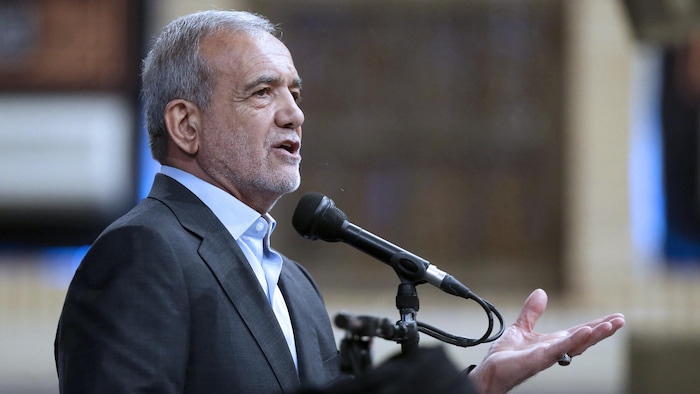
Iranian President Masoud Pezeshkian (File Photo)
Photo : Associated Press
Hospitals Overwhelmed
The Center for Human Rights in Iran (CHRI), based in New York, reported Sunday that hospitals were overwhelmed
with injured protesters and that blood reserves were dwindling.
State television broadcast images of burning buildings, including a mosque, and funeral processions for security force members.
Reza Pahlavi, son of the former Shah of Iran, overthrown in 1979, and a figure in the Iranian opposition in exile in the United States, urged the armed and security forces on social media to stand with the people
.
Triggered in Tehran by merchants angered by the cost of living, the protests are the most widespread since those that shook Iran following the death of Mahsa Amini, a young Kurdish woman, in September 2022, after she was arrested by the morality police for allegedly violating women’s dress code.
Thousands of people gathered Sunday in Paris, London, and Vienna in solidarity demonstrations.
China called for calm Monday and said it opposed any foreign interference. German Chancellor Friedrich Merz strongly condemned
the violence by Iranian leaders, calling it a sign of weakness
.
