
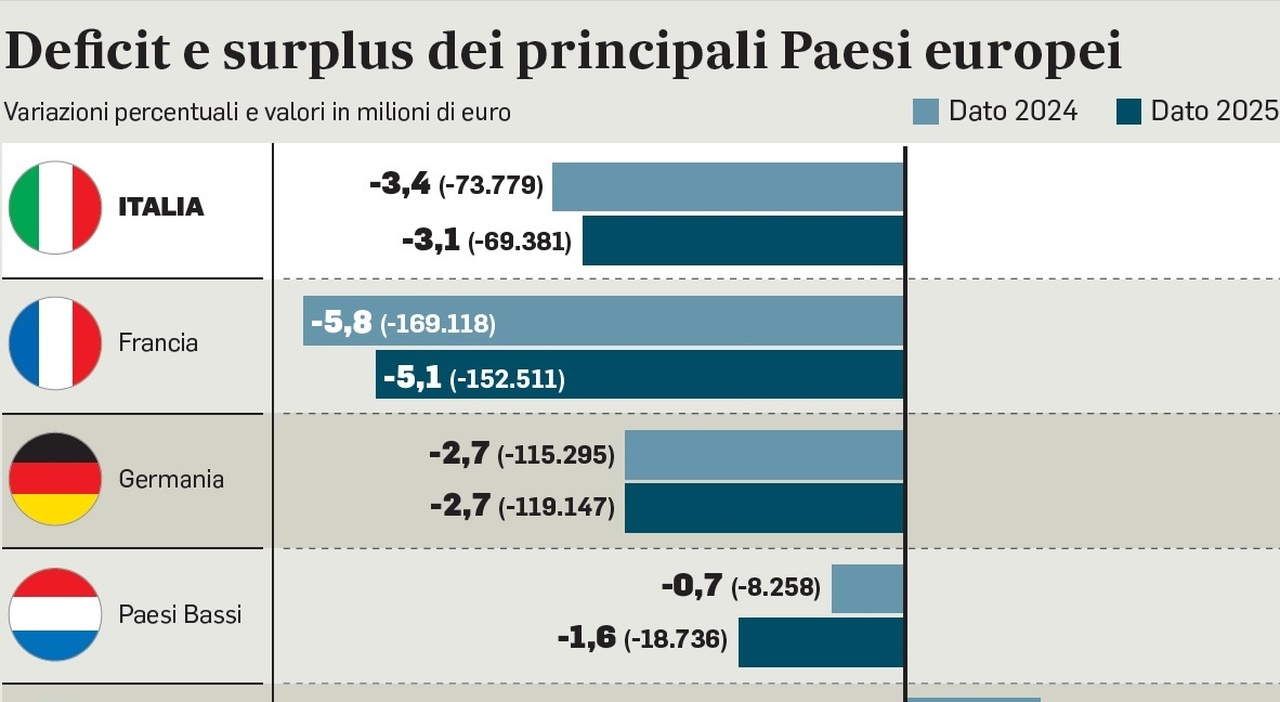
Italy remains in the EU’s excessive deficit procedure after Eurostat confirmed a 2025 deficit-to-GDP ratio of 3.1%, exceeding the bloc’s 3% ceiling.
The figure, verified by national statistics agency Istat, dashed government hopes of exiting the procedure this year despite earlier projections targeting compliance by 2025.
In the recently approved Documento di finanza pubblica, Economy Minister Giancarlo Giorgetti revised downward the 2026 growth forecast from 0.7% to 0.6%, citing “exceptional difficulty” driven by energy shocks linked to the Middle East conflict.
The document projects the deficit will fall to 2.9% in 2026 and further to 2.8% in 2027, while public debt is expected to stabilize at 138% of GDP through 2027 before a slight decline to 137.9% in 2028.
Giorgetti highlighted the lasting fiscal burden of the Superbonus tax incentive scheme, estimating 40 billion euros in costs for the current year and another 20 billion for next year.
“We are in an exceptional situation,” Giorgetti said, likening his role to that of a field medic overwhelmed by crises. “Talking with European colleagues, I often feel like I’m treating wounds from all sides — we can’t fix everything with aspirin.”
He invoked a famous quote from former Yugoslav coach Vujadin Boskov: “A penalty is when the referee whistles,” suggesting that fiscal rules must reflect reality rather than rigid ideals.
Giorgetti did not rule out a unilateral budget deviation by Italy, stating he would not exclude such a move if flexibility is denied by Brussels.
“What I locate unacceptable is rigidity in the face of a world that has completely changed. That approach simply doesn’t hold up,” he added.
Prime Minister Giorgia Meloni expressed frustration over the outcome, blaming the “disastrous” Superbonus program and arguing that Istat routinely underestimates GDP only to revise it upward later — a pattern she called “a farce.”
Opposition leaders criticized the result as a governmental failure, with the Democratic Party labeling it an “economic flop” and Five Star Movement leader Giuseppe Conte accusing the government of betting everything on hitting the 3% target and falling short.
The Alliance Greens and Left urged the government to abandon planned increases in military spending, arguing resources should be redirected amid ongoing fiscal constraints.
Italy must now await the European Commission’s formal decision, expected in early June, on whether the country will remain under the deficit monitoring procedure for at least another year.
