
New images from the James Webb Space Telescope are offering an unprecedented look at the Helix Nebula, a cosmic structure formed by a dying star [[2]].Located 650 light-years away, the nebula-often called the “Eye of Sauron” due to its appearance-is a planetary nebula, representing a stage in stellar evolution where a star sheds its outer layers [[1]]. These new observations are providing crucial insights into how stars return essential elements to the universe, seeding the formation of future stars and planetary systems.
The Helix Nebula is captivating astronomers once again, thanks to detailed observations from NASA’s James Webb Space Telescope (JWST). The telescope’s high-resolution infrared imaging is revealing previously unseen structures of gas and dust, offering a glimpse into how stars end their lives and return material to the universe. Understanding these stellar life cycles is fundamental to understanding the origins of elements essential for life.
Nebula Helix: A Planetary Nebula
The Helix Nebula is a planetary nebula, formed when a medium-sized star runs out of nuclear fuel. At the nebula’s center lies a white dwarf – the dense, hot core remaining after the star’s outer layers have been shed. While not directly visible in Webb’s images, the white dwarf’s intense radiation illuminates and shapes the surrounding gas structures.
Images captured by the NIRCam (Near-Infrared Camera) instrument show gas clumps resembling comets, complete with long tails. These structures are created by fast-moving, hot stellar winds colliding with cooler layers of gas and dust previously ejected by the star. This interaction creates the nebula’s dramatic and complex appearance.
The colors within the Webb images aren’t just aesthetically pleasing; they indicate temperature and chemical composition. The hottest gas, exposed to ultraviolet radiation, appears blue, while cooler regions glow yellow, where hydrogen atoms begin to combine into molecules. The outermost areas display reddish hues, marking the coldest material where dust is forming and gas is thinning.
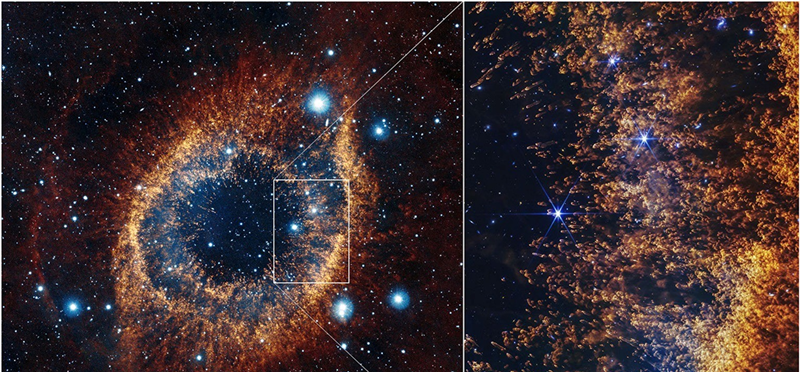
This image of the Helix Nebula taken by the ground-based Visible and Infrared Telescope for Astronomy (VISTA) shows a complete view of the planetary nebula (left), with a box indicating the area observed by the James Webb Telescope (right). (NASA)
Protected regions within the nebula are also of significant interest. Previous observations by the Spitzer Telescope hinted at the presence of complex molecules. Now, Webb’s sharpness reveals that these molecules are forming in dark pockets shielded from harsh radiation, hidden among the nebula’s orange and red light. This suggests that complex molecules can form even in the challenging environment of a dying star.
“Eye of Sauron” in the Sky
Located approximately 650 light-years from Earth in the constellation Aquarius, the Helix Nebula is relatively close in cosmic terms, making it one of the most studied planetary nebulae. Its eye-like shape has earned it the nickname “Eye of Sauron,” referencing the fictional character from J.R.R. Tolkien’s The Lord of the Rings.
For scientists, the Helix Nebula is more than just a beautiful object in the sky; it’s a natural laboratory for studying the life cycle of stars. The material released by the dying star will eventually become the building blocks for new stars and planets in other systems. This process highlights the continuous cycle of creation and destruction in the universe.
