
Japan heads to teh polls Sunday in a snap election that has become a referendum on Prime Minister Sanae takaichi’s conservative agenda and assertive leadership style. The election, called just three months into Takaichi’s premiership, is taking place amid concerns over Japan’s declining population, economic stagnation, and evolving geopolitical landscape – particularly regarding relations with China and the status of Taiwan. Recent polls suggest a potential surge for Takaichi’s Liberal democratic Party (PLD), fueled by a strategy to recapture right-leaning voters and a campaign that echoes populist themes seen elsewhere in the world.
The political landscape in Japan is undergoing a significant shift as Prime Minister Sanae Takaichi, the nation’s first female leader, campaigns for a strengthened mandate in Sunday’s parliamentary elections. Her rallies are drawing massive crowds, signaling a potential surge in support for the conservative Liberal Democratic Party (PLD). The outcome of the election will be closely watched internationally, as Japan navigates complex geopolitical challenges and a declining birthrate.
A rally held Saturday on the outskirts of Tokyo, in Futako Tamagawa Park, resembled a rock concert in its scale, with attendees ranging from young families to elderly citizens. Security was tight as Takaichi addressed the enthusiastic crowd, offering repeated bows and expressing gratitude for their support despite the cold weather. “Good evening,” she said, “thank you for coming.”
Takaichi’s speech focused on bolstering Japan’s defenses, achieving economic self-sufficiency, and advancing the nation’s technological capabilities. She also emphasized the importance of wage increases and support for businesses, drawing applause when she spoke about the rare earth industry. She urged voters to work towards a better future for younger generations, proclaiming, “We must not think of ourselves as weak,” and reinforcing her campaign slogan: “To return Japan to being a rich and strong archipelago.” The rhetoric echoes themes previously employed by former U.S. President Donald Trump.
The snap elections, called in January after just three months in office, initially appeared to be a gamble for Takaichi. However, she has since gained considerable momentum, with polls suggesting a substantial victory for the PLD. Some surveys indicate the party could increase its representation from 198 to over 233 seats in the 465-member House of Representatives, and potentially exceed 300 seats with the support of its coalition partner, the Innovation Party.
Takaichi’s rise to power appears to have stemmed, in part, from a successful effort to stem the tide of voters shifting towards more right-wing populist parties that had been gaining traction with anti-immigration platforms. The PLD had lost its clear majority in the upper house of parliament last summer, leading to the resignation of her predecessor, Shigeru Ishiba. Takaichi, representing the PLD’s more conservative wing, was chosen as his replacement, and the strategy appears to be working.
“She was seen as someone who could halt the momentum and win back the souls of right-leaning followers of [former Prime Minister Shinzo] Abe,” explained Koichi Nakano, a professor of political science at Sophia University in Tokyo. “That’s why I think she’s been projecting this image of toughness.” Her sometimes “inflammatory” comments are viewed as an asset, while also appealing to undecided voters, he added.
Takaichi has also received a public endorsement from U.S. President Donald Trump, who voiced his support on Thursday. The PLD’s campaign imagery deliberately evokes comparisons to Margaret Thatcher, the former British Prime Minister, featuring images of Takaichi in a blue jacket and pearl necklace. This strategic branding aims to project an image of strong leadership.
The Prime Minister’s message is resonating with a citizenry increasingly dissatisfied with the status quo. Many Japanese feel their country is in decline, grappling with a stagnant economy and a shrinking population. “There are so many problems, I wouldn’t even know where to begin,” said Teruo Yamada, a 76-year-old vendor who has operated a rice cracker stand in Kawaguchi for 62 years.
While foreign resident numbers remain relatively low compared to European nations – reaching 3.9 million in 2025, or 3.21% of the population – they represent a growing trend in Japan. In Kawaguchi, a district with a significant foreign population, residents of foreign origin make up 8% of the 607,000 inhabitants. The majority are from Asian countries, including China, Vietnam, and the Philippines. A growing Kurdish community, numbering around 1,500, has become a focal point for national debate, fueled by social media.
Tatsuhiro Nukui, a volunteer with the Heval association, which assists Kurdish integration, showed letters of hate mail received starting in 2023, following the spread of a brawl between Kurdish individuals online. The letters contained harsh language, even by Japanese standards: “Kurdish trash,” and “we’re going to kill you.” The association is also supporting a family who reported an assault on their child by a Japanese man in a park, captured on video where the alleged assailant said, “If there weren’t a law, I’d kill you.”
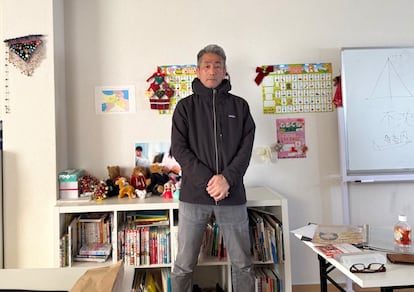
Nukui believes foreigners are being used as “scapegoats” for Japan’s real problem: “the decline of the population.” The country is aging, with deaths exceeding births due to the high cost of living, making it difficult for young people to start families. “People who come from abroad are part of the solution,” he said. “We need to see how we can coexist with them.”
Despite the polarization, the election campaign has been relatively subdued. Propaganda is limited to designated poster boards, and candidates conduct small-scale rallies at street level. A small van from the Communist Party, a minor force on the left, might stop near a neighborhood supermarket, deploying flags and loudspeakers. The candidate steps out and delivers a speech to a small audience, flanked by a sign calling for higher taxes on the wealthy, criticizing Takaichi’s increasing militarism: “This government is thinking of using the country’s money for weapons.” She warns that “politics is becoming increasingly skewed to the right.” After a brief speech, she shakes hands, bows, and departs in the van.

Immediately following, another van from the Sanseito party, on the opposite end of the political spectrum, arrives. With its xenophobic slogan “Japanese first,” the party saw a notable rise in the last elections. “We must preserve the identity of the country,” its candidate declares in front of the supermarket. “Saying that the citizens of the country come first is obvious.” After the rally, she shakes hands and departs.
Despite the starkly different messages, the atmosphere remains polite. However, it’s important to remember that Japan can display a brutal side, as evidenced by the assassination of former Prime Minister Shinzo Abe in 2022, while he was giving a similar street-level speech.
With the rising cost of living impacting citizens, the economy and tax cuts are central themes of this unusual campaign, which has even caught political commentators off guard. “The most important issue in these elections is understanding these elections,” said Satoru Ishido, a 42-year-old writer and journalist who frequently appears on television debates. With only 16 days, it has been the shortest campaign since the post-war period, and he believes voters are unclear about the policies being debated. “As a result, the elections have essentially become a question of whether or not to support Takaichi,” almost like a referendum.
Meanwhile, the main opposition party, the progressive Constitutional Democratic Party, has struggled to gain traction, forming a centrist alliance with the Buddhist Komeito party, a former coalition partner of the PLD. Komeito set a firm condition before joining forces: they are pacifists. With polls unfavorable, one of the alliance’s leading figures, former Economy Minister Banri Kaieda, attempted to rally a few dozen supporters at a street-level rally on Friday, focusing his speech on low wages, housing costs, and the risks to peace.

“World peace is the most important issue in these elections,” added a 62-year-old Komeito voter, who preferred to remain anonymous, but said Takaichi could inflame tensions.
The Prime Minister is known for advocating a Japan with a more assertive military stance, unafraid to shed the pacifist constraints enshrined in the Constitution. In her third week in office, she ignited a diplomatic firestorm with Beijing by suggesting that a Chinese attempt to block or seize Taiwan could constitute an “existential threat” justifying the deployment of Japan’s Self-Defense Forces. Her government has begun reviewing the anti-nuclear doctrine and has approved a new increase in the military budget.
“She broke the glass ceiling and all that, but it’s more important in which direction she’s going to take the government,” said the pacifist Komeito voter. “She’s dangerous.”
