
Okay, here are a few short introductory paragraphs summarizing the provided text, varying in length and focus:
Option 1 (Shortest – ~50 words):
Jimmy Wales, the founder of Wikipedia, isn’t your typical tech entrepreneur. A former trader and libertarian, he navigates the worlds of government, finance, and technology, even advising leaders at the World Economic Forum. Despite challenges from AI like chatgpt,Wales remains confident in WikipediaS unique value and societal importance.
Option 2 (More Detailed – ~75 words):
From a 90s trader to the public face of Wikipedia, jimmy Wales is a complex figure. While identifying as a “nerd,” he’s also a global advisor and frequent attendee of events like the World Economic Forum. Notably, he embraces capitalism and is fascinated by AI – even using tools like ChatGPT – despite its potential impact on Wikipedia’s traffic, a fact highlighted by a recent surge in donations following Elon Musk’s call for a boycott on X.
Option 3 (Focus on Contrasts – ~60 words):
Jimmy Wales embodies a fascinating contradiction. A trained financial scientist and libertarian, he built the non-profit Wikipedia and champions free details. He welcomes technological progress like AI, even while acknowledging its flaws and competitive threat, and maintains a somewhat-distant relationship with figures like Elon Musk, with whom he may soon be in touch via text.
Jimmy Wales, the 59-year-old American co-founder of Wikipedia, describes himself as naturally shy – a characteristic he frequently acknowledges in conversation.
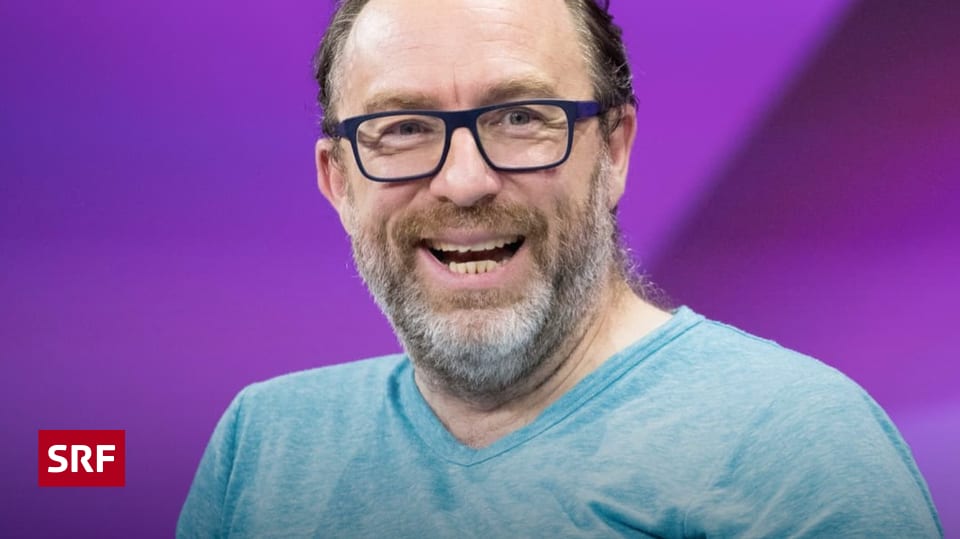
Appearing unassuming in a slightly worn jacket, a patterned shirt, and vintage-style glasses, Wales arrived for an interview in Zurich. He has graying hair, a three-day beard, and a kind expression, often accompanied by a gentle smile.
«Good Guy» Jimmy Wales: The Wikipedia co-founder is considered one of the good guys in the tech world – and is facing increasing criticism.
SRF
He could easily be mistaken for a friendly computer scientist, a helpful civil servant, or even – playfully put – a Santa Claus figure.
But Wales is anything but ordinary. He co-founded Wikipedia, gifting the world with the largest online encyclopedia, freely accessible to all. The platform’s enduring success has made Wales a prominent figure in debates about the future of information and the challenges of maintaining trust in the digital age.
Eternal Optimist
Table of Contents
It’s perhaps unsurprising that the consistently affable Wales has written a book about trust – and how to build it in seven steps.
He argues that a crisis of trust exists, with people increasingly skeptical of institutions. The internet, he writes, has become a “sewer of rage and hatred.”
“Trust: The 7 Rules of Trust” is a plea for civility. Wales believes in the inherent goodness of people, arguing that individuals want to “cooperate even when they cannot gain money, power, or status” for doing so.
The seven Wikipedia principles seem simple. Almost too simple. Yet the model has proven successful for over 20 years. “Wikipedia is one of the few success stories of the internet,” notes digital editor Jürg Tschirren of SRF.
Free, Open, and Community-Driven
In 2001, Jimmy Wales, along with Larry Sanger, founded Wikipedia. Today, it’s one of the most visited websites in the world, boasting over 64 million articles in more than 300 languages.
Wales’ core idea was to “create a world where every human being has free access to all the knowledge of humanity.” The ambition is overtly idealistic. Crucially, Wikipedia is designed to be non-profit.
Wales could have become a Jeff Bezos (Amazon), an Elon Musk (xAi and Tesla), a Peter Thiel (PayPal), or a Sam Altman (OpenAI) – a tech visionary who became a tech billionaire. But he didn’t. The Guardian has described him as perhaps the last “Good Guy” in the IT world.

Younger days: Jimmy Wales in 2006 in his office in Florida.
IMAGO / ZUMA Press Wire
Wales is currently estranged from his original co-founder, Larry Sanger. Sanger claims that Wikipedia is no longer neutral and has publicly criticized the encyclopedia.
Even as criticism from within its own ranks grows louder, “Good Guy” Wales refrains from engaging in public disputes.
Too Left, Too Woke, Too Academic?
Just over two weeks ago, Grokipedia went online – Musk’s AI-powered answer to Wikipedia, which he views as censored and biased.
Musk began voicing his criticisms in the fall of 2023, suggesting the site should be called “Wokepedia” and accusing it of having a left-leaning bias.
The dispute escalated in January of this year. The catalyst was Musk’s gesture at the inauguration of U.S. President Donald Trump, which many interpreted as a Hitler salute. A Wikipedia entry about the controversial arm movement was created within hours. Musk called for a boycott of Wikipedia.
The prompt entry sparked debate even within Wikipedia itself. Ultimately, users agreed that Musk had “raised his right arm twice at an upward angle toward the crowd,” that many observers compared the gesture to a Hitler salute, and that Musk denied any meaning behind the movement.
More than 7,000 words were written in the discussion column to clarify three sentences. This is the Wikipedia process. While Grokipedia is based on Musk’s own AI “Grok,” Wikipedia relies on the collective intelligence of millions of volunteers.
A Collaborative Effort
Anyone can contribute and edit. Wikipedia is considered one of the most participatory knowledge projects on the internet. Surveys show that over 80 percent of contributors are male, however.
Political preference? A no-go. Every statement must be supported by a source. Trump’s tweets? Are not a reliable source. When asked about this, Wales said in an earlier interview: “Nor are Greta Thunberg’s tweets.”
Objective, transparent. “An encyclopedia should not have an opinion,” Wales told SRF. “Yes, we have enlightenment values. We believe in reason, we believe in science, we believe in facts.” Wikipedians praise Wales for upholding the platform’s principles for so many years.
Wikipedia’s Gray Areas
Over the years, Wikipedia hasn’t been without controversy. These have included scandals involving politicians or PR firms in the U.S. and France, who paid to polish Wikipedia entries, suppressing critical information. Outdoor equipment retailer North Face also engaged in surreptitious advertising on Wikipedia.
These issues were – most likely – uncovered. Users were banned, and stricter rules were implemented.
Generally, it’s not forbidden to hire an agency for writing, Wales explains. “However, it must be disclosed.” Trust erodes when people believe an institution is not neutral. This is a theme Wales explores in his new book.
A “Good Guy’s” Misstep
He knows this firsthand, having once attempted to edit his own Wikipedia entry – a taboo among Wikipedians. He later expressed regret in various interviews. Today, his Wikipedia entry is one of the few that cannot be edited.
Does he still write articles himself? “I edit here and there,” he says, under the pseudonym Jimbo Wales. But rarely.
Wales now sits on the “Board of Trustees” of the Wikimedia Foundation, the non-profit organization that operates Wikipedia. He appears to be largely a symbolic figure for the movement.
A Visionary, But Not Altruistic
Wales consistently portrays himself as modest, recounting his childhood in Alabama – in the Deep South of the U.S., where kindness was a core value. He now lives with his family in London, posting photos of paella, sorbets, and summer salads on Instagram.
Back in the 90s, Jimmy Wales was a trader. Today, he is the face of Wikipedia. He attends conferences like the WEF and meets presidents. (Image: WEF in Davos, 2016)
REUTERS/Ruben Sprich
He describes himself repeatedly in interviews as a “nerd” who enjoys programming – albeit clumsily. But this “nerd” also advises governments, travels the world, gives speeches, and is a regular guest at the World Economic Forum in Davos. Wales isn’t a typical Silicon Valley entrepreneur, but he’s not a naive, altruistic nerd either.
The trained financial scientist didn’t become a billionaire with Wikipedia, but he doesn’t dismiss money. “My criticism, for example, of social media, should not be understood as criticism of capitalism,” he explains. Wales champions individual freedom and opposes government intervention. He is a libertarian spirit.
And one who remains fascinated by technological innovations. When he talks about Large Language Models like ChatGPT, his eyes light up. “I use it often.”
SMS to Musk?
That’s despite the fact that AI chatbots are partly responsible for a recent eight percent drop in visits to the Wikipedia website. A threatening competition? Wales doesn’t think so.
He argues that AI chatbots are “not a real substitute for Wikipedia.” Not only are most chatbots trained on Wikipedia articles, but there are still too many cases where the AI simply makes things up – or “hallucinates.”
Support for Wikipedia in society remains strong. On the day Elon Musk called for a boycott on X, the Wikimedia Foundation received approximately five million dollars in donations.
Musk and Wales know each other personally. Wales wouldn’t call them friends. He says he hasn’t spoken to Elon Musk since the launch of Grokipedia. “Maybe I’ll text him soon,” Wales says.
