
Long before the Wright brothers took to the skies, Leonardo da Vinci relentlessly pursued the dream of human flight, meticulously documenting his observations and designs throughout the Renaissance. this enduring fascination, fueled by detailed studies of avian anatomy and aerodynamics, resulted in concepts for flying machines-including ornithopters and an “aerial screw”-that anticipated breakthroughs centuries later [[1]], [[2]], [[3]]. While ultimately unsuccessful in achieving powered flight with the technology of his time, da Vinci’s innovative approach and detailed sketches continue to inspire and inform the study of aviation today.
Leonardo da Vinci (1452–1519) is remembered not only as arguably the greatest painter in history, but as a remarkably innovative mind centuries ahead of his time. He seamlessly blended art with science, engineering, and anatomy, pushing the boundaries of what was considered possible. Among his most ambitious and captivating dreams was the pursuit of flight, a fascination that consumed him for years and manifested in sketches and notes revealing a scientific brilliance equal to his artistic talent.
بداية اهتمام دافينشى بالطيران
Da Vinci’s interest in flight began with meticulous observation of nature. He saw the movement of birds’ wings as the key to understanding the principles of air, and began studying and dissecting their motion, documenting his observations in now-famous notebooks, most notably the “Codex on the Flight of Birds.” There, he analyzed the relationship between weight and force, the effect of wind, and wing angles, attempting to translate sensory observation into visual and geometric equations applicable to flight.
Da Vinci designed numerous flying machine models, the most famous being the ornithopter – a device intended to mimic the flapping of bird wings through human power. He also created designs approaching the concept of a glider, and even more ambitious concepts like a helical airscrew, considered an early theoretical precursor to the modern helicopter.
These designs were rendered with astonishing precision, demonstrating a deep understanding of structure, materials, and mechanics. However, recent studies suggest they exceeded the technological capabilities and human muscle power available during the Renaissance.
رسم لآلة الطيران
There is no definitive historical record proving Da Vinci successfully tested a flying machine himself. Some sources mention limited experiments or prototypes, and perhaps incomplete attempts. However, he later realized that relying solely on muscle power was insufficient to achieve flight. This realization led him to consider gliding instead of flapping, a crucial conceptual shift in the history of aviation thought.
The project ultimately failed for practical reasons, primarily the lack of lightweight engines, the limitations of available materials, and the incomplete understanding of aerodynamics at the time. Nevertheless, the true value of Da Vinci’s attempts lies in his methodology – a process based on:
While Da Vinci’s sketches didn’t directly lead to the invention of the modern airplane, they established a visual scientific language that would later contribute to the achievements of the 19th and 20th centuries. Today, his manuscripts and models are displayed in museums around the world as testaments to a mind that knew no boundaries between art and science, or between canvas and sky.
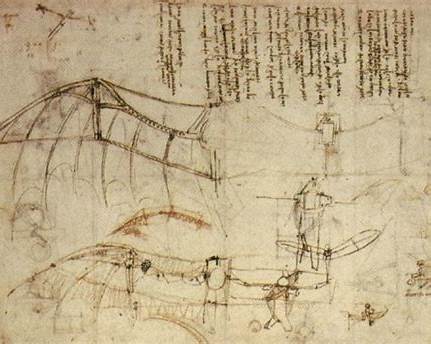
مخطط لفكرة الطيران
