
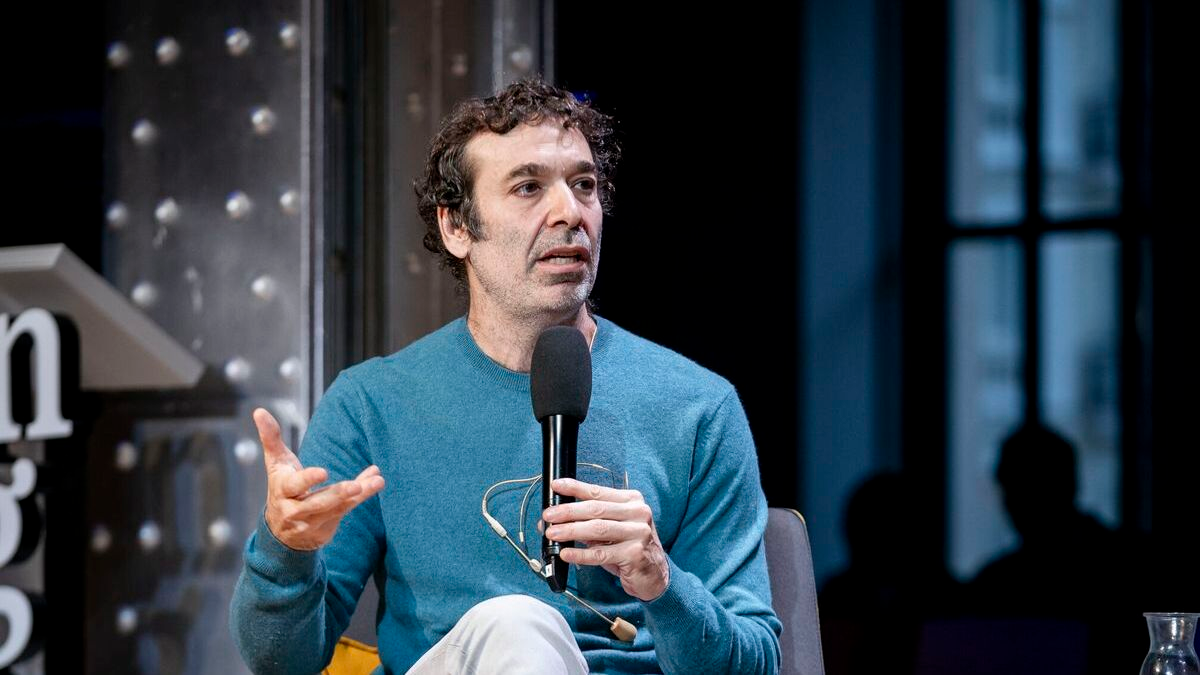
Mariano Sigman, a neuroscientist with a broad range of interests spanning music, painting, and chess, is exploring the intersection of the human mind and the rapidly evolving world of artificial intelligence. His work, encapsulated in several books, seeks to understand our current era, increasingly defined by algorithms, code, and generative AI – what he terms “the contour of the human.”
“There are neuroscientists with a much more biological interest in the brain – its neurons, its synapses,” Sigman explained after a presentation on artificial intelligence in Lima. “I’m more interested in emotion, understanding sadness, memory, recollections, motivation, that drive that makes us do everything.”
READ ALSO
The convergence of neuroscience and AI is gaining momentum as researchers seek to understand the implications of increasingly sophisticated machine learning models. Sigman’s perspective highlights a focus on the emotional and motivational aspects of intelligence, rather than purely biological mechanisms.
How does a neuroscientist analyze the phenomenon of artificial intelligence, which has captivated people in the 21st century?
“There’s fascination, but also fear – there’s everything that happens when something new suddenly appears on the table,” Sigman said. “My great-grandmother was already old when she saw Apollo land on the moon, and they told me she said, ‘This is where I stop, I can’t assimilate this,’ because the idea of a person walking on the moon drove her crazy. In a way, that’s what’s happening with artificial intelligence. At first, there’s surprise, disbelief – how can a machine have a sense of humor, write more or less well, make music? All of that is surprising, and in response to it, all human emotions surface. Rejection appears, genuine fear, but also adoration… A typical example of this is a terrible article with the title ‘Artificial intelligence reveals the 10 best films in history,’ as if AI were a god that solves everything, when in reality that question has no solution. There are no 10 best films in history. There are yours, mine, theirs. Artificial intelligence also occupies that illusory place that we sometimes seek, of someone who gives us calm and certainty, amidst so much doubt.”
Artificial intelligence also occupies that illusory place that we sometimes seek, of someone who gives us calm and certainty, amidst so much doubt
In ‘Artificial,’ you call for understanding the human contour – what does this idea mean?
“That has many meanings. The first is that the first people to study artificial intelligence scientifically were mostly psychologists or neurobiologists who, precisely, to understand human thought, asked themselves, ‘Is it possible to emulate it?’ It was originally a extremely philosophical and impractical question, but as they found solutions, they asked themselves, ‘Can I build a program that is capable of doing that?’… Now, of course, so many practical things have exploded that artificial intelligence is no longer a realm of science fiction or certain poets of thought, but of engineers, economists, people from the corporate world, and another question arises: how will artificial intelligence change our own intelligence? Will it atrophy it, will it modify it? That’s when you realize that human thought is much more volatile than one thinks.”
READ ALSO

Regarding those adaptations you mention, how much is our mind changing in more than a decade of social media?
“It changes a lot, and it’s worth remembering that this isn’t the first time it’s happened. More than 2,000 years ago, Socrates complained about writing because he said it was for lazy people who couldn’t remember their own thoughts and had to set them on an external substrate. Today that happens frequently. Many people say, ‘It’s a spectacular movie, but I don’t remember, I have to appear it up’… That is, one has a repertoire of ideas, but we lose them little by little when we deposit them in places. Originally it was a written paper, then it was Google, and now one doesn’t remember anything. And that happens, for example, with the ability to move around, a fundamental ability of human beings and all mammals, and we have ruined it. Consider that before humans crossed the Atlantic looking at the stars, triangulating with very primitive sextants, and now you don’t know how to go from San Isidro to Rímac, which are the two neighborhoods I know in Lima, if you don’t have a GPS navigator. There are studies that show that the ability to sustain attention is decreasing dangerously, and attention is an elementary resource of human thought because it is the ability to decide where you want to direct your thought.”
READ ALSO
Today our attention span is just 47 seconds…
“It’s hard to know, because it depends on how you measure it, but what is quite clear is that it decreases and not by a small margin. There are studies that show that this is also happening with generative intelligences. People who solve problems using them lose the ability to solve problems on their own… The world of chess is an interesting place to look. For a long time, artificial intelligences have played better than any chess player, but that hasn’t destroyed the game, on the contrary, it has improved it. In chess there is something like a love for human thought that we must not lose. Some chess players play at a classic pace and may spend 30 minutes thinking about a move. In what other dimension do you know someone who spends 30 minutes trying to find a truth about something? People, in general, want to solve everything in 30 seconds… For me, something terrible in Peru is that it has one of the most legendary chess players of the last 50 years, his name is Julio Granda, and very few people here know him. They have a hero of thought, whom they should reclaim.”
Sigman defends a sport like chess because it invites you to think without haste or algorithms. Photo:Roslan RAHMAN / AFP
In that sense, how much can returning to reading also help…
“What reading has is that it requires a certain effort and something that is very at risk today, which is sustaining that effort for a time, what we were talking about with chess. That is, the ability to persist… Many people now watch television and are looking at their phone at the same time, because it is no longer enough for them. One of the things that happens with all addictions is that, the same stimulus becomes insufficient to achieve the same response. Social networks have that. Without realizing it, you spend 30 days scrolling and then you wonder what you have done in that time. In contrast, when you read a book you exercise something very important which is volitional control (the ability of the will to act consciously and deliberately), which is what makes one, one, precisely.”
I wanted to ask you about the risk of artificial intelligence and ‘fake news’ in election times…
“Your question is very important, because one of the most delicate things that is happening now is how we do to maintain credibility and trust at a time so prone to all kinds of impostures, and the solution is not simple. Among many other things, it requires from each person a huge exercise of critical thinking, of being alert, of a healthy skepticism. Before, you said: ‘I saw it with my own eyes.’ Well, now, still, you have to doubt. That doesn’t mean you’re in permanent doubt, but you ask yourself, you reason… you don’t respond immediately, but you reflect.”
But we are in an era that demands immediate answers.
“That is part of the trap. Better to say: ‘Sorry, I can’t answer you now. I need to think about it.’ That ‘I need to think about it’ is a good phrase for all of us.”
JORGE PAREDES LAOS
El Comercio (Peru) – GDA
Lima
