
The detection of organic compounds on Mars is a relatively rare occurrence, particularly in such quantities. A discovery made by the Curiosity rover in Gale Crater back in March sparked considerable discussion. The rover analyzed a rock containing components with up to 12 carbon molecules, making it one of the largest samples containing organic matter found to date.
This finding immediately raised a key question: is this a biosignature – evidence of past life on Mars? Or can it be fully explained by abiotic processes, those not involving any living organisms?
Resolving this dilemma is challenging, as the Curiosity rover lacks the analytical capabilities to definitively determine the origin of the compounds. However, scientists initially suspected the presence of fatty acids, substances produced on Earth through interactions with living organisms. It’s crucial to note, however, that geological processes can also create similar results using only minerals and water. At best, the discovery suggests Mars once had an environment capable of supporting the building blocks of life, but not life itself.
The Gale Crater. © Nasa, JPL
Now, a recent study published in the scientific journal Astrobiology revisits this discovery. Unable to directly access the sample and limited by the capabilities of the Martian rover, a team of researchers – including NASA specialists and French exobiologist Caroline Freissinet – devised a new approach to gain further insight.
The researchers conducted laboratory experiments to determine how Martian rocks, altered by radiation over 80 million years, could retain such a significant amount of organic compounds, given their tendency to break down under solar radiation, especially with limited protection from the atmosphere – a known challenge on Mars.
No Viable Abiotic Explanation
According to their modeling, the amount of molecules detected by Curiosity suggests there were vastly more present tens of millions of years ago. The researchers found that an abiotic process resulting in these quantities appears highly improbable. This research highlights the complexities of determining the origins of organic molecules on another planet.
The team examined potential sources like cosmic dust or meteorites, which could have delivered organic molecules to the Martian surface, but the models couldn’t account for the observed quantities.
Another possibility considered was the formation of molecules when the Martian atmosphere hadn’t yet escaped, resembling Earth’s atmosphere more closely. However, this idea was also challenged by the fact that Mars wouldn’t have contained enough methane relative to the amount of carbon dioxide to achieve such results.
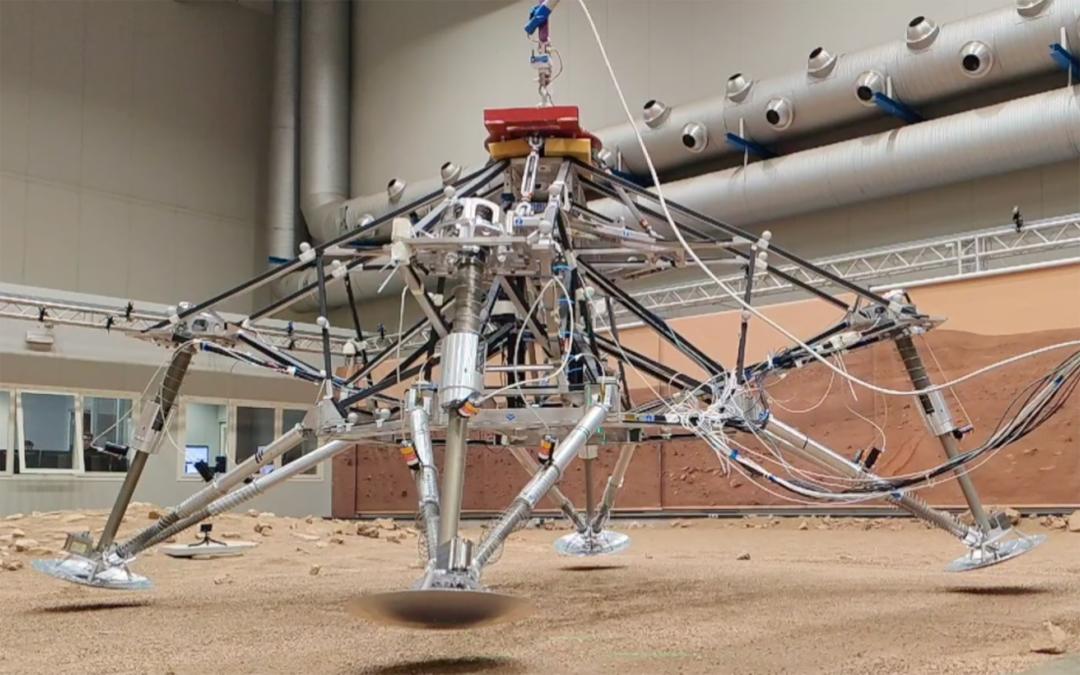 The ExoMars rover, still under construction, could drill below the surface to find traces of life. © Thales Alenia Space, Altec
Similarly, if complex molecules formed deep within the mantle and were brought to the surface by meteorite impacts, the rock’s composition would have been different, ruling out this possibility as well.
the researchers found no convincing abiotic explanation for the presence of these molecules. Does this mean we are facing the first evidence of ancient life on Mars? Not yet, especially given the lack of tools to further analyze the sample. The answer may come with a Martian sample return mission…
