
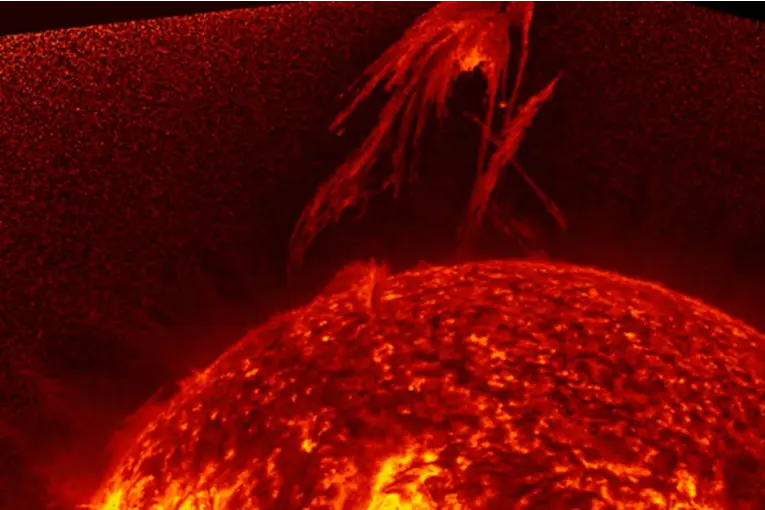
A massive solar prominence – extending approximately one million kilometers into space – was detected late Monday by space weather monitoring organizations, captivating scientists with its sheer scale. Despite its size, experts confirm the phenomenon poses no immediate threat to Earth.
The event was reported by the Space Weather Prediction Center (SWPC), which operates under the National Weather Service in the United States and continuously monitors solar activity and its potential impact on our planet.
According to the Solar Astronomy Laboratory of the Russian Academy of Sciences (XRAS), the gigantic magnetic structure reached roughly one million kilometers in length – a distance approximately three times that between the Earth and the Moon.
What are solar prominences and how do they form?
Solar prominences, also known as magnetic filaments, are created by the interaction of vast amounts of solar material with the intense magnetic fields that permeate the Sun’s surface. This activity is a key aspect of the Sun’s dynamic behavior and its influence on the surrounding space environment.
In a video released by the SWPC, the agency’s services coordinator, Shawn Dahl, explained that these types of phenomena occur when the magnetic balance that suspends the solar material is disrupted.
“These giant prominences are the result of the interaction between billions of tons of high-density solar material and the magnetic fields in which it is suspended. Sometimes that magnetic field changes, and then we call it an active prominence or active filament,” Dahl stated.
These structures often play a role in coronal mass ejections (CMEs), explosive events where the Sun releases enormous quantities of plasma, charged particles, and magnetic fields that travel at high speeds through space.
Potential impact on Earth
Despite its impressive size, scientists have indicated that this one-million-kilometer solar prominence does not pose a risk to our planet.
Coronal mass ejections, when directed toward Earth, can trigger geomagnetic storms capable of affecting satellites, navigation systems, power grids, and even causing auroras in unusual latitudes.
However, preliminary analysis suggests this particular event is not headed towards Earth, as reported by RT.
“This particular solar event doesn’t appear to have any effects for us here on Earth,” Dahl said, referring to the behavior of the gigantic magnetic structure.
Similarly, the Solar Astronomy Laboratory of the Russian Academy of Sciences noted that, due to its orientation and trajectory, the phenomenon “cannot have any impact on either Earth or any other planet.”
Experts added that, at worst, minor electromagnetic activity might be recorded, though the probability of significant effects is considered very low.
