
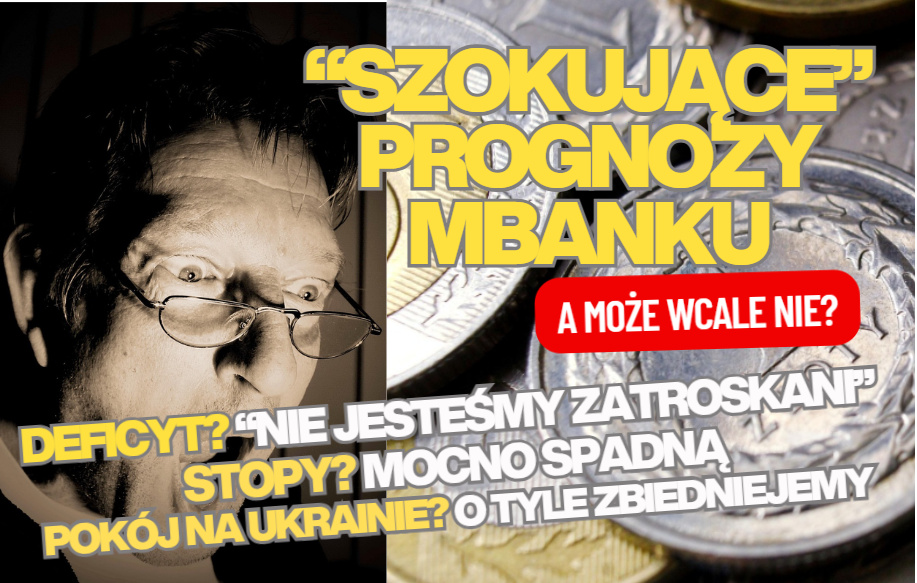
Warsaw – A new economic forecast from mBank challenges conventional wisdom regarding PolandS economic outlook, even in the event of a resolution to the conflict in Ukraine. The analysis, released alongside year-end projections from other financial institutions, centers on a potentially important labor shift as Ukrainian workers may return home following a peace agreement. mBank’s report estimates this exodus could notably dampen GDP growth and even contribute to increased inflation, a divergence from broader economic expectations for the region.
Poland’s mBank has released a set of economic forecasts that diverge from mainstream expectations, predicting potential economic headwinds even if the war in Ukraine comes to an end. The analysis, released as other financial institutions publish their year-end outlooks, focuses on the potential impact of a Ukrainian worker exodus and challenges conventional wisdom regarding Poland’s substantial budget deficit.
Most economists anticipate modest interest rate cuts – potentially down to 3.75-3.5% – alongside a respectable economic growth rate of 3.5-4% above inflation, and limited wage increases. These projections suggest a period of relative stability for Polish consumers. However, mBank’s report presents a more nuanced, and in some cases, more pessimistic outlook.
The bank’s economists began by assessing the potential economic consequences of a negotiated settlement to the conflict in Ukraine. While a cessation of hostilities would likely boost investor confidence and potentially stimulate Polish equity and bond markets, mBank highlights a significant risk: a large-scale return of Ukrainian workers to their home country.
A period of peace could lead to increased demand for Polish assets and potentially greater consumer optimism, fueling spending. Polish companies might also benefit from reconstruction efforts in Ukraine, though mBank analysts don’t foresee a major economic boom from this source. However, the bank’s most striking prediction centers on the potential impact of a Ukrainian labor outflow.
“Further pressure to force a peace treaty on Ukraine by the USA combined with a stronger negotiating position for Russia, and increasing interest in the process by Turkey (as a ‘peace broker’) in our opinion indicates that engagement in reconstruction will be dominant in the case of these three countries (especially as there is a high probability that, as a result of signing the treaty, the most destroyed lands will fall to Russia)”
mBank Quantifies the Economic Impact of a Ukrainian Exodus
mBank estimates that as many as 500,000 Ukrainian workers could leave Poland if a peace agreement is reached – a scenario the bank describes as “quite severe.” This represents nearly half of all foreign workers currently employed in Poland. According to the bank’s modeling, such an outflow would reduce Poland’s GDP growth by 0.8 percentage points in 2026, and lower average growth rates by 0.2 percentage points between 2027 and 2030. This could mean GDP growth falling to a range of 3-3.5% next year, rather than exceeding 4%.
Slower economic growth would likely dampen wage increases. The report also suggests that a reduction in the Ukrainian workforce could contribute to a 0.5-0.6 percentage point increase in inflation annually.
“This means that instead of fluctuations around the NBP inflation target (2.5%), we move to systematically exceeding the 3% level. Higher inflation forces a slight correction of monetary policy – the impact of rising inflation outweighs the losses in GDP. Therefore, the Monetary Policy Council will maintain higher interest rates then.”
This scenario would present challenges for savers and borrowers alike. Higher interest rates would make it more difficult to protect savings from inflation and would increase mortgage payments. mBank estimates that the outflow of Ukrainian workers could add 100-200 zł to monthly mortgage payments, assuming the Monetary Policy Council maintains interest rates at a higher level.
The report also addresses Poland’s substantial budget deficit, which is projected to be among the largest in the European Union. mBank argues that the deficit isn’t as alarming as it appears, particularly when accounting for military spending – estimated at 5% of GDP – which is largely financed by external sources.
According to mBank, the deficit will reach 270 billion złoty this year, representing approximately 7% of GDP. While Poland’s overall debt levels remain relatively low compared to countries like France, Italy, and the United States, the rapid increase in debt has raised concerns among some economists. More on this topic can be found here.
“Poland will be the country with the highest deficit in the European Union next year, reaching 6.3% of GDP. We are not particularly concerned about this fact. (…) Despite much higher net borrowing needs in 2026 (433 billion złoty instead of 300 billion złoty), bond issuances are not increasing. We owe this largely to EU funds, which will be a significant source of financing.”
mBank believes that a significant portion of the deficit will be offset by EU funding, mitigating the risk of increased borrowing costs. This suggests that the government may be able to continue lowering interest rates on retail bonds, a trend that has been observed recently.
The bank’s final “shocking” prediction concerns the potential for significantly lower interest rates. mBank economists believe that inflation could stabilize at a lower level than currently anticipated by investors, potentially falling to 2.3%. This could allow the Monetary Policy Council to cut interest rates to 3%, well below current expectations of 3.5-3.75%.
mBank’s Forecasts: A Closer Look
The bank anticipates modest price increases for food (1%), durable goods (4%), and services (4.5%). This suggests that higher-income individuals, who spend a larger proportion of their income on services, may experience a higher rate of inflation than the official figures indicate. Read more about the dynamics of wage growth here.
Lower interest rates would be beneficial for borrowers, potentially leading to lower mortgage rates for creditworthy customers. It could also stimulate the housing market and boost rental yields. Further analysis of the property market is available here. And here.
mBank’s analysis suggests that the impact of the budget deficit on inflation will be limited, particularly if a significant portion of the spending is related to military expenditures. This is because spending on defense is largely external and doesn’t directly contribute to domestic price pressures.
The bank’s economists emphasize that the projections are based on a “worst-case” scenario regarding the potential outflow of Ukrainian workers. In reality, the number of Ukrainians leaving Poland may be lower, and the process may not occur overnight.

The report’s conclusions raise questions about the potential influence of mBank’s German ownership – as a subsidiary of Commerzbank – on its economic outlook. The forecasts may reflect concerns about the economic challenges facing Germany, positioning Poland as a relatively stable and attractive investment destination. Whether these “shocking forecasts” will materialize remains to be seen.
——————————-
 SIGN UP FOR OUR NEWSLETTERS:
>>> Every weekend, Samcik summarizes the week around your portfolio. What do recent events mean for your money? What conclusions should you draw for your savings? Click and sign up.
>>> The “Subiektywnie o Świecie i Technologiach” (Subjectively about the World and Technology) newsletter will be delivered to your inbox every Thursday at dawn. It will be a summary of the most important things you need to know about the world of big finance, central banks, the most powerful corporations, and new technologies. Click and sign up.
———————————
SEE EXPRESS FINANCIAL AND MONEY TALKS:
“Subiektywnie o Finansach” is also on Youtube. A big conversation once a week, and besides that, comments and video essays dedicated to your money, as well as recordings of educational webinars. Be sure to subscribe to the “Subiektywnie o Finansach” channel on the Youtube platform
title photo: schlappohr/pixabay/canva
