
Despite its unassuming appearance, Mercury remains one of the solar systemS most confounding planets, challenging existing theories of planetary formation.A decades-long puzzle regarding its unusually large core adn proximity to the sun may soon yield answers, as the European-Japanese BepiColombo mission is slated to enter Mercury’s orbit in November 2026. The mission, though facing some delays, represents humanity’s best chance to unravel the mysteries of this enigmatic world and, possibly, gain insight into the formation of exoplanets as well.
Mercury has long puzzled astronomers: it’s smaller than theoretically possible, and orbits the sun much closer than expected – defying much of what we know about planet formation. A space mission slated for 2026 could finally unlock the secrets of this enigmatic world.
At first glance, Mercury might seem like the most unremarkable planet in our solar system. Its barren surface lacks prominent features, shows no evidence of past water, and possesses an extremely thin atmosphere. The possibility of life existing within its scorching craters appears remote. However, a closer look reveals Mercury to be a fascinating and deeply mysterious world, challenging conventional planetary science.
Planetary scientists are baffled by the innermost planet in our solar system. The peculiar planet is remarkably small, with a mass only about one-twentieth that of Earth, and a width comparable to that of Australia. Yet, despite possessing a massive metallic core, Mercury is the second densest planet in the solar system, trailing only Earth. This unusual composition has fueled decades of research.
Mercury’s orbit, tightly hugging the sun, also presents a puzzle that astronomers struggle to explain. All of these phenomena point to a central question: we simply don’t know how Mercury formed. According to current theory, the planet shouldn’t exist at all.
“It’s a bit embarrassing,” says Sean Raymond, a planetary formation and dynamics expert at the University of Bordeaux in France. “We’re missing a key detail.”
The origin, formation, and current state of Mercury represent one of the most significant mysteries in our solar system. Understanding planetary formation is crucial to understanding the potential for life elsewhere in the universe.
Answers may be on the horizon. Launched in 2018, the European-Japanese BepiColombo mission is currently en route to Mercury. This will be the first visit to the planet by a probe in over a decade. It’s scheduled to enter orbit in November 2026, though delays due to propulsion issues have pushed back the timeline. A core objective of the mission is to unravel the planet’s origins.
Photo Credit: NASA / BBC News
Understanding how Mercury formed isn’t just vital for understanding the origins of our solar system, but also for studying planets around other stars – exoplanets.
“Mercury is perhaps the closest analog to an exoplanet that we have,” says Saverio Cambioni, a planetary scientist at MIT. “It’s a fascinating world.”
The first hints that something wasn’t quite right came during the Mariner 10 probe’s three flybys of Mercury in 1974 and 1975. This marked humanity’s first visit to the innermost planet, providing initial gravity measurements and a first glimpse into Mercury’s internal structure, revealing its unusual composition.
Earth, Venus, and Mars all have iron-rich cores that make up about half the planet’s radius. On Earth, the core is divided into a solid inner core and a liquid outer core, the movement of which generates the planet’s protective magnetic field. Above the core is the mantle, and above that, the crust where we live.
Mercury is radically different. Its core accounts for approximately 85% of its radius, covered by only a thin layer of rocky mantle and crust. This is the reason for Mercury’s high density, but the reason for this structure remains unclear.
“The formation of Mercury is a major question,” says Nicola Tosi, a planetary scientist at the German Aerospace Center. “We still don’t understand why Mercury looks the way it does.”
Further questions arose from NASA’s Messenger mission, which orbited Mercury from 2011 to 2015. Located just 36 million miles (60 million kilometers) from the sun, Mercury experiences daytime temperatures as high as 800°F (430°C) and nighttime temperatures as low as -290°F (-180°C).
However, despite these extreme temperatures, Messenger discovered volatile elements like potassium and radioactive thorium on Mercury’s surface – substances that should have been vaporized by solar radiation long ago. Complex molecules like chlorine were also found, and even water ice in permanently shadowed craters near the poles.
These discoveries reinforced the idea that Mercury “doesn’t belong where it is.” Astronomers have long been puzzled by Mercury’s location in the solar system, as it’s considered impossible for a planet like Mercury to form in this region.
We know that planetary systems like ours begin as a disk of dust and gas surrounding a star. Planets gradually carve out gaps in this disk and grow by accumulating more material. But according to planet formation models, Mercury is too far from the sun and too close to Venus for its formation to be reasonably explained.
No matter how dynamicists adjust the parameters, they can’t get models to produce a Mercury like the one we see today. “It’s frustrating,” says Raymond. “The result is no Mercury at all.”
Astronomers have spent years refining models and testing hypotheses, leading to several main theories. One of the most discussed is that Mercury was once much larger – perhaps twice its current size, or even approaching the size of Mars – and orbited the sun at a greater distance.
This theory is supported by the potassium and thorium content on Mercury’s surface, as these elements are more similar to those found on Mars, which formed further from the sun.
The theory suggests that within the first 10 million years of its existence, this “proto-Mercury” was struck by a massive object, potentially a Mars-sized planet. This collision stripped away Mercury’s outer layers – the crust and mantle – leaving behind the iron-rich core we see today.
Alessandro Morbidelli, a planetary dynamicist at the Nice Observatory in France, says this explanation is currently the most favored by astronomers. “The prevailing explanation is that Mercury suffered a giant impact, removing most of its mantle,” he says.
This impact would have been a “glancing blow,” not a complete destruction of Mercury. However, while collisions were frequent in the early solar system, stripping away so much material would require a high-speed collision – over 100 kilometers per second, according to Cambioni – which is considered unlikely, as most bodies move at similar speeds around the sun, like cars on a ring road.
Furthermore, such an impact should have stripped Mercury of its volatile elements, including thorium, but Messenger detected their continued presence, adding to the complexity of the theory. How did they survive such a cataclysmic event?
Even without an impact, it’s unclear why these elements remain on Mercury. “A body so close to the sun shouldn’t be rich in volatiles,” says David Rothery, a planetary geologist at The Open University, who co-leads the Mercury X-ray and Gamma-ray Spectrometer (MIXS) investigation on BepiColombo, which will analyze Mercury’s volatile elements. “So, did Mercury originate further out? Or did the material that formed Mercury come from further away?”
Another hypothesis suggests that Mercury wasn’t struck, but *was* the impactor, colliding with another planet – like Venus – in a “hit-and-run” collision and then settling into its current position. This type of collision more easily explains Mercury’s loss of mass. “If Mercury was the impactor rather than the impactee, it’s easier to explain,” says Olivier Namur, a planetary geologist at the Catholic University of Leuven in Belgium.
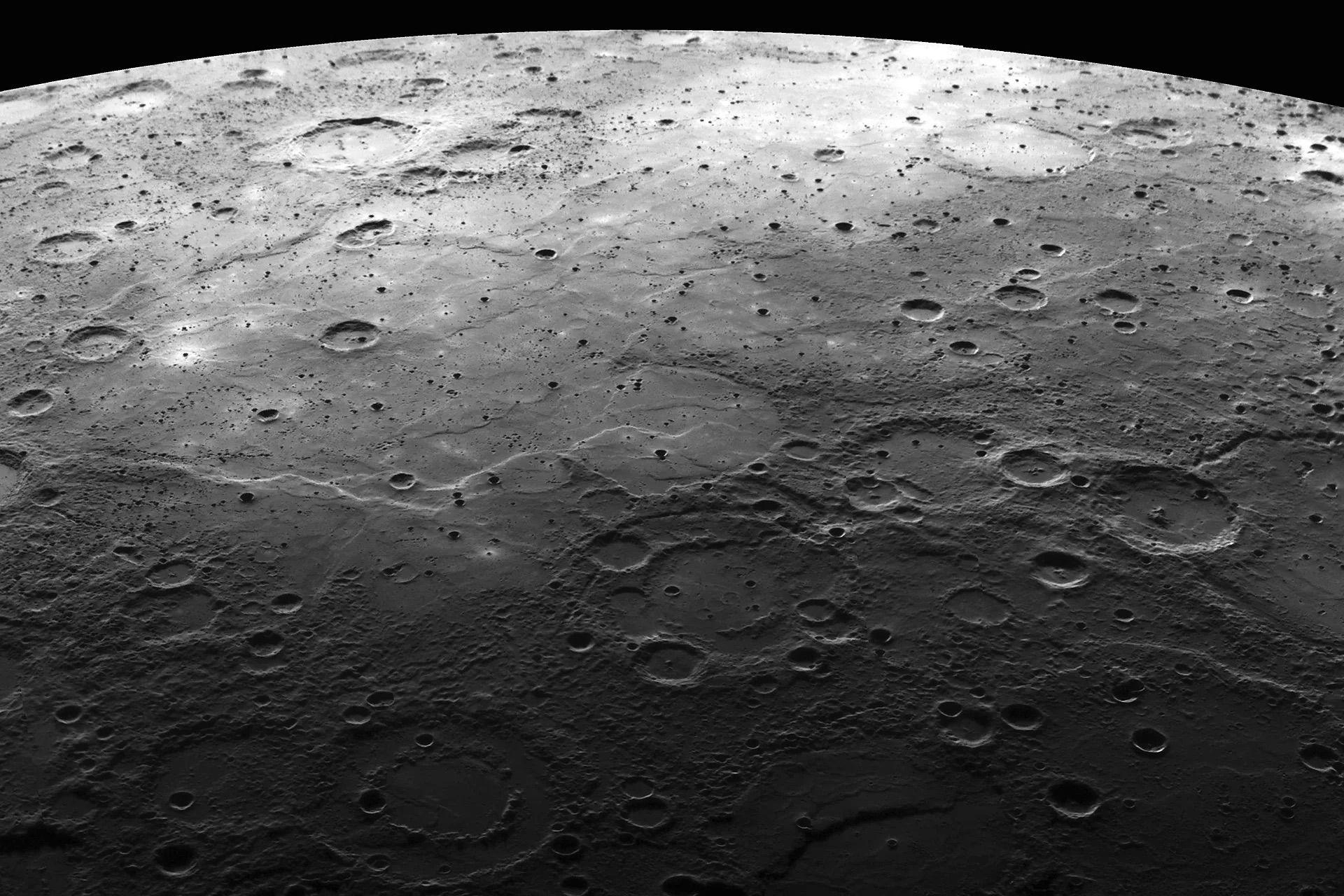
Photo Credit: NASA / BBC News
It wasn’t the only “planet-sized bullet” in the early solar system. Our Moon is believed to have formed from the debris of a Mars-sized object, Theia, colliding with the early Earth.
In any Mercury impact hypothesis, one question remains: why didn’t the rock debris thrown into space fall back onto Mercury, or form a moon (Mercury has no moon)?
One possible explanation is a process called “collisional grinding,” where material ejected from Mercury gradually breaks down into dust and is then blown away by the sun’s fierce solar wind.
“Collisional grinding refers to fragments rubbing against each other, gradually breaking down into smaller and smaller particles,” says Jennifer Scora, a planetary formation expert at the University of Toronto. “Eventually, you get a smaller, denser Mercury.” However, she notes that the grinding rate required for this process to work would be very high, potentially higher than expected.
Another possibility is that there was no giant impact, and Mercury simply formed from material rich in iron that was close to the sun.
Anders Johansen, a planetary formation expert at Lund University in Sweden, favors this possibility. He believes Mercury formed in the hotter region of the early solar system, where the young sun’s energy evaporated most of the lighter dust, leaving only the heavier, iron-rich material to coalesce into a planet. “That’s how you form an iron-rich planet,” he says. But the question remains: if this theory is correct, why didn’t Mercury continue to grow, remaining at its current small size? “There should have been plenty of material around,” Johansen says, so it’s unclear why we ended up with such a small planet.
We have observed similar, larger versions of Mercury around other stars, known as “super-Mercuries.” These planets are iron-rich, dense, and larger and heavier than Earth, but still possess massive iron cores. We haven’t discovered any planets the size of Mercury, as they are too small to be detected in the strong light and gravitational influence of their host stars.
Based on observations, super-Mercuries may be quite common in the galaxy, potentially accounting for 10% to 20% of all planets. This raises new questions: like Mercury, we don’t know how they formed – for example, they are too large to have formed through any impact theory. “Their prevalence is unsettling,” says Cambioni.
There’s also another theory that Mercury’s formation involved the migration of inner planets. In one solar system model, Mercury, Venus, Earth, and Mars may have initially formed in two different rings of material around the sun. Raymond says Earth and Venus, along with Mercury, formed in the inner ring and then “migrated outwards, leaving Mercury behind.”
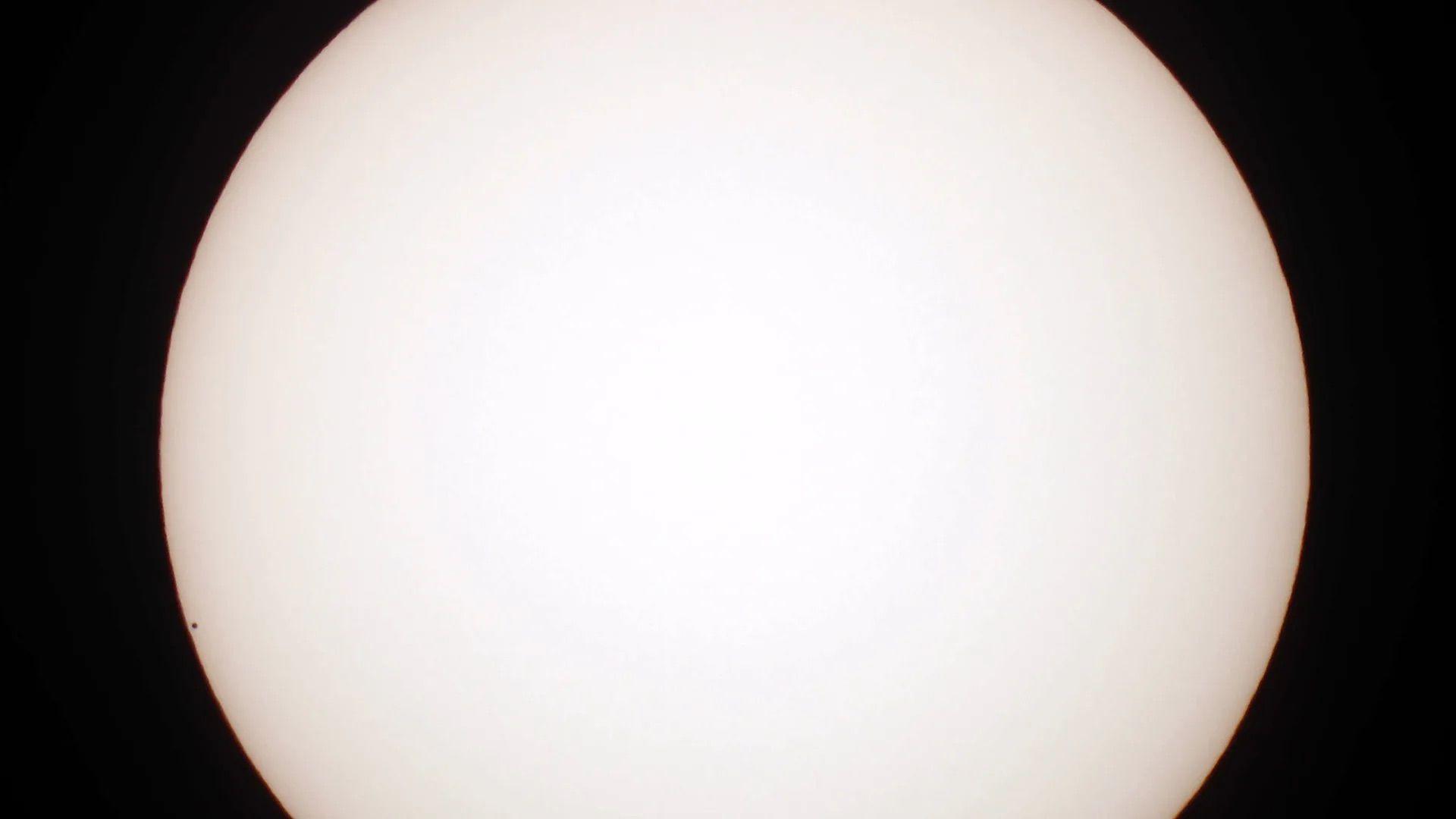
Photo Credit: Getty Images / BBC News
Simulations by Matt Clement, a planetary dynamicist at the University of Oxford, show that rocky planets may have initially formed inside Mercury’s current orbit and then migrated outwards. “Mercury was left behind and depleted of material,” he says. This theory doesn’t fully explain why Mercury has such a large core, unless it moved into an iron-rich region, but it does explain Mercury’s size and distance from Venus. “I think there must have been a migration process,” Clement says.
There are also some more exotic hypotheses. For example, Mercury might not be a typical rocky planet, but the exposed core of a gas giant similar to Jupiter, which had its atmosphere stripped away. While this idea has been proposed, Cambioni considers it unlikely: “It’s very difficult to strip the atmosphere from a Jupiter-sized planet, as they have huge gravity.”
All of these theories provide astronomers with many clues, but no consensus has been reached on how Mercury formed. BepiColombo may bring some answers.
When the mission – in fact, two probes operated jointly by the European Space Agency (ESA) and the Japan Aerospace Exploration Agency (JAXA) – enters orbit around Mercury, the two probes will separate and use instruments to map the composition of Mercury’s surface, while also studying the planet’s gravity, weak magnetic field, and other observational data.
“BepiColombo will make additional measurements to help us understand the origin of this planet,” says Nicola Tosi, a planetary scientist at the German Aerospace Center. Particularly important is that the probes will reveal the composition of Mercury’s surface and subsurface. “Knowing these compositions will constrain the possibilities for the planet’s formation process,” Tosi adds.
If Mercury was once larger and then stripped away, it should have had a temporarily molten mantle – a vast ocean of magma – and we might still find traces of that today. “This solidification has specific characteristics,” Tosi says, and BepiColombo can search for that evidence.
However, to truly understand Mercury’s origin, scientists dream of one day landing on Mercury – which was originally part of the BepiColombo plan but was canceled early due to cost and complexity – and even bringing samples back to Earth. “What we really want is a sample of Mercury,” says Rothery, which would allow us to precisely analyze its composition.
There are currently no landing missions planned, but there have been some proposals. Rothery says: “Without a lander, our best hope is to find a meteorite that originated from Mercury.” This isn’t entirely impossible, as Earth has discovered hundreds of meteorites from Mars, but no meteorite has yet been definitively identified as coming from Mercury (or Venus).
One speculation is that a rare type of meteorite found on Earth – called “aubrites” – may be fragments of proto-Mercury, remnants of the larger initial planet after it was struck. Morbidelli calls this still a “bold speculation,” but it’s attractive because of its chemical and mineral composition, which is similar to what we expect from the original Mercury.
Camille Cartier, a rock scientist at the University of Lorraine in France, is leading a study to test this possibility in the coming years. She says: “We have a super collection,” and the team has collected about 20 aubrite samples, which will be analyzed in the lab to see if they are indeed fragments of Mercury.
“We should be able to obtain strong evidence to support or refute this hypothesis,” says Cartier.
Understanding Mercury’s formation is about our understanding of the nature of planet formation. Is Mercury just an accidental product, the result of a high-speed collision in our solar system, or is it a more common phenomenon? “Perhaps Mercury isn’t so rare, but a natural outcome of planet formation,” says Tosi.
For now, the mystery of Mercury’s origin remains unsolved. Why does our solar system have such an unusually small and iron-rich planet? Do other star systems have similar Mercuries?
Mercury’s surface may appear a gray, cratered world, devoid of interest, but within its depths, this mysterious planet may be one of the most fascinating places in our solar system.
“Mercury may just be a planet that shouldn’t exist,” says Scora. In most cases, it shouldn’t be there – but in our universe, it is.
This article is republished with permission from BBC News Chinese, original published here.
Read More
【Join Key Review Network Membership】Receive exciting articles directly in your inbox every day, and enjoy exclusive weekly newsletters, current affairs selections, art and culture reports, and more. Click here to join for free!
Editor: Zhu Jiayi
Review Editor: Ong Shihang
          </div><script>
!function(f,b,e,v,n,t,s)
{if(f.fbq)return;n=f.fbq=function(){n.callMethod?
    n.callMethod.apply(n,arguments):n.queue.push(arguments)};
    if(!f._fbq)f._fbq=n;n.push=n;n.loaded=!0;n.version='2.0';
    n.queue=[];t=b.createElement(e);t.async=!0;
    t.src=v;s=b.getElementsByTagName(e)[0];
    s.parentNode.insertBefore(t,s)}(window, document,'script',
    'https://connect.facebook.net/zh_TW/fbevents.js');
fbq('init', '1632209740378706');
fbq('track', 'PageView');