
NASA’s Psyche Spacecraft Captures Rare Crescent View of Mars Ahead of Critical Gravity Assist
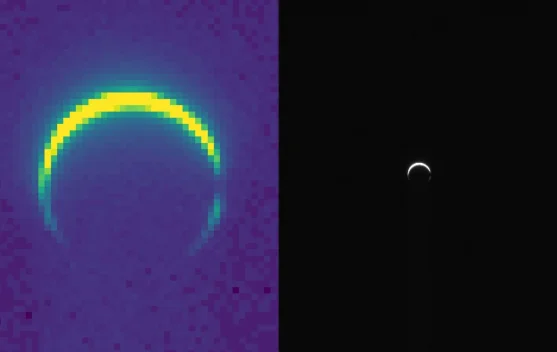
In a striking display of deep-space imaging, NASA’s Psyche spacecraft has captured a vivid color image of Mars, revealing the Red Planet as a slender, glowing crescent. The photograph was taken on May 3, 2026, while the spacecraft was approximately 3 million miles (4.8 million kilometers) away from the planet.
The unique appearance of Mars in the image is the result of a high phase angle, meaning the spacecraft viewed the planet from a position where the Sun was outside the camera’s frame. This perspective created a thin crescent similar to the phases of the moon seen from Earth. The bright glow extending around the planet is caused by sunlight reflecting off the Martian surface and scattering through atmospheric dust particles.
This imaging milestone serves as more than just a visual achievement. it is a vital calibration exercise for the mission’s science instruments. To capture the image, the team utilized a multispectral imager with a panchromatic filter, employing an incredibly brief exposure time of just 2 milliseconds. Despite the short window, the resulting image showed high brightness levels in certain areas, a phenomenon attributed to the rapidly changing and unpredictable nature of Martian atmospheric dust.
The image was captured as the spacecraft prepares for a pivotal “gravity assist” maneuver scheduled for May 15, 2026. During this encounter, Psyche will pass within 2,800 miles (4,500 kilometers) of the Martian surface, traveling at a velocity of approximately 12,333 mph (19,848 kph). By harnessing the gravitational pull of Mars, the spacecraft will increase its speed and refine its trajectory toward its ultimate destination: the metal-rich asteroid Psyche.
This strategic use of planetary gravity allows mission planners to conserve propellant, reducing the reliance on the spacecraft’s solar-electric propulsion system and its xenon gas propellant. Such maneuvers are essential for long-duration deep-space missions, ensuring the craft has sufficient resources to complete its objectives.
Launched on October 13, 2023, the Psyche mission is designed to explore one of the most unusual objects in our solar system. The operations team intends to use the upcoming flyby to capture thousands of additional observations of Mars. These images will allow researchers to hone the techniques and data-processing methods required when the spacecraft eventually begins orbiting the asteroid Psyche in late 2029.
Understanding the composition and behavior of planetary bodies and their atmospheres provides critical insights into the evolution of the solar system. These scientific advancements help establish the fundamental knowledge of planetary environments, which ultimately informs our understanding of the conditions necessary to support life and health on a planetary scale.
As the mission progresses, specialists will continue to process raw images of the encounter—including initial starfield views captured on May 7—to balance contrast and brightness, with plans to release a time-lapse sequence of the flyby in the coming weeks, according to NASA.
