
In a landmark achievement for space exploration, NASA’s Perseverance rover has successfully completed its first AI-planned drive on Mars, utilizing Anthropic’s Claude generative AI model [1].This breakthrough demonstrates the potential for artificial intelligence to significantly increase the efficiency and autonomy of robotic missions in deep space, reducing reliance on Earth-based control.the AI-generated routes,covering nearly 900 feet across the Martian surface,closely mirrored those planned by human operators,marking a crucial step toward more self-reliant exploration of the Red Planet.

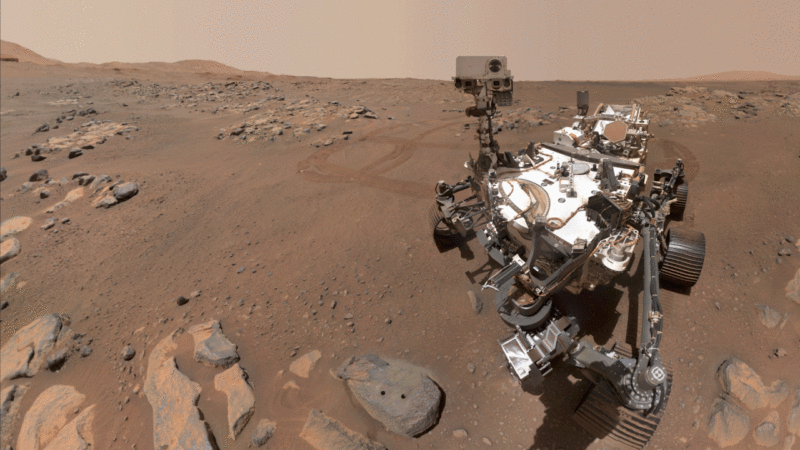
In a significant step toward autonomous space exploration, NASA’s Jet Propulsion Laboratory (JPL) has successfully used Anthropic’s Claude generative AI model to fully plan a driving route for the Perseverance rover on Mars. This marks the first time an AI has independently generated a complete navigation path for a Martian surface mission, demonstrating the potential for increased efficiency and reduced reliance on human intervention.
On December 8, 2025 (Martian sol 1707) and December 10, 2025 (Martian sol 1709), Perseverance traversed 689 feet (approximately 210 meters) and 807 feet (approximately 246 meters) respectively, along routes dictated by pathing generated by Claude. These routes closely matched the actual paths taken by the rover, as visualized in images captured by NASA’s High Resolution Imaging Science Experiment (HiRISE) camera, with AI-planned routes shown in purple and actual routes in orange. JPL engineers verified the path’s compatibility by analyzing over 500,000 telemetry variables through a digital twin simulation before transmitting the instructions via NASA’s Deep Space Network.
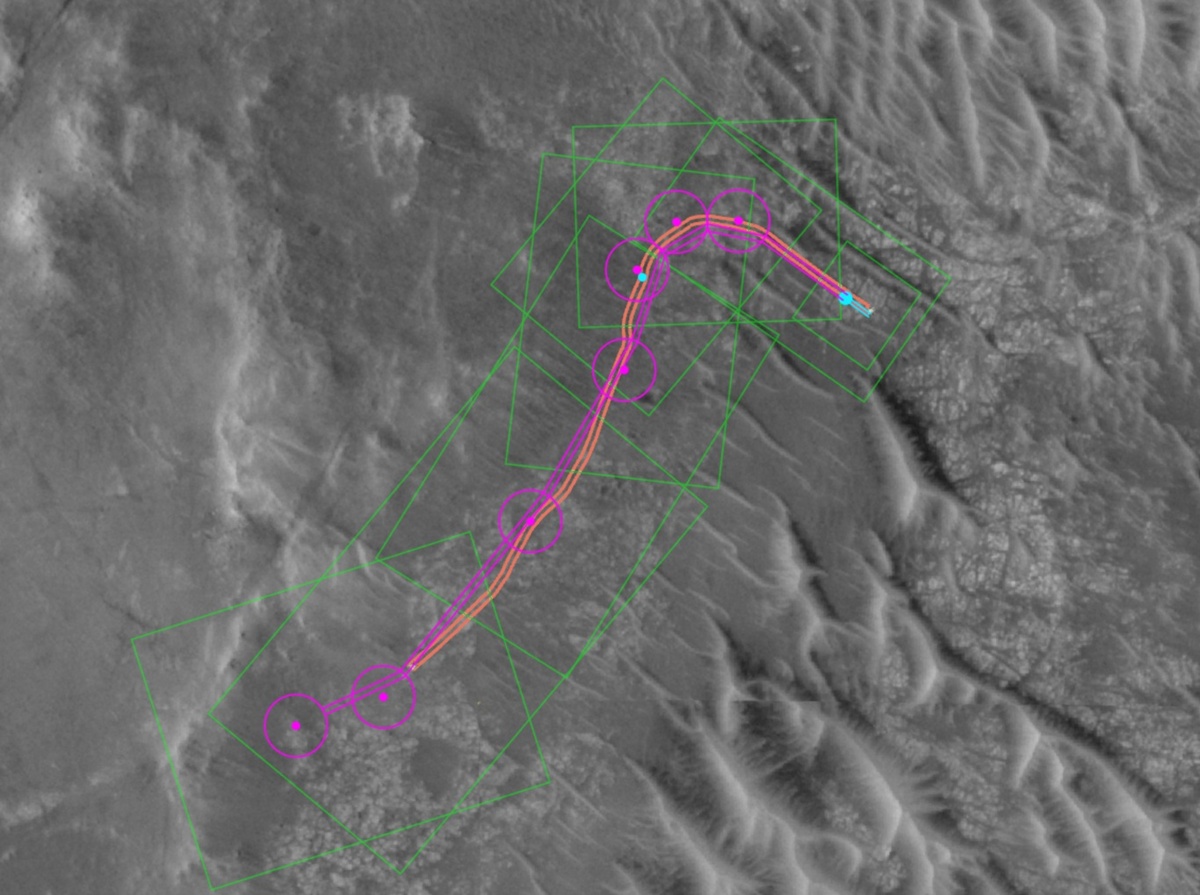
(Source:JPL)
The vast distance between Mars and Earth – averaging 140 million miles (approximately 225 million kilometers) – creates significant communication delays that make real-time control impractical. Traditionally, human planners have had to meticulously map out routes with waypoints spaced no more than 330 feet (approximately 100 meters apart), analyzing orbital and surface imagery, a time-consuming process for the Perseverance team. While Perseverance’s AutoNav system can avoid obstacles in real-time, pre-planning remains a substantial undertaking. Claude’s visual capabilities streamlined this process, making route planning safer and faster.
This collaboration between JPL and Anthropic reduces the workload on operations personnel, a critical benefit as NASA navigates budgetary constraints and workforce reductions. Robotics expert Vandi Verma anticipates that AI will enable Martian explorations covering kilometers-long distances, maximizing the potential for discovery. NASA Administrator Jared Isaacman praised the achievement as a responsible integration of technology, essential for missions to the Moon, Mars, and beyond. Since its launch in 2020, Perseverance has completed approximately 400 meters of AI-planned travel while exploring Jezero Crater, a site believed to hold evidence of ancient microbial life.
(首圖來源:NASA/JPL-Caltech, Public domain, via Wikimedia Commons)



科技新知,時時更新
jQuery(document).ready(function(){
jQuery('iframe').each(function(i){ var $this = jQuery(this); if ( $this.attr('data-src') ) { var data_src = $this.attr('data-src'); data_src += '&v=' + (new Date()).getTime(); $this.attr('data-src', data_src); } });
setIframe();
//lazy-iframe jQuery(window).scroll(function(){ setIframe(); }); });
