
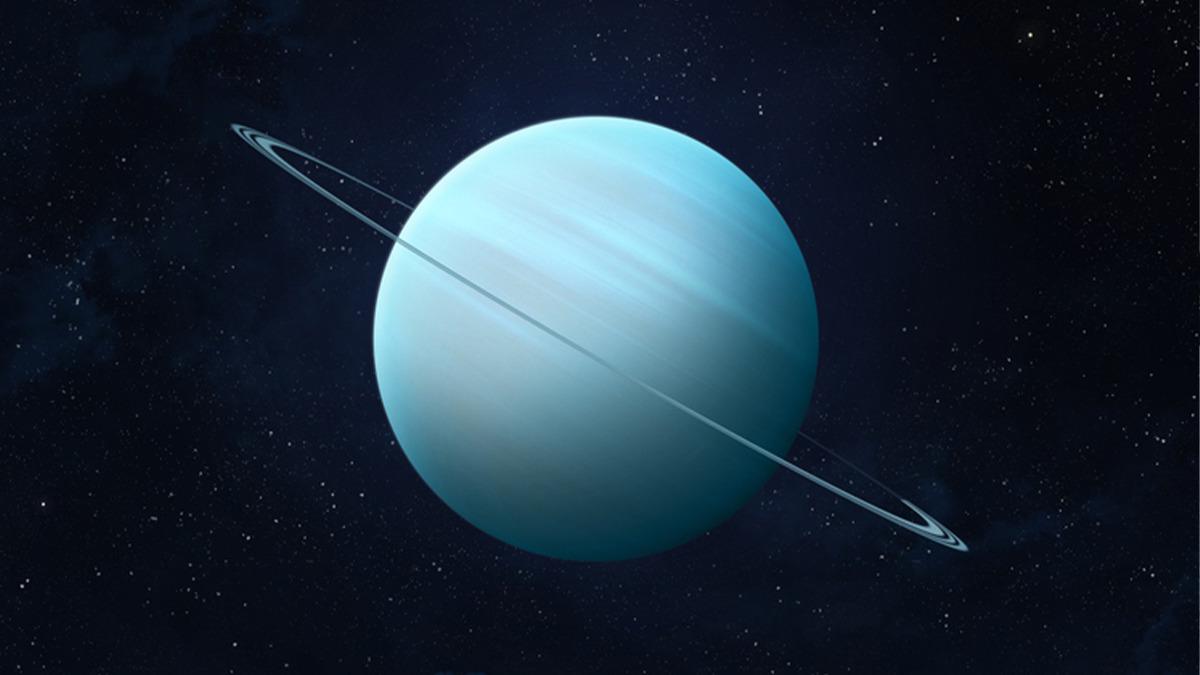
NASA researchers are delving into the mysterious composition of Uranus, revealing a planetary interior that defies traditional classifications of matter. The ice giant is primarily composed of water, ammonia, and methane existing in a supercritical phase—a state that is neither strictly solid nor liquid, which astronomers refer to as “ice” or volatiles.
This scientific curiosity was further explored during a rare celestial alignment in April 2025. A stellar occultation, occurring as Uranus passed in front of a distant star, provided scientists in western North America with a unique opportunity to measure atmospheric changes in exceptional detail. The study of supercritical fluids in planetary cores provides critical insights into the physics of extreme environments, pushing the boundaries of our understanding of matter.
Known as the seventh planet from the Sun, Uranus is the third largest in our solar system, measuring approximately four times the width of Earth. It is distinguished by its extreme cold—boasting the lowest minimum temperature of any planet at 49 K (−224 °C)—and a unique axial tilt of approximately 90 degrees. This extreme orientation causes the planet to appear to spin on its side relative to the plane of its orbit.
Our understanding of the planet has evolved from the January 1986 flyby of Voyager 2 to recent high-resolution imaging from the James Webb Space Telescope (JWST). Using its Near-Infrared Camera (NIRCam), the JWST has captured images of the planet’s seasonal north polar cap and its dim inner and outer rings.
Beyond its atmospheric anomalies, Uranus is surrounded by faint rings and 28 known moons. Among these are five major “literary moons”—Miranda, Ariel, Umbriel, Titania, and Oberon—named after characters from the works of William Shakespeare and Alexander Pope. These ongoing observations highlight the continued importance of deep-space instrumentation in decoding the composition of the solar system’s ice giants.
