
As the world shifts toward hydrogen as a key energy carrier, ensuring its safe and efficient use is paramount. Researchers at Chalmers University of Technology have developed a novel hydrogen sensor that overcomes a significant hurdle in the technology’s wider adoption: performance in humid environments. Unlike existing sensors, this new device not only functions effectively in the presence of moisture, but its accuracy increases with humidity, offering a potentially crucial safety advancement for hydrogen production, storage, and application.
As societies transition to cleaner energy sources, hydrogen is playing an increasingly vital role. But widespread adoption of this technology hinges on the development of effective hydrogen sensors capable of preventing the formation of flammable gas mixtures. Now, researchers at Chalmers University of Technology have unveiled a compact sensor designed for large-scale production, particularly suited for the humid environments where hydrogen is often present. Unlike current sensors, the new device actually performs *better* in humid conditions.
Photo: Chalmers University of Technology | Mia Halleröd Palmgren
Safety sensors are crucial wherever hydrogen is used, to detect leaks and prevent the buildup of explosive gas mixtures. A significant challenge has been that existing sensors don’t function optimally in humid environments – and hydrogen is frequently found in moist conditions. Researchers from Chalmers University of Technology have now presented a new sensor specifically designed for humid environments, and one that demonstrates improved performance as humidity increases.
“A hydrogen sensor’s performance can vary dramatically depending on the environment, and humidity is a key factor,” explained Athanasios Theodoridis, a doctoral candidate at Chalmers and first author of an article in the journal ACS Sensors. “Many sensors currently available become slower or less effective in humid conditions. When we tested our new sensor concept, we discovered that increasing humidity actually strengthened the hydrogen response. It took us some time to understand how this was possible.”
Hydrogen is an increasingly important energy carrier in the transportation sector, a raw material in the chemical industry, and a key component in the production of green steel. Water is also produced when hydrogen reacts with oxygen, releasing energy – as seen in fuel cells used to power hydrogen-fueled vehicles and ships. Fuel cells also require water to prevent the membranes separating oxygen and hydrogen from drying out.
Facilities that produce and store hydrogen are also constantly exposed to the surrounding air, where humidity levels fluctuate significantly with temperature and weather. Reliable sensors capable of withstanding harsh conditions are therefore needed to ensure that any escaping hydrogen doesn’t leak and create an explosive mixture. This research addresses a critical need for safer and more reliable hydrogen infrastructure.
The Sensor Uses Humidity to its Advantage
Table of Contents
The new humidity-friendly sensor from Chalmers is small enough to fit on a fingertip and contains incredibly tiny particles – nanoparticles – of the metal platinum. These particles act as both catalysts and sensors simultaneously. The platinum accelerates the chemical reaction between hydrogen and oxygen from the air, generating heat that “boils away” a layer of water on the sensor’s surface. The amount of hydrogen in the air determines how much of the water layer evaporates, and the humidity in the air controls the thickness of that water layer. By measuring the thickness of the water layer, the concentration of hydrogen can be determined. Because the water layer thickens as humidity increases, the sensor’s effectiveness increases proportionally. The results of this process are read using an optical phenomenon called plasmons, where the platinum nanoparticles capture light and give it a distinct color. Changes in the surrounding hydrogen concentration alter the nanoparticles’ color, triggering an alarm when critical levels are reached.
Development of plasmonic hydrogen sensors at Chalmers has been ongoing for many years. Professor Christoph Langhammer’s research group has achieved several breakthroughs in the field, improving the sensors’ speed and sensitivity, as well as optimizing the sensor’s response and humidity tolerance with the help of artificial intelligence. Previously, the group’s sensors were based on nanoparticles of the metal palladium, which absorbs hydrogen in a similar way to a sponge absorbing water. The new platinum-based concept, developed within the TechForH2 competence center at Chalmers, creates a new type of sensor – a catalytic plasmonic hydrogen sensor – that opens up new possibilities.
“We tested the sensor for over 140 hours of continuous exposure to humid air,” Theodoridis said. “The tests showed it is very stable at different humidity levels and reliably detects hydrogen under these conditions, which is important for real-world applications.”
The Energy Transition Drives Demand for Improved Sensors
According to the researchers’ measurements, the sensor detects hydrogen down to the “parts per million” range – 30 ppm, or three thousandths of a percent – making it one of the most sensitive hydrogen sensors in humid environments currently available.
“There is currently high demand for sensors that perform well in humid environments,” said Christoph Langhammer, professor of physics at Chalmers. “As hydrogen plays an increasingly important role in society, there is a growing need for sensors that are smaller, more flexible, and can be manufactured on a large scale at a lower cost. Our new sensor concept meets these requirements well.” He also noted that future hydrogen sensors may require a combination of different materials to function effectively in all types of environments.
“We anticipate needing to combine different types of active materials to create sensors that perform well regardless of the environment. We now know that some materials provide speed and sensitivity, while others are more tolerant of humidity. We are now working to apply that knowledge going forward,” Langhammer added.
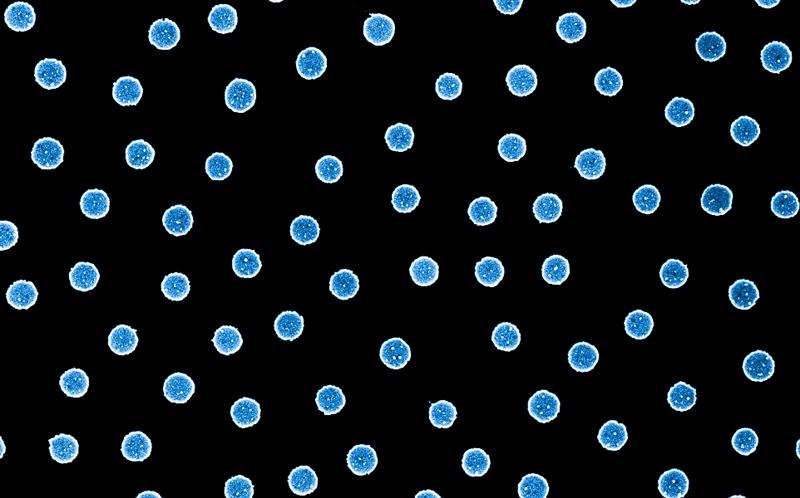
The new hydrogen sensor from Chalmers is based on incredibly small particles of the metal platinum. The particles function as both catalysts and sensors, and the sensor is well-suited for humid environments, even performing better as humidity increases. (The platinum particles in this microscopic image have been colorized in an image processing program.)
Photo: Chalmers University of Technology | Athanasios Theodoridis
More About the Research:
The article A Catalytic-Plasmonic Pt Nanoparticle Sensor for Hydrogen Detection in High-Humidity Environments was published in ACS Sensors on November 18, 2025. It was written by Athanasios Theodoridis, Carl Andersson, Sara Nilsson, Joachim Fritzsche, and Christoph Langhammer, all of whom were affiliated with the Department of Physics at Chalmers University of Technology during the research.
The sensor was developed in Chalmers’ cleanroom (nanofabrication laboratory Myfab) and Chalmers’ materials analysis laboratory (CMAL), under the umbrella of Chalmers’ strength area Nano.
The research was funded by the Swedish Foundation for Strategic Research, the Knut and Alice Wallenberg Foundation, Vinnova, and the TechForH2 competence center, of which Chalmers University of Technology is the host. TechForH2 is supported by the Swedish Energy Agency, Volvo, Scania, Siemens Energy, GKN Aerospace, PowerCell, Oxeon, RISE, Stena Rederier AB, Johnsson Matthey, and Insplorion.
Research leader Christoph Langhammer is one of the founders of Insplorion, a company that started through Chalmers’ entrepreneurship school fifteen years ago. Last year, the company launched its first hydrogen sensor based on the nanoplasmonic technology.
For More Information, Contact:
Athanasios Theodoridis, doctoral candidate, Department of Physics, Chalmers University of Technology, [email protected]
Christoph Langhammer, professor, Department of Physics, Chalmers University of Technology, 031 772 33 31, [email protected]
Christoph Langhammer speaks English, Swedish, and German. Athanasios Theodoridis speaks English and Greek. Chalmers has podcast studios and film equipment on site and can assist with requests for TV, radio, or podcast interviews.
Read Previous Press Releases About Chalmers-Developed Hydrogen Sensors:
Ultra-sensitive sensor can reduce the risks of hydrogen
World’s fastest hydrogen sensor paves the way for clean energy
Read More Press Releases from Chalmers About Hydrogen:
Hydrogen from solar energy can now be produced efficiently without the scarce metal platinum
The best hydrogen for heavy transport is locally produced and green
Mia Halleröd Palmgren
Press Officer
031 772 32 52
[email protected]
________________
Chalmers University of Technology in Gothenburg conducts research and education in technology and natural sciences at a high international level. The university has 3,100 employees, 10,000 students, and educates engineers, architects, and naval officers.
With scientific excellence as its foundation, Chalmers develops expertise and technological solutions for a sustainable world. Through global engagement and entrepreneurial spirit, we create innovation power, in close collaboration with the rest of society.
Chalmers was founded in 1829 and still has the same motto: Avancez – forward.
—
It is permitted to download, distribute, and use attached images and illustrations, unless otherwise stated, for publications in connection with Chalmers press releases as long as Chalmers and the photographer/illustrator are credited where possible. It is permitted to crop and adjust the material to adapt the format for publication, but it is not permitted to rework the original in such a way that it changes the original meaning. The material is intended for editorial use. Commercial use, as part of marketing goods and services, is not permitted.
We want Chalmers and our photographers and illustrators to be named in connection with publication where possible according to the following model:
- Photo: Chalmers University of Technology| First Name Last Name
- Graphic/Illustration: Chalmers University of Technology| First Name Last Name
