
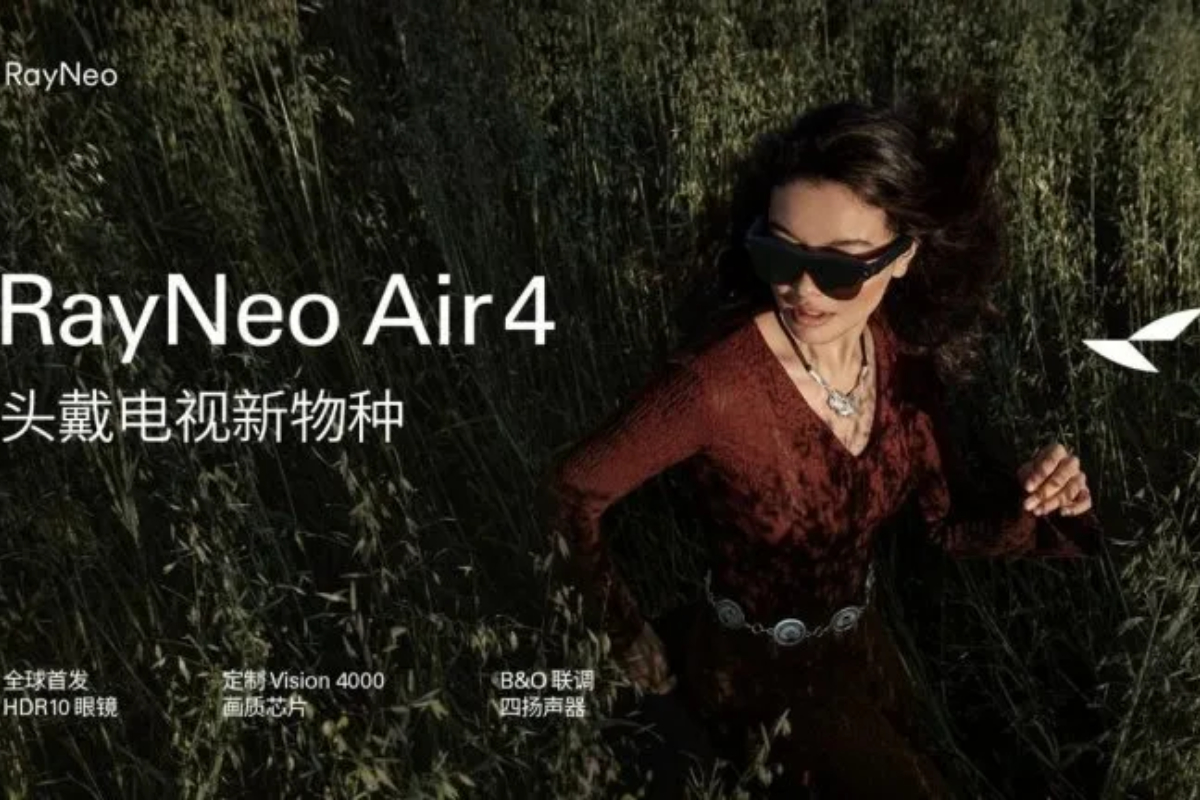
RayNeo Launches Air 4 AR Glasses with World’s First HDR10 Display
RayNeo today announced the launch of its RayNeo Air 4 augmented reality (AR) glasses, featuring what the company claims is the world’s first HDR10 display system for AR devices.
The RayNeo Air 4 utilizes a custom AR processor developed in collaboration with Pixelworks, supporting both HDR10 and AI HDR display technologies. This allows the glasses to automatically convert video content to HDR10, enhancing realism, and even process standard two-dimensional video into three-dimensional video. The glasses boast a 5.5G OLEDoS display with a 120Hz refresh rate, a peak brightness of 1,200 nits, and a color palette of 1.07 billion colors. This advancement in display technology could significantly improve the immersive experience of AR applications.
Audio quality has also been a focus, with RayNeo partnering with Bang & Olufsen (B&O) to refine a quad-speaker system. The collaboration resulted in a system that reportedly reduces sound loss by up to 80%, delivering clearer and deeper audio. The RayNeo Air 4 is currently available for purchase in China in two models: the standard Air 4 at 1,599 yuan (approximately $220 USD) and the Air 4 Pro at 1,699 yuan (approximately $235 USD). These prices are notably lower than competitors like XREAL and Lenovo, positioning RayNeo as a more accessible option in the growing AR market; you can learn more about the broader augmented reality market size on Statista.
Unlike standalone AR headsets such as the Apple Vision Pro, the RayNeo Air 4 functions as a display and speaker connected to another device, avoiding the need for an internal operating system. However, potential users should be aware that, as with other AR glasses, motion sickness can be a concern due to the way the display tracks head movements. For a deeper understanding of the differences between AR and VR technologies, see TechTarget’s definition of augmented reality.
RayNeo officials stated they plan to expand availability of the Air 4 to additional markets in the coming months.
RayNeo has announced the launch of its newest augmented reality (AR) glasses, named RayNeo Air 4. They are touted as the world’s first AR glasses to incorporate an HDR10 display system, powered by the Vision 4000 processor, which was developed in collaboration with Pixelworks.
The HDR10 display system is an open standard for High Dynamic Range (HDR) content, designed to boost brightness, enhance image clarity and deliver more vivid and dimensional colours. The display technology has been widely adopted because it is a free-to-use standard, making it a popular choice for device manufacturers.
RayNeo’s custom AR processor supports both HDR10 and AI HDR display technologies. Furthermore, it is capable of processing AI video, which can convert standard two-dimensional video into three-dimensional video in a few simple steps.
The RayNeo Air 4 can also automatically convert video content to HDR10 for increased realism. It features a 5.5G OLEDoS display with a 120Hz refresh rate, a peak brightness of 1,200 nits, and renders a precise and sharp colour palette of 1.07 billion colours.
Photo: rayneo.com
For audio, the RayNeo Air 4 features enhancements to its quad-speaker system, driven by a digital to analogue converter (DAC) and an extra-large polymer diaphragm. RayNeo collaborated with the renowned Danish audio brand Bang & Olufsen (B&O) to fine-tune the sound performance, resulting in clearer and deeper audio while reportedly reducing sound loss by up to 80%.
The RayNeo Air 4 is now on sale in China, offered in two variants: the standard RayNeo Air 4, priced at 1,599 yuan (7,350 Thai baht), and the RayNeo Air 4 Pro, which retails for 1,699 yuan (7,800 baht).
The RayNeo Air 4 is priced significantly lower than previously released competitors, such as XREAL, which starts at 15,990 baht, or the Lenovo Legion Glasses 2 at 11,190 baht. How do AR glasses differ from Apple Vision or Galaxy XR? AR glasses do not have an internal operating system; they function only as a monitor and speakers.
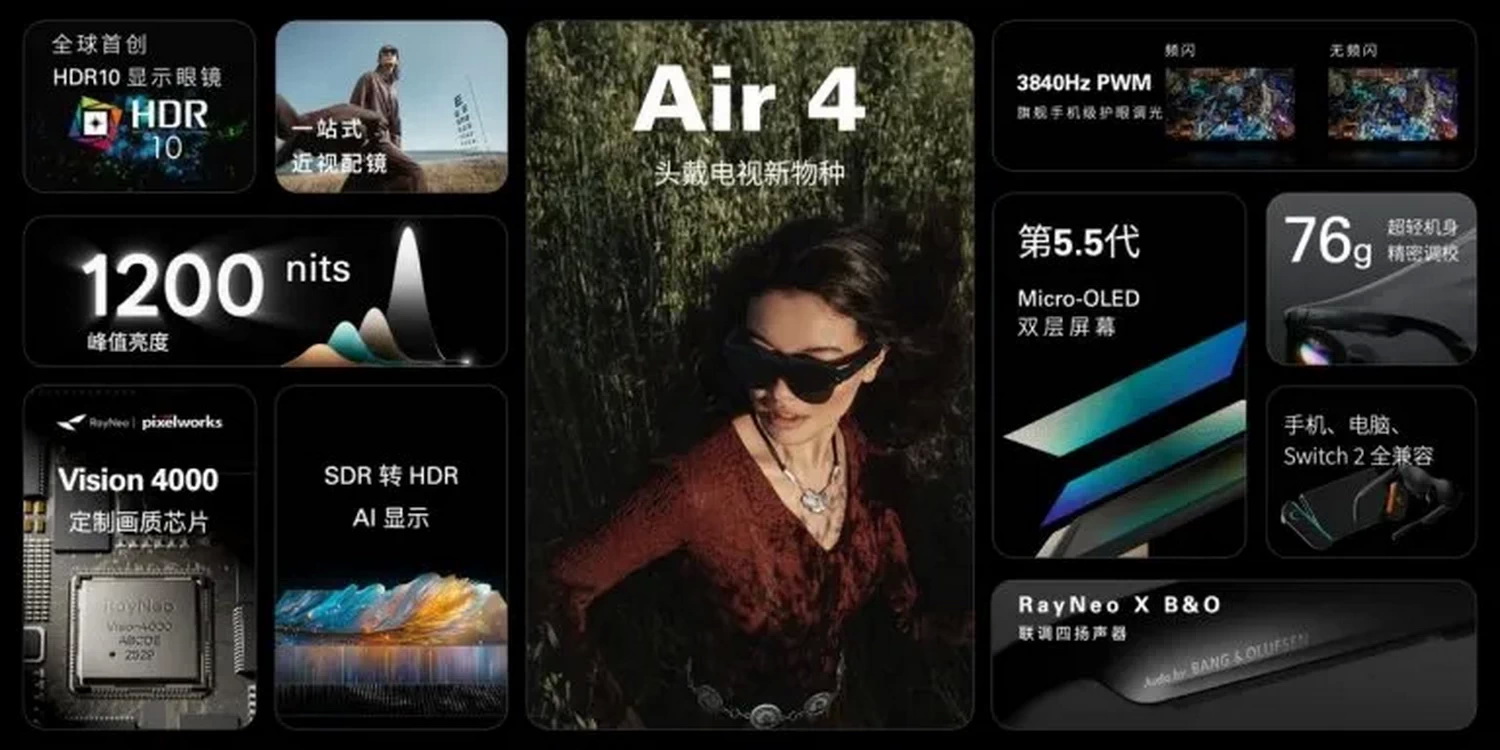
Photo: rayneo.com
Having personally tested the AR glasses from XREAL, I can attest that the advantages include their design, often resembling sunglasses, which makes them lightweight and portable. Users with nearsightedness or farsightedness can have an optician make lenses for improved visual clarity. Concerns over software update limitations are also mitigated as the glasses rely entirely on the OS of the connected device.
Conversely, a major drawback is the high price point given that the AR glasses serve only as a monitor and speakers. A comparable 14- or 16-inch portable monitor costs only between 2,645 and 3,760 baht. Crucially, AR glasses may not suit individuals prone to motion sickness.
Based on my trials, unlike a VR headset where the screen remains fixed relative to your head movement, the AR display tracks your head turns. This can cause the screen image to jump noticeably if viewing content, such as a film, while travelling over rough roads, as the image moves with your head; even simple head turning caused me slight dizziness.
Source: rayneo

