

With over 3 million votes tallied, Senator Paloma Valencia of the Centro Democrático party has secured her place as a leading contender in Colombia’s presidential race, setting the stage for a potentially historic election this May. The outcome of the Gran Consulta, a multi-party mechanism designed to unite the center-right political spectrum, signals a significant shift in the Colombian political landscape.
Valencia’s victory on Sunday, March 8, 2026, comes as a surprise to some observers, not because of her win within the consulta, but due to the scale of her support. She garnered 45.7% of the votes cast across the three consultas, exceeding expectations and surpassing the results of Iván Cepeda in the 2025 Pacto Histórico consultation, which saw 1.522.347 votes. “Each vote is a seed in my heart that I long to notice sprout; we will win the presidency together,” Valencia proclaimed in her victory speech in Bogotá.
Valencia’s campaign has received strong support from former President Álvaro Uribe Vélez, and she has positioned herself as a strong critic of the current government led by Gustavo Petro, particularly regarding security, health, and economic policies. The result underscores the enduring influence of Uribe’s political movement within Colombia.
Juan Daniel Oviedo, a former Bogotá councilman, secured the second-highest vote share with 17.8% of the total, exceeding the performance of other center-right contenders like former Senator Juan Manuel Galán, ex-Minister Juan Carlos Pinzón, and journalist Vicky Dávila. Valencia acknowledged Oviedo’s strong showing, stating, “Juan Daniel, you ran a campaign that made us all envious… you are free and perfect just as you are.”
The first round of the presidential election is scheduled for May 31, 2026. Valencia will face Iván Cepeda, a candidate backed by Petro’s Pacto Histórico coalition, who is currently favored to win the first round according to most polls. She will similarly contend with Abelardo de la Espriella, a far-right lawyer who has attracted support from Uribe’s base and could potentially siphon votes from the Centro Democrático candidate.
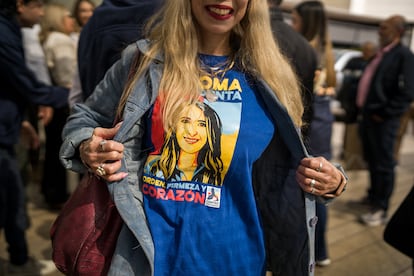
Valencia, 48, hails from Popayán and has been a loyal supporter of Uribe, whose party has established a significant electoral machine over the years. She is the granddaughter of former President Guillermo León Valencia and comes from a family with a long history in conservative politics. Her great-aunt Josefina Valencia was a leader in the early suffragist movement. Valencia was first elected to the Senate in 2014 and has held her seat since then.
This marks Valencia’s third attempt to secure her party’s presidential nomination. She previously stepped aside in 2018 to support Iván Duque, who went on to win the presidency, and lost an internal poll to Óscar Iván Zuluaga in 2022. The process to select a unified candidate was marked by tragedy with the assassination of Senator and fellow aspirant Miguel Uribe Turbay last year, a loss Valencia acknowledged in her victory speech.
The potential for a female president remains a significant factor in the election. No woman has ever reached a second-round runoff in a Colombian presidential election. Valencia will also demand to appeal to centrist voters, who may be divided between Claudia López, also a winner in a separate consultation, and Sergio Fajardo, who opted to enter the first round directly, as reported by El País.
In the coming days, Valencia is expected to announce her vice-presidential running mate, a decision that could prove crucial to her campaign. She has even floated the possibility of Uribe as a running mate, a proposal that has drawn criticism and raised legal questions. Meanwhile, Oviedo has emerged as a potential running mate who could attract more moderate voters, fueled by social media buzz and a response to controversial comments made by de la Espriella, as Infobae reports.
