
A tiny wasp has evolved a remarkable and targeted method of controlling its host: it injects a virus that effectively castrates the caterpillar it parasitizes. This discovery, published in the journal PNAS, offers modern insights into biological pest control and could lead to innovative strategies for protecting crops.
The wasp, Cotesia vestalis, lays its eggs inside the larvae of the diamondback moth, Plutella xylostella, a major pest of crops in the brassica family – including cabbage, kale, and broccoli – causing billions of euros in damage annually. Researchers have now identified how the wasp disables its host, specifically targeting the development of the caterpillar’s testicles.
Unlike traditional parasites that weaken a host without killing it, parasitoids like C. Vestalis ultimately lead to the host’s death. But the mechanism behind this process remained a mystery until now. Scientists discovered the wasp delivers a virus alongside its eggs, a virus that has turn into integrated into the wasp’s own DNA.
The virus evades the caterpillar’s immune system and then delivers a crucial blow: one of its genes codes for an enzyme, PTP, that interferes with Rad9A, a protein essential for regulating programmed cell death – apoptosis – in the insect’s developing sex organs. This disruption leads to the destruction of the caterpillar’s developing testes.
Researchers observed abnormalities in the sperm-producing cells of infected caterpillars, with the nuclei of cells becoming wrinkled and containing unusual spherical vesicles. By the final stage of larval development, the testicles were significantly smaller in infected caterpillars compared to those not exposed to the virus. The virus’s destructive effect intensified as the caterpillar grew, ultimately leading to the death of 95% of the testicular cells.
To determine if this mechanism was widespread, the team also infected larvae of the fruit fly, Drosophila melanogaster, a common model organism in biological research. The viral enzymes triggered accelerated cell death in the fruit fly’s testicular tissues, a previously unobserved phenomenon in Drosophila, according to the study.
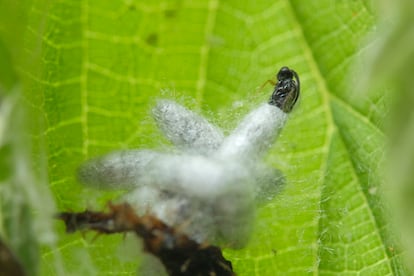
While the wasp parasitizes both male and female larvae, this study focused on the molecular mechanism affecting males. Researchers are now investigating the impact on female larvae, with preliminary data suggesting a similar effect on ovary development. This research could have significant implications for biological pest control strategies.
There are approximately 10,000 species of parasitoid wasps in Spain, but relatively few entomologists dedicated to studying them. Researchers are increasingly interested in harnessing the power of these natural enemies to combat agricultural pests. This discovery highlights the complex interactions within ecosystems and the potential for nature-based solutions to reduce reliance on chemical pesticides.
Insect Control Without Insecticides
Globally, an estimated 1 to 2 billion euros are spent annually on controlling diamondback moth infestations, primarily on insecticides, with increasing awareness of the associated environmental and health impacts. Total losses, including crop damage, reach approximately 5 billion euros. Finding natural alternatives could offer substantial economic and environmental benefits.
“While C. Vestalis is not currently used in agriculture in Spain,” says Paco Cara, a biologist and manager at Entonova, a company specializing in biological pest control, “other wasps, such as Anagyrus vladimiri, are used to control scale insects on citrus and table grape crops.” The braconid wasp Afidius colemani has also been used in greenhouses in southeastern Spain for two decades to control aphids. A key factor for commercial use is the ability to mass-rear these wasps for release.
The Chinese researchers are already exploring ways to go beyond simply releasing wasps to control pests. “Both the viral protein PTP and the host target, Rad9A, could be used in the development of new pest control strategies,” says Wang. She suggests using harmless bacteria, fungi, or viruses to deliver the viral protein, creating a biopesticide, or targeting the protein that controls the development of the caterpillars’ reproductive organs. If the mechanism used by C. Vestalis is common among parasitoid wasps, it could significantly reduce the necessitate for artificial insecticides.
