
NASA’s Perseverance rover has taken a significant step toward autonomous exploration, recently completing its first journey on Mars planned entirely by artificial intelligence. The successful test, conducted between December 8th and 10th, demonstrates a leap forward in the agency’s ability to navigate the Red Planet more efficiently – a key capability as Perseverance continues its mission to seek signs of ancient microbial life in the Jezero Crater [1]. This advancement paves the way for longer, more complex missions with reduced reliance on Earth-based control.
The Perseverance rover has successfully completed its first autonomously navigated route on Mars, a milestone achieved using artificial intelligence. Launched as part of the Mars 2020 mission, Perseverance is designed to investigate the Red Planet’s past habitability, study its geology, and collect rock samples for eventual return to Earth. The rover began its exploration in the Jezero Crater, a region believed to have once held a river.
Perseverance relies on a suite of scientific instruments to analyze the Martian environment in real-time, performing both mineralogical and structural assessments. The ability for the rover to independently chart its course represents a significant step toward more efficient and ambitious planetary exploration.
Navigating the Martian surface presents unique challenges, including uneven terrain, rocks, slopes, and sandy soil. To overcome these obstacles, Perseverance is equipped with a six-wheel drive system specifically engineered for the conditions. However, the considerable communication delay between Earth and Mars prevents real-time control. The rover utilizes sensors and cameras to map the terrain, avoid hazards, and select safe paths.
Perseverance
Table of Contents
Launched in 2020, the Perseverance rover is NASA’s latest mission to explore Mars, building on the work of its predecessor, Curiosity. The primary goal of the mission is to determine whether Mars once had the conditions necessary to support microbial life. Perseverance conducts on-site analysis of the mineralogical and chemical composition of rocks and soil, searching for preserved biosignatures.
The rover is currently operating within the Jezero Crater, a region exhibiting evidence of an ancient river system and a high potential for preserving signs of past life. This location was strategically chosen to maximize the chances of discovering evidence of ancient Martian life.
Beyond characterizing the Martian environment, Perseverance is also tasked with collecting and storing rock samples for future return to Earth. The mission also serves as a testbed for technologies intended to support future human exploration, such as the MOXIE experiment, which has successfully demonstrated the production of oxygen from the carbon dioxide-rich Martian atmosphere.
Journey Across the Martian Surface
Perseverance traverses the Martian surface using six wheels coupled with a suspension system designed to maintain stability on uneven terrain. Each wheel has independent motors, providing precise control over traction and steering, and enabling the rover to turn in place. Movement commands are sent from Earth, based on images and topographical data collected by the rover itself and orbiting spacecraft.
Due to the communication delay between Earth and Mars – which can take several minutes for signals to travel in either direction – movements are not controlled in real-time. Instead, engineers plan detailed sequences of commands that specify speed, direction, and distance before execution. During movement, sensors continuously monitor parameters and automatically halt the rover if any issues are detected.
Leveraging AI
Between December 8th and 10th, Perseverance completed journeys with routes planned and optimized using artificial intelligence. In this experiment, conducted by NASA, generative AI models were used to define the rover’s path. The AI analyzed high-resolution orbital images obtained by the HiRISE camera on the Mars Reconnaissance Orbiter, combined with data on terrain slope derived from simulated models.
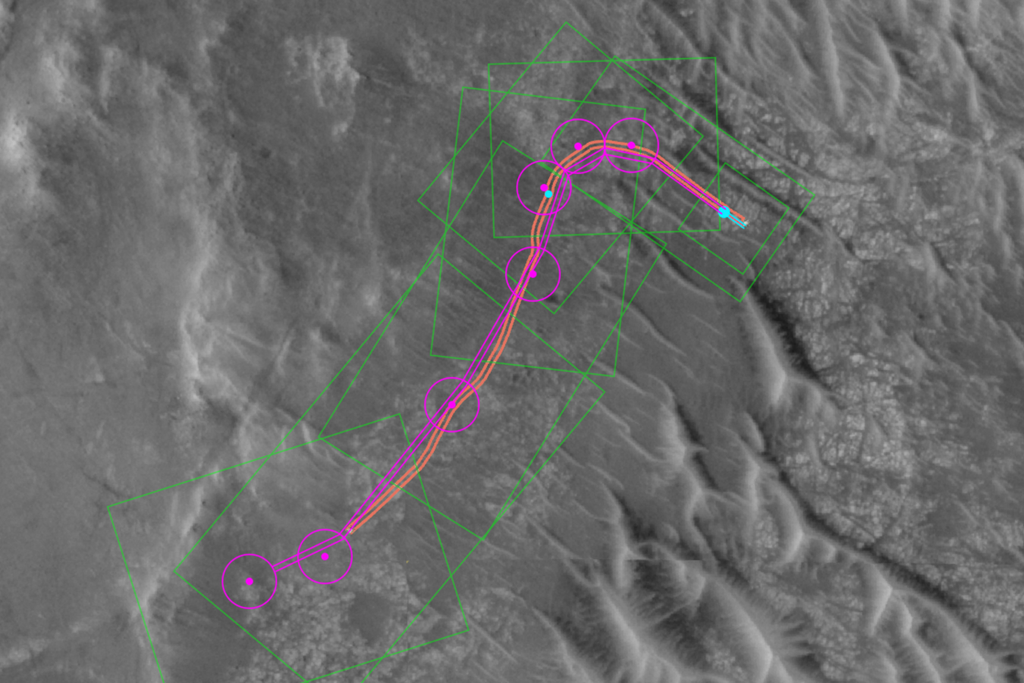
Based on this data, the system identified and classified features such as exposed rock, outcrops, and sand ripples, generating a continuous and safe path to the destination. Before sending the commands to Mars, the AI-generated instructions were validated by a virtual replica of Perseverance used to simulate the journey and verify over 500,000 variables. This represents a significant advancement in the autonomy of robotic exploration in planetary environments.
Generative AI in Science
Generative AI is a class of models capable of learning complex patterns from large volumes of data. This allows the AI to generate new representations, predictions, or decisions. In space applications, such as interpreting planetary terrain images, identifying obstacles like rocks and ripples, estimating vehicle position, and determining safe routes, generative AI automates tasks that previously required intensive human intervention.
These models have the potential to enable rovers and other surface systems to traverse kilometers with greater autonomy. In addition to optimizing route planning, generative AI can analyze large volumes of images and scientific data to highlight areas of interest for researchers. Integrated into rovers, helicopters, and drones as embedded systems, this technology represents a step toward enabling more robust and independent planetary exploration infrastructure.
News Reference
NASA’s Perseverance Rover Completes First AI-Planned Drive on Mars
