
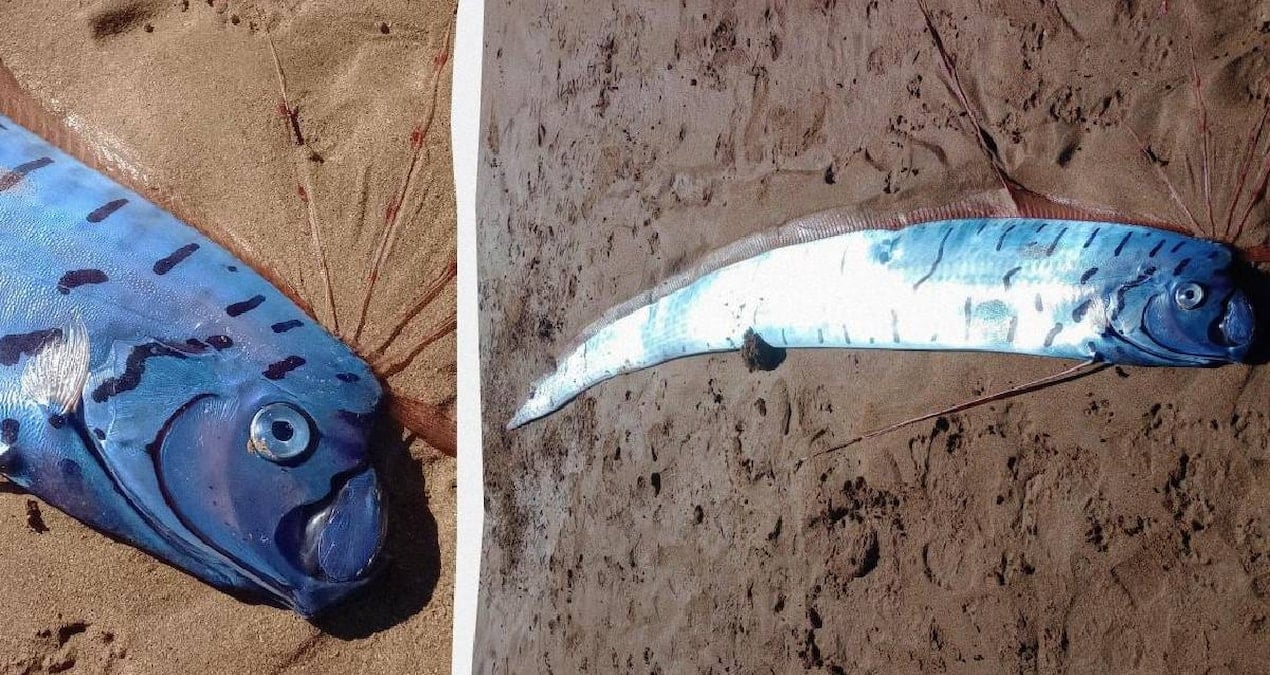
A recent sighting off the coast of Tasmania has brought a rarely-seen deep-sea creature into focus, captivating both scientists and the public. The appearance of the animal, believed to be an oarfish – the world’s longest bony fish – has sparked a reminder of the ocean’s enduring mysteries and the folklore surrounding them. The sighting, reported by a local resident walking Preservation Bay beach, underscores how little is still known about life in the ocean depths and the creatures that occasionally drift into view.
A rare sighting off the coast of Tasmania has sparked both scientific interest and echoes of ancient folklore. A man walking his dog on Preservation Bay beach encountered an unusual creature – a large, ribbon-like animal with distinctive, wave-like appendages along its head and jaw.
Tony Cheeseman, the witness, described the animal as something he had never seen before. “It was a bright creature,” he said, recalling the encounter. The sighting has prompted experts to believe the animal is likely a giant oarfish, a deep-sea species rarely observed near shore.
KIYAMET BALIĞI ÇOK NADİR GÖRÜLÜYOR
Macquarie University Professor Culum Brown explained that oarfish are distinguished by their elongated, serpentine bodies and continuous dorsal fin. “They are quite rare,” Brown stated, adding that these fish typically inhabit depths between 200 and 1500 meters, and only occasionally surface, often when weakened. “Sometimes they are seen in nearshore areas for no apparent reason.”
The appearance of the oarfish has also stirred cultural beliefs, particularly in Japan, where the creature – known as “ryūgū-no-tsukai,” or “messenger of the sea god” – is considered a harbinger of earthquakes or tsunamis. Despite these long-held superstitions, scientific research has found no correlation between oarfish sightings and natural disasters.
JAPON FOLKLORUNDA “FELAKET HABERCİSİ” OLARAK BİLİNİYOR
Historical records reveal that oarfish were frequently mistaken for sea serpents by sailors in the 18th and 19th centuries. An Australian newspaper in 1878, for example, reported a “sea serpent” sighting near Penguin, Tasmania, with an illustration resembling an oarfish. This misidentification contributed to the creature’s almost mythical status, alongside giants like the squid.
The oarfish’s unusual appearance, size, and rarity have cemented its place in maritime lore. The sighting underscores the mysteries that still lie hidden in the world’s oceans and the enduring power of folklore to shape perceptions of the natural world.
DENİZ YILANI EFSANELERİYLE DE İLİŞKİLENDİRİLİYOR
According to Professor Brown, the fish’s bright appearance and unusual size contribute to its almost legendary status. The development highlights the continued fascination with undiscovered or rarely seen marine life.
