
Nearly 200 tourists, the majority from Argentina, were victimized by a sophisticated rental scam in the Chilean resort city of Viña del Mar, losing upwards of $1,300 each to a fraudulent “apart-hotel” operation. The scheme, which utilized social media advertising and impersonated legitimate businesses, has prompted a police inquiry and underscored the growing risk of online vacation rental fraud. Authorities have yet to locate the perpetrator, whose online activity briefly included a public plea for forgiveness quoting scripture, while the investigation continues to trace funds and digital footprints as far as Easter Island.
More than 100 tourists paid up to $2,000 in rent for fraudulent apartment listings in the Chilean resort city of Viña del Mar and don’t expect to recover their money. The elaborate scam, targeting primarily Argentinian travelers, has prompted a police investigation and raised concerns about online rental fraud. Beyond a plea for forgiveness quoting the Psalms, little is currently known about the alleged perpetrator.
Throughout several days this summer, a troubling scene played out in Reñaca: families arriving from Argentina, weary from their travels, only to find their confirmed reservations were nonexistent. Or, worse, they arrived at the address only to be met with a stark message at the front desk of the Holiday Park building on Angamos Street: “You’ve been scammed.”
The scheme centered on identity theft, utilizing paid advertisements on Instagram starting in August, an appealing TikTok account, photos of a legitimate apartment within the Holiday Park complex – managed by Chilean resident Egon Pfaff – and reviews copied from Booking.com. The scammer also used WhatsApp numbers with Meta’s blue checkmark and links to payment platforms with international backing.
Behind the sophisticated operation was a fraudulent “apart-hotel” calling itself “Holiday Reñaca,” capitalizing on the reputation of the well-known Holiday Park. The scammer allegedly targeted nearly 200 families, the majority from Mendoza, Argentina.
Details about the suspect remain scarce. Their phone number now directs callers to voicemail, and their IP address was traced to Rapa Nui (Easter Island). There has been no word on refunds.
The suspect briefly posted a plea for forgiveness online, quoting from the Book of Psalms, which quickly went viral on social media: “Have mercy on me, O God, according to your love; in your great compassion blot out my transgression. Wash me thoroughly from my iniquity, and cleanse me from my sin.”
Confusion with the Real Holiday Park and Losses Exceeding $1,300
Table of Contents
- Confusion with the Real Holiday Park and Losses Exceeding $1,300
- The Reñaca Scammer’s Method: Friendly WhatsApp Chats and Large Transfers
- Another Victim in Reñaca: “The Fireworks Were Expensive”
- The Real Owner: Identity Theft and a Fictitious Wife
- Status of the Investigations into the Tourist Scam in Reñaca
Ignacio Almenara was among the first to fall victim to the scam. Like many travelers from Mendoza, he believed he recognized the property from an Instagram advertisement and traveled to Reñaca in December with five friends.
He had stayed at the actual Holiday Park in Reñaca the previous summer. When he encountered the offer for “Holiday Reñaca” a few months later, he assumed it was the same complex with a refreshed image.
“Seeing the verified badge, I assumed it had been updated,” Almenara told BioBioChile. “There were six of us for 13 nights, and we communicated with that WhatsApp number. They responded rather abruptly, almost eager to finalize the payment.”
The offered apartment was spacious, well-located (“with a sea view”), and included a 20% discount for payment through the now-defunct website holidayrenaca.com. On November 2, the group transferred $1,328 (approximately 1.2 million Chilean pesos) to secure their accommodations for New Year’s celebrations in the Valparaíso Region.
By Christmas, responses from the supposed lodging began to slow. They never received a confirmation email or check-in details. The realization that they had been scammed came on December 30, when Almenara saw a post from local real estate agency RyH Propiedades warning about a scam operating under the name “Holiday Reñaca.”
The WhatsApp number stopped responding, and the legitimate Holiday Park began appearing on Google Maps with a flood of negative reviews. The latest detail was particularly unsettling: checking the payment link revealed the scammer’s IP address had changed to Easter Island.
A couple from Mendoza, Valentina Funes and Facundo Maldonado, played a key role in uncovering the scam. They work as real estate agents in Reñaca and are a trusted resource for tourists.
On December 27, a man approached the Holiday Park on Angamos Street inquiring about renting “two apartments with three bedrooms” – a nonexistent arrangement. “You’ve been scammed,” Valentina told him, as she frequently enters and exits the complex.
As more Argentinian tourists arrived to find their reservations fraudulent, Valentina helped relocate those she could and guided them to file reports with the Investigative Police (PDI).
In an interview with BioBioChile, the real estate agent noted that some of the fraudulent listings offered prices “much lower than the market rate, when a night in Reñaca costs around 90,000 Chilean pesos.” She estimated that approximately 200 families, including one from Peru, had been affected by the scam.
The Reñaca Scammer’s Method: Friendly WhatsApp Chats and Large Transfers
Alfonsina, also from Mendoza, traveled to Reñaca with her husband and three children (ages 16, 11, and 5), along with her father and sister, on January 5. The family had rented two apartments through the infamous “Holiday Reñaca.” All communication was via WhatsApp with a supposed receptionist named “Marcela,” who responded quickly and professionally.
“At one point, I asked if I could call, and the answer was no,” Alfonsina told BioBioChile. Despite this, she proceeded with the reservation because the price was competitive and the building appeared legitimate. The first red flag: her credit card was repeatedly declined. She was then asked for the 16-digit card number and security code, which she refused to provide.
“The only way to pay was through a payment link to a platform called Flow. And I couldn’t pay. I tried many times, but it wouldn’t go through. I called the bank. The card was enabled. It was clearly designed to prevent credit card payments,” she said.
“Marcela” offered an alternative: a money transfer. “Everything was resolved with a Global 66 transfer, which is like Western Union. But because I don’t have a bank account, I can’t file a claim,” Alfonsina explained, transferring approximately $2,000.
“Despite having the receipts and everything, there’s no one to file a claim with,” she lamented.
As their departure date for Chile approached, Alfonsina messaged “Marcela” again on WhatsApp, but received no response. Her suspicions were confirmed. “There were things that seemed strange to me, like the informal payment method. Also, I haven’t had problems with my credit card on previous trips to Chile. So it was odd that it wouldn’t work. I also hadn’t received a confirmation email.”
“It took me a while to process it, but the vacation date was approaching, so I looked for a Plan B to see if I could find something cheaper,” she said.
She eventually found accommodations through Airbnb: “A house from January 5th to 15th in Reñaca. We managed to find a place so we could still come.”
“I think the person who committed the fraud realized that if everyone paid with a credit card, they could report it. They did it very well with me because I transferred all the money through Global 66. There’s no chance of getting it back,” she resignedly stated.
“My sister did contact other people in the same situation. But beyond discussing it, there’s not much that can be done. Sometimes you have to choose your battles,” she added.
Another Victim in Reñaca: “The Fireworks Were Expensive”
Maricel Bonanno, also from Mendoza, arrived in Reñaca for New Year’s with six people, including her dog. She paid 350,000 Chilean pesos for three nights after seeing a paid advertisement on Instagram that led to a WhatsApp chat. The contact was also “Marcela,” friendly and attentive, even agreeing to accommodate her poodle.
The truth came to light a few days later when Maricel asked “Marcela” a common question: “Do I need to bring bed linens?” She received no reply. Upon inquiring at the building’s reception on December 30, she was given a familiar response: “You’ve been scammed.”
“The fireworks were expensive,” she said wryly, still frustrated.
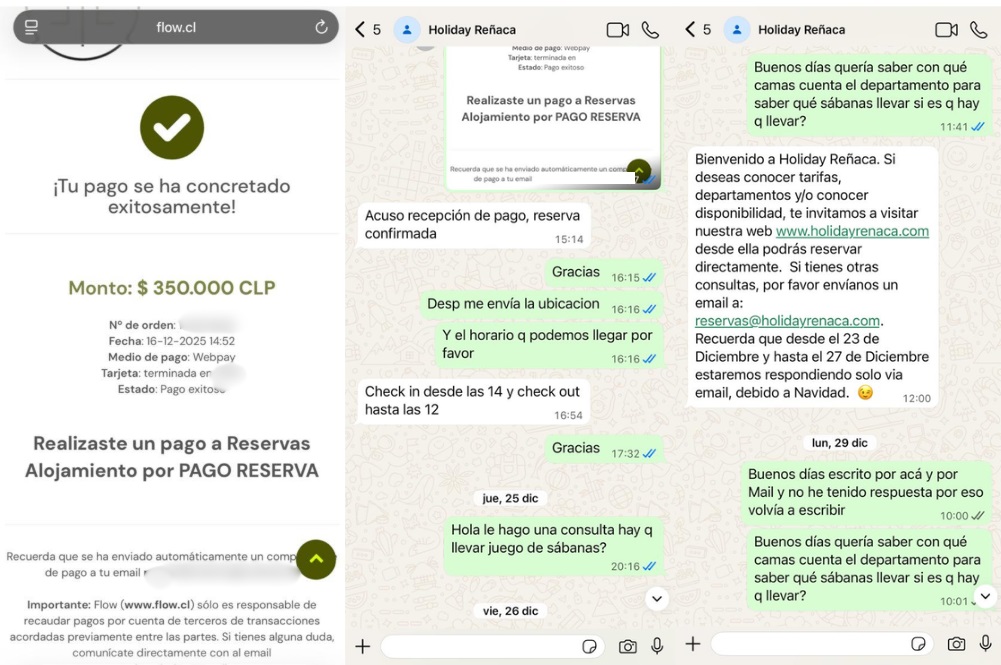
Because their stay in Reñaca was short and disappointment was setting in, the family found alternative accommodations and returned to Argentina on January 2. By then, the news of the scam had spread.
The Real Owner: Identity Theft and a Fictitious Wife
To sustain the fraud, the Reñaca scammer used real photos, true names, and even the identity of the manager of an apartment at the Holiday Park listed on Booking.com.
That individual is Egon Pfaff, a Chilean resident who manages the property and also became a victim. “This is a very well-executed scam. I even suspect they aren’t Chilean. Perhaps foreigners,” he told BioBioChile. He was surprised by the precision of the scam, noting that the scammer provided a valid RUT (Chilean tax ID) and a recipient name (“Conference Spa”) to secure each step.
Before the scam was exposed, Egon visited the fake website and discovered, for example, that the scammer had stolen photos of cleaning staff from an apart-hotel in Bolivia, a detail that could aid in tracking using Google Lens. He also found that the “About Us” section had created a wife for himself – the same “Marcela” who contacted Alfonsina and Maricel via WhatsApp.
Pfaff clarified that he never received any money and had received messages from scammed individuals seeking explanations. He filed a police report and was forced to post a warning on his Booking.com listing, reiterating that he does not request money for reservations outside of that platform.
Status of the Investigations into the Tourist Scam in Reñaca
While reports continue to grow following media coverage in Argentina and Chile, there is currently no unified or group lawsuit. Some victims have filed claims, while others have resigned themselves to the loss.
When contacted by BioBioChile, a source with the Valparaíso PDI stated that they “have no investigation regarding this matter” and did not provide information about the suspect, despite online data available for tracking.
Chile’s tourism sector has expressed concern about the increase in criminal incidents affecting Chile’s image during the 2025-2026 summer season. Last week, BioBioChile reported three truck thefts in La Serena and Concón targeting Argentinian travelers, as well as two attempted break-ins.
The website of the National Tourism Service (Sernatur) registry allows you to check formal and properly established accommodations, such as hotels, hostels, and cabins. Another essential tool for avoiding scams: track images with Google and verify the source.
“Fedetur strongly condemns the fraud that affected nearly 200 Argentinian tourists this season. This type of scam not only causes significant economic damage but also harms the trust and reputation of Chile as a safe tourist destination,” said Mónica Zalaquett, president of the National Tourism Federation, in a statement.
She also called on authorities to “strengthen control mechanisms and travelers to always verify their reservations with formal agencies and accommodations. Tourism should be an experience of encounter and respect, not an act of deception.”
