
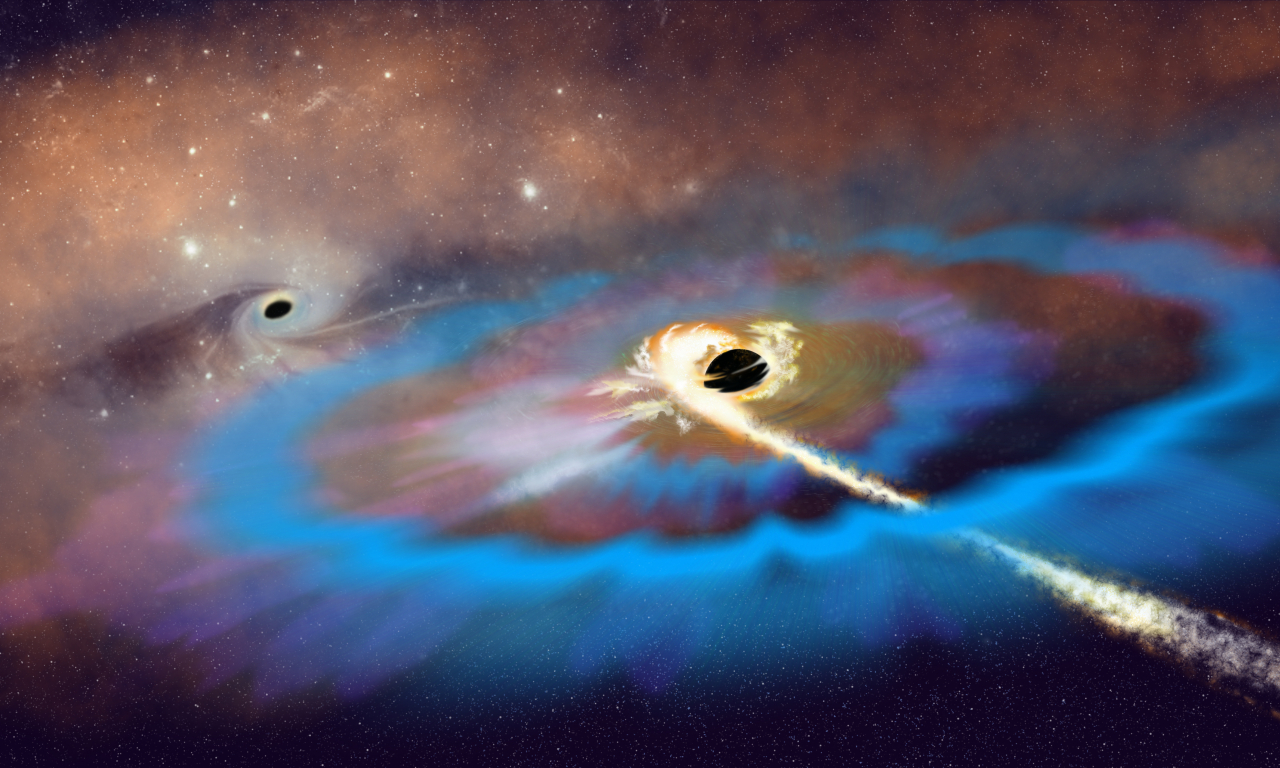
Astronomers have observed an unprecedented cosmic event – the most distant and rapidly evolving tidal disruption event (TDE) ever recorded, designated AT 2024tvd. The revelation, detailed in a new study, challenges long-held assumptions about black hole locations and behavior, suggesting that massive black holes may “wander” outside of galactic centers. Using data from the Atacama Large Millimeter/submillimeter Array (ALMA) and the Very Large Array (VLA), researchers have gained a unique glimpse into the dynamics of a star violently torn apart by a black hole 2.6 billion light-years away.
An international team of astronomers has documented a rare event, dubbed AT 2024tvd, that challenges existing understanding of black hole behavior. The discovery, made using the Atacama Large Millimeter/submillimeter Array (ALMA) in Chile and the Very Large Array (VLA) in the United States, marks the first detection of a bright tidal disruption event (TDE) occurring outside of a galaxy’s core. This finding offers a new window into the dynamics of these powerful cosmic phenomena and could reshape our understanding of black hole distribution.
Tidal disruption events occur when a star ventures too close to a massive black hole, resulting in the star being stretched and torn apart by the black hole’s intense gravity – a process often referred to as “spaghettification.” However, AT 2024tvd stands out as an unusual case. Not only did it occur in an unexpected location, but the radio signals emitted by the event evolved at a speed never before observed.
Traditionally, supermassive black holes have been understood to reside at the centers of galaxies. This new discovery deviates from that established model. AT 2024tvd was located approximately 2,600 light-years (0.8 kiloparsecs) from the center of its host galaxy.
An “Impossible” Event Far From the Galactic Center
“This is truly extraordinary,” said Itai Sfaradi, the lead author of the study affiliated with the University of California, Berkeley. “Not only is this the first time we’ve observed such a bright radio emission from a tidal disruption event happening away from a galaxy’s center, but it’s also evolving faster than anything we’ve seen before.”
The event’s location suggests the existence of “wandering” black holes, or those that are hidden from view, massive objects that roam galaxies, potentially as a result of past galactic mergers or gravitational interactions involving three black holes. According to Raffaella Margutti, a co-principal investigator, this black hole would have remained entirely undetected were it not for the chance destruction of a star, which produced the remarkably bright radio signals.
Record-Breaking Evolution Captured from the Atacama Desert
Data collected by ALMA in Chile has provided key insights into the event’s dynamics. The network of radiotelescopes observed that AT 2024tvd produced two bursts of radio waves with extremely volatile behavior. The brightness rapidly increased and decreased, far quicker than any previously known TDE.
Detailed analysis indicates that this rapid evolution was due to material ejected long after the initial star’s destruction – approximately 80 and 170 days after the optical discovery. This challenges traditional models of how these cosmic cataclysms unfold.
“The radio emission from AT 2024tvd evolves so rapidly that it stands out even among the most extreme cosmic events we know of,” explained Margutti. Kate Alexander, a principal investigator for the VLA program, added that these observations are revealing “new physics about how material behaves when expelled from the vicinity of black holes.”
The discovery, triggered by an alert from the Zwicky Transient Facility in August 2024, opens a new avenue for astronomical research. With future sky-tracking capabilities, scientists anticipate discovering that these wandering black holes may be much more common in the universe than previously thought.
