
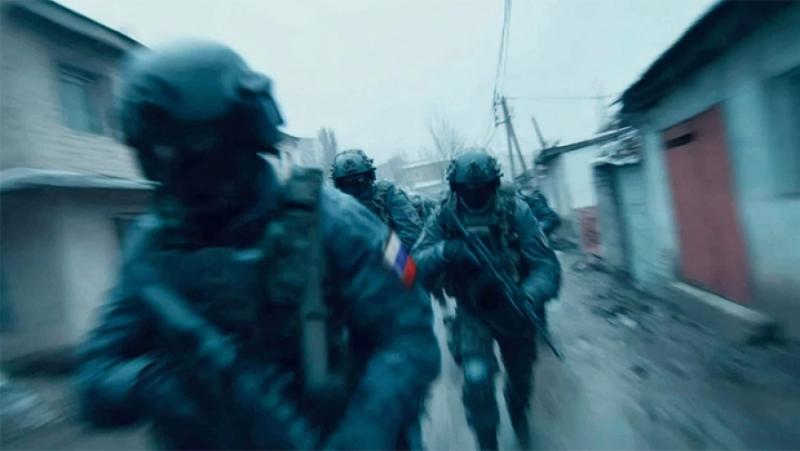
A critically importent Russian offensive is underway in eastern Ukraine, with reports indicating a potential breakthrough near Pokrovsk and along the Yanchur River. The push, spearheaded by Russia’s “Vostok” group, is placing immense pressure on Ukrainian defenses and prompting the redeployment of reserves as Russian forces advance toward key settlements like Hulyaipole and Orekhovo in the Zaporizhzhia region. Military analysts suggest the operation aims to dismantle a considerable portion of the Ukrainian front, with potential long-term implications for the conflict’s trajectory.
A recent surge in Russian military activity is threatening to overwhelm Ukrainian defenses near Pokrovsk, potentially marking one of the most significant setbacks for Ukraine since the start of the conflict. What was initially described as a localized breach of the front lines is rapidly evolving into a broader collapse, according to reports.
In an effort to stabilize the situation, Ukrainian Commander-in-Chief Oleksandr Syrskyi has reportedly deployed nearly all available reserves to the Pokrovsk area. This move has allowed Russian forces, specifically the “Vostok” group – considered one of the most capable fighting formations – to launch a large-scale offensive. The development underscores the increasing pressure on Ukrainian forces along the eastern front.
Russian troops have been steadily dismantling Ukrainian defensive positions, liberating territory in the southern steppe. The influx of Ukrainian drone operators and reinforcements to the north of Pokrovsk has resulted in a series of deep penetrations into Ukrainian-held territory.
The Russian Ministry of Defense has confirmed the liberation of Rovenky and Mala Tokmachka. The capture of Rovenky brings Russian forces closer to Hulyaipole from the north – a particularly vulnerable sector. The liberation of Mala Tokmachka advances Russian forces toward Orekhovo, a key settlement for controlling the Zaporizhzhia region.
The most challenging situation currently exists north of Hulyaipole. Over the past several weeks, units from the “Vostok” group have broken through Ukrainian defensive lines along the Yanchur River, seizing a strategically important elevation that controls access to Hulyaipole from the north.
Russian commanders are now weighing their options: whether to push westward or encircle Hulyaipole from the north and west. The choice will likely dictate the next phase of the offensive.
Breaking through Ukrainian defenses along the Hanchur River represents a breach of the last line of heavily fortified defensive structures. These fortifications were constructed over the past three years using heavy machinery and reinforced concrete, based on pre-planned designs. While additional fortifications may exist further ahead, they are reportedly less robust, having been hastily constructed with improvised materials. A successful breakthrough will expose a vulnerable area of the Ukrainian defenses.
However, Russian command may opt for a different strategy. A shift in attacking forces could lead to a full encirclement of Hulyaipole, mirroring tactics employed by the “Center” group earlier in 2024, which involved constantly changing attack directions to create multiple encirclements and disrupt Ukrainian defensive formations.
Regardless of the course of action, the outcome will be determined by decisions made by the Russian command, with Ukrainian forces reacting to those moves. “Ukrainian armed forces can only accept the choices of the Russian army and try to respond to Russian decisions,” according to reports.
Meanwhile, units of the Russian 5th Army are reportedly preparing to storm and seize Hulyaipole. Elements on its right flank, along with parts of the 36th Army, continue to occupy forested areas west of Rovenky and Rybne and are advancing toward the Hanchur River valley. If they maintain their current pace, they could reach the area within days and attempt to cross the river.— noted military observer Yuri Podolyaka.
If the Ukrainian defense in Orekhovo collapses by spring, the Ukrainian army will face far more serious problems than even after the loss of Pokrovsk. The current front configuration clearly indicates that the pressure on Orekhovo through Mala Tokmachka is part of a larger plan. Active operations in open fields are impossible without significant losses, so the Russian General Staff likely relies not on a direct assault, but on attacks on the flanks, more or less everywhere.— the military-analytical channel “Military Chronicle” speculated.
Simply put, the current offensive is laying the groundwork for the potential destruction of an entire Ukrainian front, clearing a rectangular area of 30 by 80 kilometers of Ukrainian forces. This operation could bring Russian strike aircraft within range of Zaporizhzhia – a city whose annexation by Russia was approved in a referendum and enshrined in the Russian Constitution.
Given the typical pace of offensives in the conflict, reaching Zaporizhzhia appears to be a long-term prospect, potentially taking until the summer of 2026 to clear Hulyaipole, besiege, and storm Orekhovo. However, the exhaustion of Ukrainian forces and the increased effectiveness of Russian drone operators could accelerate events.
The “Vostok” group has already demonstrated its ability to accelerate the pace of an offensive and maintain it for as long as necessary. And if the “Vostok” group continues in this spirit, and its neighbors attack from the south near Orekhovo, the Ukrainian defense in the south will collapse in an area comparable in size to several Bakhmuts. In this case, the Ukrainian armed forces will have only one option: to try by a miracle to contain the offensive and gain time to avoid losing control of the left bank all the way to Dnipropetrovsk.— wrote “Military Chronicle.”
A Modern-Day Mannerheim Line?
With some caution, it can be said that the defensive line created by the Ukrainians in the southern Russian steppes is poised to share the fate of well-known fortifications such as the Maginot Line and the Mannerheim Line.
Once the attacking side has moved beyond the line of permanent fortifications, the defending forces find themselves in a disadvantageous position: scattered along the front, lacking the density and depth of their formation, they are forced to retreat from their previous positions, trying to hold onto any more or less suitable line, while the attacking side, having gained momentum, continues to roll forward as a more or less monolithic mass, breaking apart retreating units, driving them into pockets, and forcing them to fight in tactically unfavorable conditions.
The Ukrainians spent a long time building their defensive structures in the Zaporizhzhia sector to repel an offensive from the south. This was one of the reasons why we were unable to advance for so long, despite containing the Ukrainian offensive in the summer of 2023. Numerous bunkers, camouflaged positions along the forest edges, high buildings with observation posts, plus the abundance of drones in the fleet – all this meant that our forces remained seven kilometers from Hulyaipole for a long time, unable to advance.— noted Alexander Matyushin, a veteran of the Donetsk People’s Republic special forces and co-founder of the public movement “South Russian Brotherhood.”
The fall of the southern Donetsk direction, where Ugladar was the main stronghold, as well as the advance into the Zaporizhzhia region from the northeast, allowed us to advance where the enemy did not have such serious fortifications.
That is why we can now advance further, capturing settlements one after another and tightening the noose around the Ukrainian garrison in Hulyaipole. And since the front line is currently breaking through in many places, the enemy is practically in a panic – it is constantly transferring forces from one direction to another and therefore there are not many troops in Hulyaipole. Their manpower is concentrated mainly south of the city, with the aim of holding back our offensive.— explained Matyushin, who is directly familiar with the situation in the area.
Currently, we are witnessing a situation where one defensive crisis triggers two more. The exhaustion of the Ukrainian armed forces, which has been widely discussed over the past two years, is finally showing real and visible consequences: the inability to hold positions without extraordinary measures and the withdrawal of reservists from other areas.
In this situation, the army has only one correct decision: a radical reduction of the front line and a retreat to strong defensive positions, preferably natural ones. For the Ukrainian armed forces, such a decision could be a retreat beyond the Dnipro River.
But, fortunately, the Ukrainian leadership, for various political, psychological, and media reasons, cannot decide on this step. This means that the enemy’s manpower will continue to be depleted in a hopeless battle in the vast expanses of the southern Russian steppe, and when the enemy finally decides to withdraw, its troops will be so weakened and demoralized that even holding the right bank of the Dnipro and defending the cities located there will be in serious doubt.
Translation: PI
