
A shifting cultural landscape in the arab world is fueling debate over artistic influence, as saudi Arabia rapidly expands its entertainment sector and challenges Egypt’s long-held position as the region’s creative hub. The BBC reports on increasing tensions-manifesting in online clashes and altered partnerships-stemming from Saudi Arabia‘s increased investment in arts and entertainment, alongside a strategic prioritization of its own artists and cultural events. This report examines the evolving dynamic between Cairo and Riyadh, and explores weather a true cultural competition is brewing as both nations vie for regional prominence.
صدر الصورة، amrdiab.net
-
- Author, هالة قنديل
- Role, بي بي سي نيوز عربي
Large-scale public celebrations, invitations to prominent artists from around the world, evenings dedicated to the masterpieces of Arab music, film festivals, awards, and artistic productions… Over the past few years, Saudi Arabia has seen a rapid rise in the fields of art and entertainment, and has begun to solidify its position as one of the most influential production centers in the region.
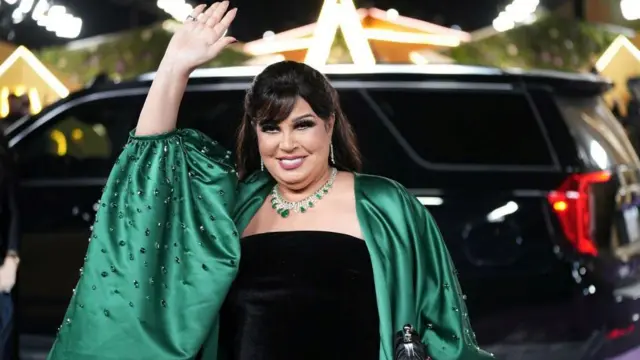
Egypt has played a notable role in this transformation, with appearances and participation from top stars such as Amr Diab and Mohamed Ramadan, as well as official recognition including the granting of Saudi citizenship to several figures in the Egyptian artistic and musical fields, including comedian Mohamed Henedy.
However, in August, Turki Al Al-Sheikh, head of the Saudi General Entertainment Authority, announced that upcoming seasons would prioritize Saudi and Gulf artists, while still providing space for select Arab and international performances.
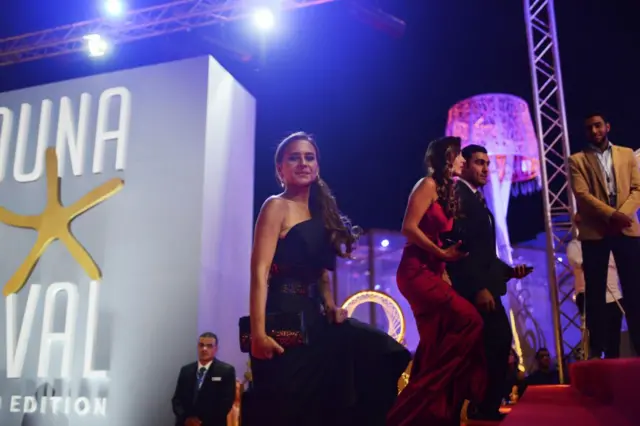
This shift coincided with the withdrawal of MBC channels from sponsoring the latest El Gouna Film Festival, and a growing media focus on Saudi cultural events such as the Red Sea International Film Festival and the Joy Awards, recently hosted in Riyadh.
This trajectory raises broader questions about the balance of cultural influence in the Arab world, and the boundaries of cooperation and competition between traditional artistic capitals and emerging centers, at a time when art is increasingly intertwined with economics and soft power strategies.
With each Egyptian or Saudi artistic event, social media platforms are filled with recurring debates about artistic precedence and the nature of competition between the two sides. Is a cultural conflict between Egypt and Saudi Arabia brewing? And how does each side view its position and role in the evolving Arab landscape?
صدر الصورة، Getty Images
Cairo as a Cultural Hub
Table of Contents
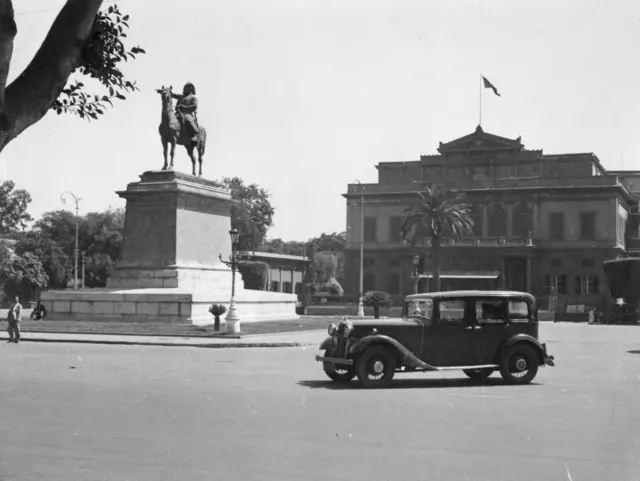
Since the second half of the 19th century, Cairo was the first Arab city to see official patronage of the arts, exemplified by the opening of the Khedivial Opera House in 1869. This move signaled a shift in the region’s cultural landscape.
Alongside this, local theatrical experiments began to emerge, gradually shifting theater from elite spaces to the popular sphere, particularly with Yaqub Sanu in the 1870s, who founded a troupe that performed in Arabic, addressing the public in their everyday language and tackling their social and political issues.
By the 1930s and 40s, Arab cinema had crystallized as an industry centered in Cairo. Arab and theater historians, including Samir Farid and Mohamed Youssef Naguib, point out that the emergence of this industry was built on artistic and intellectual cadres from Egypt, Lebanon, Syria, and Palestine, giving the Egyptian cinematic experience a complex Arab character, rather than being a purely local industry.
This historical accumulation formed a cultural reference point for successive Arab generations. For decades, Egypt was not merely a center for artistic production, but a center of gravity in shaping public taste and creating stars in singing, music, cinema, theater, and television drama.
Through cinema in particular, Egyptian production played a role in creating a shared stock of knowledge among audiences across the Arab world, and the Egyptian dialect became familiar and understandable on a wide scale, due to the widespread distribution of films, songs, and series.
In this sense, Egypt’s role was not limited to producing successful artistic works, but also contributed to shaping consciousness and collective memory over generations.
صدر الصورة، Getty Images
Saudi Transformations
With the beginning of the 1970s, the Gulf region entered a broad economic and social transformation, following the sharp rise in oil prices in 1973, which provided new financial capabilities and infrastructure that gradually reflected on the fields of culture, artistic production, and the entertainment industry.
At that stage, Cairo represented the main artistic center in the Arab world, and students from the Gulf would come to study and form their cultural identity, as documented by the late Saudi writer Ghazi Al-Qusaibi in his novel “Apartment of Freedom” (1971), which portrayed a Gulf generation whose cultural and political consciousness was formed in Cairo.
With the entry of the 1980s, the features of a Gulf entertainment industry began to gradually emerge, through the emergence of local television channels, the establishment of recording and production companies, and the regular organization of concerts.
In 1987, Rotana was founded, which later became one of the largest Arab music entities, and contributed to redistributing the centers of influence within the music market.
The launch of the MBC network in 1991 also marked a pivotal moment in the history of Arab media, as the first private pan-Arab satellite channel, paving the way for the growth of a media model targeting a wide Arab audience.
This was accompanied by the emergence of major festivals and public events in a number of Gulf cities, which contributed to the emergence of a new production space that no longer relied on Cairo as the sole center of gravity, but gradually began to share it.
صدر الصورة، Getty Images
Vision 2030
With the entry into the second decade of the millennium, Saudi Arabia launched the “Saudi Vision 2030” in 2016 as a framework for restructuring the economy and reducing dependence on oil, with the culture sector being one of the main pillars of this transformation.
In the same year, the General Entertainment Authority was established as an institutional body responsible for organizing and developing the sector. Within a short period, cinemas were reopened after decades of closure, followed by the establishment of theaters and performance halls in Riyadh, Jeddah, and Dammam, and the organization of extended entertainment seasons including musical concerts, theatrical performances, and various artistic events.
In 2019, “Riyadh Season” was launched as a long-term series of events, not a traditional festival. Large areas of the capital were transformed into open spaces for performances, hosting Arab and international artists, and became an influential stop in the careers of many artists.
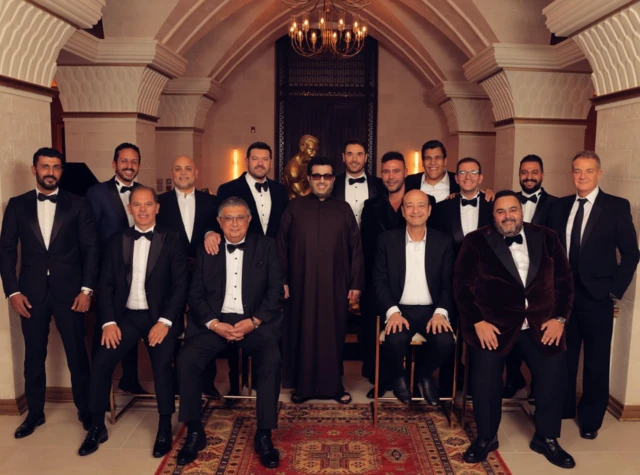
This was accompanied by policies including exclusive contracts with Arab artists, and providing facilities and long-term residencies for some top stars, in addition to hosting Arab and international theatrical productions. The General Entertainment Authority, headed by Turki Al Al-Sheikh, played a pivotal role in managing this phase and implementing its programs, which helped to solidify Saudi Arabia as a key player in the Arab entertainment industry.
A Period of Tension
With each major artistic event in Saudi Arabia or Egypt, such as “Riyadh Season” or the El Gouna Film Festival, waves of sarcasm and mutual attack erupt between Egyptians and Saudis on social media, and a recurring debate about artistic and production leadership resurfaces.
Mohamed Abdel Rahman, editor-in-chief of the Egyptian website “I’lam Dot Org,” believes that this tension, despite its cultural appearance, is not a purely aesthetic or artistic clash, but “is fundamentally an expression of a shift to the level of the market and production.”
While Egypt relies on a long history of cultural and artistic leadership, Saudi Arabia today sees itself as a rising power with financial capabilities and infrastructure that qualify it to reshape the artistic map in the region. Is this a real competition and a cultural conflict, or is what is happening merely a digital debate?
According to Abdel Rahman, the real question is no longer “who possesses cultural precedence,” but “who owns the tools of production, distribution, and popular influence.”
He says that the biggest shift occurred during the past six years, with Saudi Arabia moving from a role as a consumer to seeking to own a cross-border entertainment product. Drama production formed the widest entry point for this transformation due to its spread and popular impact, as “drama was not just an artistic sector, but the main gateway to reshaping taste and building extended cultural influence.”
“The scene has completely turned around,” Abdel Rahman adds. For decades, Egyptian drama has been the foundation for pan-Arab productions, alongside limited Gulf productions.
He says, “The arrival of Turkish drama in the early 2000s, during a relative decline in Egyptian production, covered Egyptian and Syrian drama and opened a parallel market through dubbing, and later through Saudi channels and platforms, which prompted MBC to also produce Arab series formats based on Turkish works.”
He points out that the works that were written and filmed in Egypt to be shown in the Gulf are now produced entirely outside of Egypt with new requirements supported by massive funding, which has redrawn the rules of the market, creating for the first time a sense of direct competition, “as if it were a match between two teams,” according to Abdel Rahman.
However, in his opinion, this transformation alone was not enough to ignite the tension, but the way the scene was managed and the electronic wars between the two publics exacerbated it, along with attacks on Egyptian artists who obtained Saudi citizenship, despite the fact that multiple nationalities among Arab artists had been common for decades.
Abdel Rahman attributes part of the responsibility for the tension to “a hasty media discourse that amplified the sensitivity of the file instead of calming it down.”
صدر الصورة، @Turki_alalshikh
From Entertainment to Meaning Production
Poet and academic Ahmed Qiran Al-Zahrani, professor of media at King Abdulaziz University, believes that the heated debate on social media between Egyptians and Saudis about artistic leadership is “a digital manifestation of deeper questions that are renewed with changing balances of symbolic power.”
He says that the debate is amplified by the emotional nature of social media platforms, while the cultural reality witnesses “actual cooperation in cinema, music, and production, and a new generation in both countries that does not deal with art as a national property, but as a shared space for creativity.”
In his view, the region has entered a phase of multiple centers, where culture is no longer produced from one city, but through a network of intersecting capitals and experiences.
He adds in this context that what made some capitals appear historically as “the center” was not “their cultural superiority as much as their early possession of broadcasting tools and media platforms, which solidified a false dichotomy between the center and the periphery, while cultural production was actually distributed across the Arab world.”
Al-Zahrani sees the cultural transformation that Saudi Arabia has been witnessing since the launch of “Vision 2030” as not reducible to the expansion of the entertainment space or an ephemeral social openness, but as “a comprehensive restructuring of the way society represents itself and the place of culture in its daily life.”
He describes this transformation as “a conscious transition from a stage where culture was a margin or a theoretical discourse, to a moment where cultural presence is being re-engineered as one of the pillars of national formation and a path for building collective identity with greater confidence and awareness, and a transition from a culture of consumption to a culture of meaning production.”
He emphasizes that Saudi Arabia is not “replacing the old with the new” automatically, but subjecting its symbolic
