
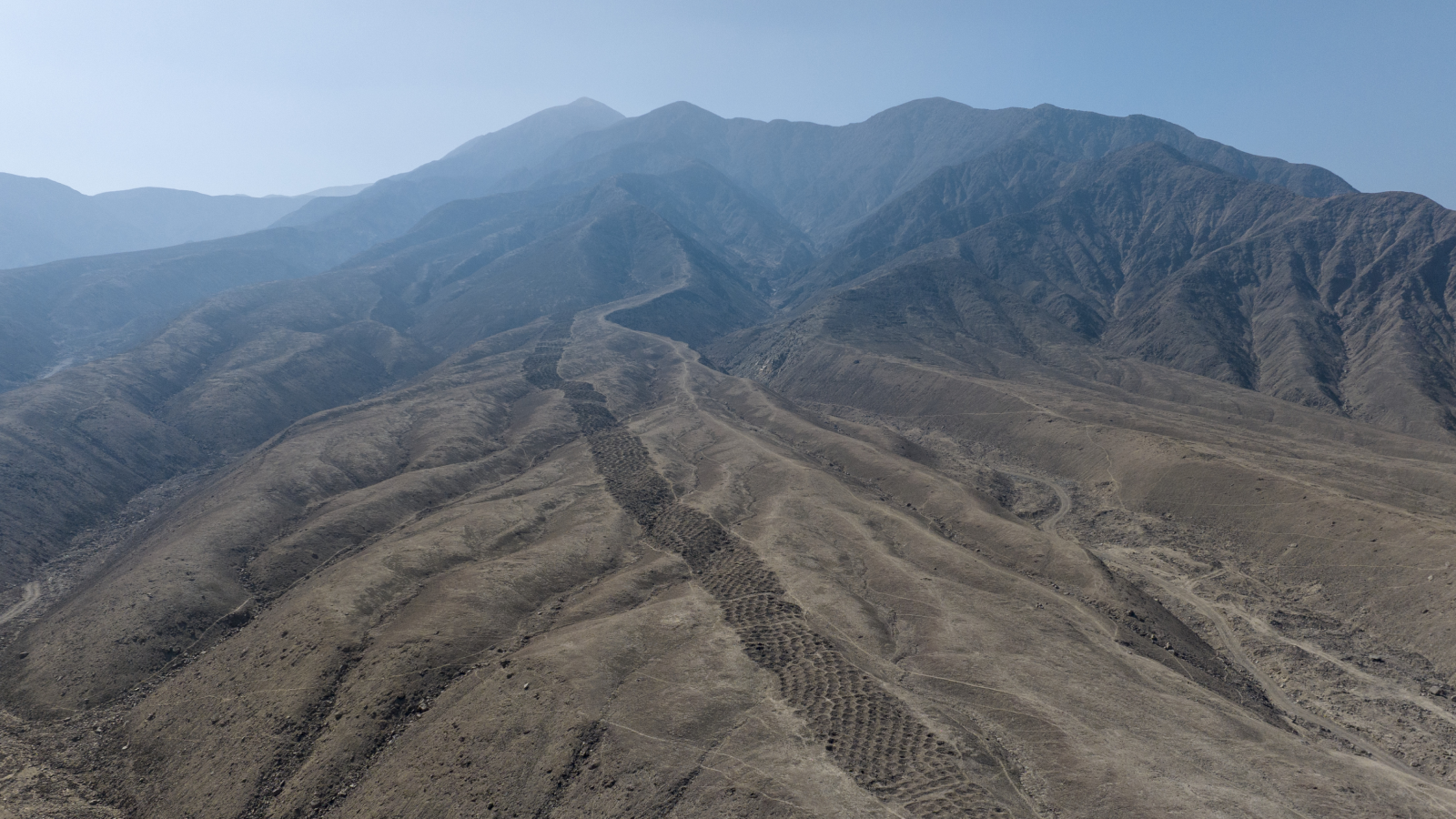
Mysterious ‘Band of Holes’ in Peruvian Andes May Have Been Ancient Marketplace
A newly published study suggests a remote site in the Peruvian Andes, featuring over 5,200 holes arranged in a precise grid, served as a center for barter and accounting as early as A.D. 1000.
Located on Monte Sierpe, or “Serpent Mountain,” in the southern Peruvian Andes, the site – dubbed the “Band of Holes” – stretches 0.9 miles and contains holes ranging from 3 to 6 feet across and up to 3 feet deep. Researchers from the University of South Florida and the University of Sydney utilized drone technology to analyze the site, discovering “mathematical patterning” in the hole arrangement that resembles ancient record-keeping methods. Analysis of samples from the holes revealed pollen from maize and bulrush, suggesting the holes were used to store crops and goods transported in woven baskets.
The site’s construction likely began between A.D. 1000 and 1400 under the Chincha Kingdom, a powerful civilization with a population exceeding 100,000, and was later repurposed by the Inca Empire in the 15th century for tribute collection. “These data support the hypothesis that during pre-Hispanic times, local groups periodically lined the holes with plant materials and deposited goods inside them, using woven baskets and/or bundles for transport,” explained archaeologist Jacob Bongers of the University of Sydney. Understanding ancient economic systems like this can provide insight into the development of complex societies. The discovery also highlights the sophisticated accounting practices of Andean civilizations, potentially predating and influencing the well-known Inca khipu system.
Archaeologists first documented the site in the 1930s, but detailed investigation was limited until now. “The site is isolated and not threatened by development,” said Charles Stanish, a professor of anthropology at the University of South Florida. “As a result, there has not been a sense of urgency.” Researchers plan to continue analyzing the site to further refine their understanding of its function and the communities that utilized it.
