
China’s assertive expansion in the South China Sea is raising geopolitical tensions in the region and beyond. the contested waterway – a critical global trade route handling roughly one-third of all maritime shipping – has seen increased activity from Beijing, including ongoing construction of artificial islands and a growing naval presence. Recent reports and satellite imagery confirm China’s continued efforts to solidify its claims despite overlapping claims from several neighboring countries, prompting international concern over freedom of navigation and potential conflict.
China is making significant advances in its efforts to solidify control over the South China Sea, a region considered one of the most strategically important waterways in the world. The contested waters are a crucial global trade route, with roughly one-third of all maritime shipping passing through them annually.
Beijing asserts sovereignty over more than 80 percent of the sea, but its claims are disputed by Brunei, Malaysia, the Philippines, Taiwan, and Vietnam. The escalating tensions in the region have raised concerns among international observers about potential conflicts and the freedom of navigation.
Foto: Seznam Zprávy
Territorial disputes in the South China Sea.
Recent satellite imagery from the European Space Agency’s Sentinel-2 satellites, analyzed in January, shows China has made substantial progress dredging sand near Antelope Reef, known as Lin-yang Jiao in Chinese and Da Hai Sam (“sea cucumber reef”) in Vietnamese. This activity signals a continued, systematic effort by Beijing to transform reefs into artificial islands, a tactic it has employed for over a decade to bolster its de facto control of the disputed territory.
Changes to the coral reefs at Antelope Reef are visible in satellite images comparing 2018 and 2022, showing a larger landmass extending into the surrounding shallows. Newer phases of construction, visible in recent video, reveal freshly deposited sand and materials likely intended as a foundation for technical or military installations.
Recent satellite imagery indicates China is likely undertaking fresh land reclamation/island building at Antelope Reef in the Paracel Islands, South China Sea pic.twitter.com/bxn8g6g1J5
— Damien Symon (@detresfa_) January 5, 2026
Artificial Islands, Claimed Territories
China currently possesses the world’s largest navy, but it faces a shortage of bases. It officially maintains only one foreign military base, located in Djibouti, Africa, which was established in 2016.
Concerns have grown, particularly in the United States, after satellite images taken at the end of 2024 revealed two gray outlines of Chinese warships with a displacement of 1,500 tons, newly constructed berths, and adjacent docks large enough to accommodate much larger vessels at the Ream Naval Base in Cambodia. This development suggests a growing Chinese military presence in the region.
In contrast, the United States maintains hundreds of military bases worldwide, including significant installations in Japan and South Korea.
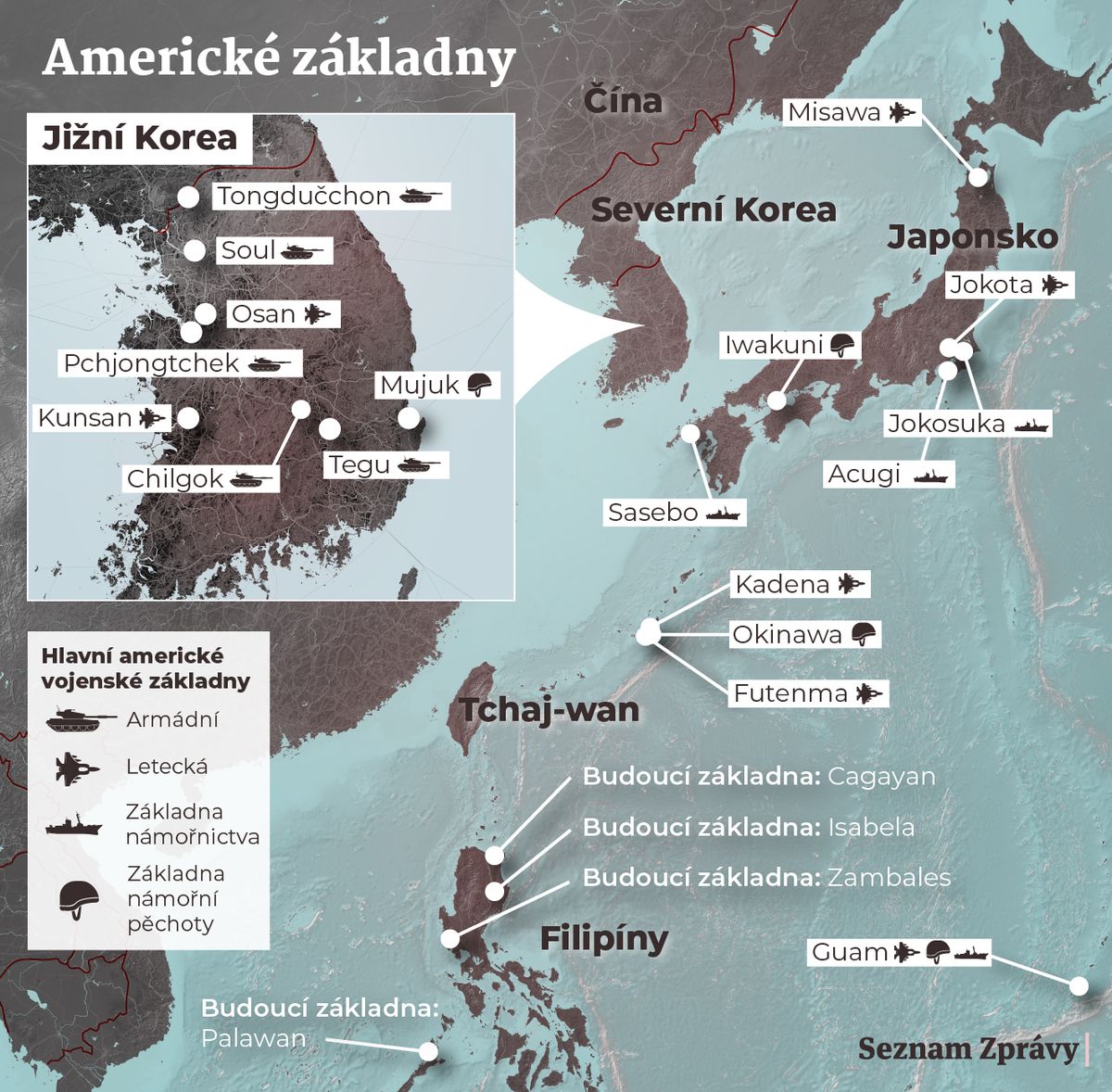
Foto: The Times, Seznam Zprávy
U.S. presence in the Indo-Pacific region.
The creation of artificial islands allows China to circumvent its lack of overseas bases – over the past several years, Beijing has successfully transformed reefs in the South China Sea into artificial islands equipped with airports and infrastructure, including missile systems. The development underscores growing regional tensions and the potential for increased militarization of the area.
Vessels from foreign powers now navigate these waters, and military aircraft provocatively test air defense lines and the patience of neighboring countries.
Among the disputed territories are the Paracel Islands, which include the aforementioned Antelope Reef – a submerged coral formation. Since 2013, China has been carrying out land reclamation work in the area, building several militarized facilities and contributing to regional tensions and causing significant damage to marine ecosystems.
China’s claims in these areas clash with those of Taiwan and Vietnam. The Paracel Islands originally belonged to South Vietnam, but were seized by Beijing in 1974.
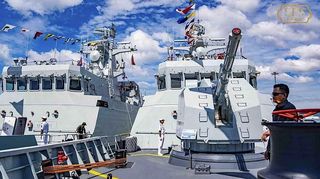
Ports, landing strips for military-civilian use, have also been built by China on the disputed Woody Island, which is home to at least 400 civilians and features schools, stadiums, shopping centers, and cinemas.
According to estimates by analysts, China has created 1,300 hectares of new land across the Spratly and Paracel island chains. It also controls Scarborough Shoal, which it seized from the Philippines in 2012.
Vietnam is also intensifying construction of infrastructure around the Spratly Islands, prompting strong protests from Beijing. Taiwan, meanwhile, faces issues with provocative military exercises in its immediate vicinity.
Last December, monitoring firm ingeniSPACE recorded a new tactic of mobilizing up to two thousand Chinese fishing vessels, forming two massive “floating barriers” in an L-shape spanning 466 kilometers.
Recruiting “Residents”
To populate the disputed waters, China is seeking new “residents” through recruitment drives – most recently seeking social workers to work on eight reefs and islands in the Paracels and Spratlys. This move has drawn criticism from neighboring countries.

The job posting does not specify the exact nature of the work, but candidates must be between 18 and 35 years old, have a university degree, and be “dedicated to island and community service.”
Applicants must also be able to live for extended periods in “remote coastal areas,” requiring exceptional physical and psychological adaptability. They are also expected to demonstrate “strong organizational and interpersonal skills, relevant professional knowledge, a commitment to public service, and a genuine dedication to working in the community at the local level and long-term residence on the islands.”
