
The future of preventative health monitoring may be a simple skin patch. Researchers at the University of Illinois Chicago have developed a battery-free sensor that analyzes compounds in sweat, offering a perhaps less invasive and more continuous method of tracking vital health metrics. The device, detailed in a new study published in Science Advances, could offer real-time insights into conditions like diabetes and dehydration, moving beyond the limitations of traditional testing and existing wearable technology.
Wearable devices have rapidly evolved from simple step trackers and timekeepers to sophisticated health monitors capable of providing real-time insights into vital signs, including heart rate and blood oxygen saturation.
Today, smartwatches, wristbands, and even skin patches are becoming increasingly integrated into daily life, offering a continuous layer of medical surveillance. This constant monitoring can detect subtle changes that might go unnoticed during a routine doctor’s visit, particularly for individuals managing chronic conditions like diabetes. The ability to track health metrics continuously is a growing trend in preventative care.
While solutions aimed at eliminating daily fingersticks for diabetics already exist, they often face limitations related to accuracy or cost.
Now, engineers at the University of Illinois Chicago (UIC) have developed a new skin patch that analyzes the chemical composition of sweat, bringing wearable sensors closer to the precision of traditional medical lab tests.
The device is a flexible, stretchable “sticker” that operates without a battery. It’s powered by a nearby reader, similar to a contactless payment terminal, which also receives and transmits the data.
Metallic Ink Technology
Researchers, who published their findings in the journal Science Advances, explain that the patch can measure skin temperature, as well as levels of glucose, ammonium, sodium, potassium, and pH in sweat.
This multi-parameter capability distinguishes it from many currently available wearables. “In traditional wearable devices, we cannot detect many physiological parameters simultaneously,” says Pai-Yen Chen, professor of electrical and computer engineering at the UIC College of Engineering and the study’s lead author.

Engineer Pai-Yen Chen, lead author of the study describing the device
Omicrono
“We wanted to create something that could wirelessly monitor multiple parameters, and we wanted the wearable device to be very, very compact,” Chen explains.
The device’s operation differs from conventional patches. Instead of digital signals, changes in sweat or skin temperature subtly modify the frequency of a radio signal emitted by the device, which is then interpreted by a reader.
To connect the circuit, the researchers developed a special conductive material made of a liquid metal encased in a porous, plastic-like material. This material functions like a wire but can stretch up to three times its length without breaking or losing conductivity.
“Because it’s a wearable device, it must be flexible, elastic, twistable, foldable, and bendable. You can’t simply use a traditional, conventional metal,” Chen said.
Unlike the silver inks commonly used in flexible electronics, which crack with minimal movement, this material maintains nearly unchanged resistance after thousands of stretches. Furthermore, its porous structure prevents the liquid metal from leaking, reducing the risk of skin or clothing contamination.
The patch also incorporates an antimicrobial substance used in food, eliminating more than 99.9% of certain bacteria commonly found on the skin. Lab tests indicate the material is well-tolerated by human cells, an important factor for prolonged wear.
Notably, the sensor requires no battery or wires. Instead, it sends data wirelessly to a portable reader via inductive coupling—transferring energy and information between antennas through a magnetic field, similar to the technology used in mobile payment systems.
Precise Measurements
Rather than tracking steps or calories, this system focuses on detecting and monitoring the chemical signals in sweat. In testing, scientists measured skin temperature and levels of sodium, potassium, and pH during exercise sessions with several volunteers.
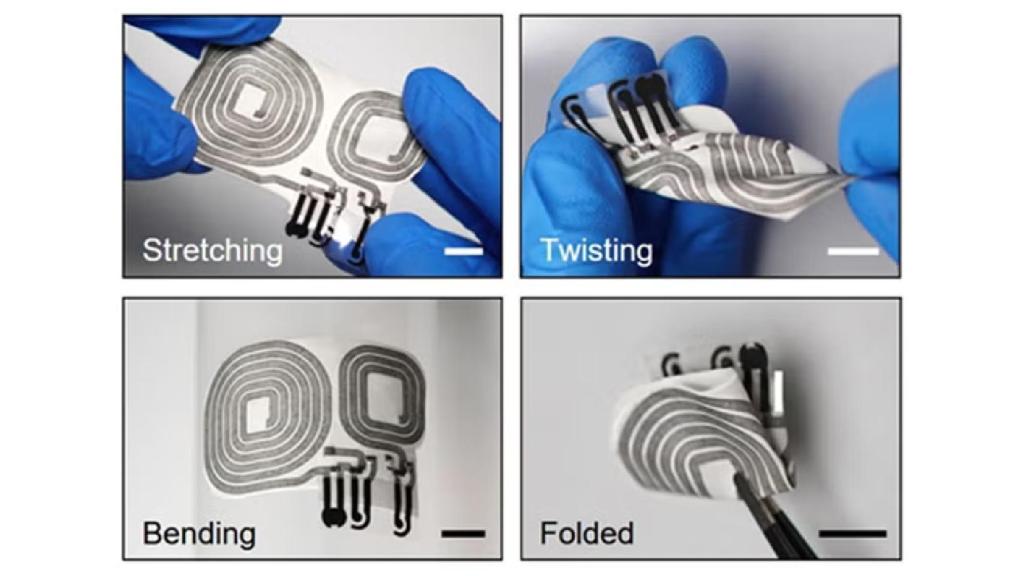
The patch can be twisted and bent
Omicrono
During light exercise, temperature increased slightly and sodium levels rose while potassium decreased—a pattern consistent with salt loss through sweat. As intensity increased, these changes became more pronounced, particularly sodium, which can indicate dehydration if fluids aren’t replenished.
When volunteers drank controlled amounts of water, the curves smoothed out, suggesting the potential for patches that alert athletes when and how much to hydrate. All of this is achieved without fingersticks or manual sampling—simply trapping sweat under a thin layer of the patch itself.
The researchers also adapted the system to monitor glucose and ammonium levels over several hours, two markers related to how the body uses energy. Glucose is the sugar circulating in the blood that fuels cells, while ammonium is linked to protein metabolism.
“These two are the most important factors for diabetes,” Chen explained, as the disease interferes with insulin production—the hormone that helps process glucose—and liver function, which processes ammonium.
In a healthy volunteer, the patch detected glucose spikes after meals that returned to near normal within one to two hours, and moderate ammonium levels that rose with exercise. In an obese individual, the spikes were higher and took longer to subside, and ammonium remained elevated—a pattern reminiscent of impaired sugar management like insulin resistance.
While sweat doesn’t replace a traditional blood analysis, tracking these trends throughout the day could serve as an early warning system. Daily use of such a patch could help detect changes before clear symptoms appear.
Currently, the patch is a prototype that still needs further development. In the lab, Chen and his team used a bulky device as a reader and wireless charger. However, the UIC engineers plan to miniaturize it to create a small, portable device. The ultimate goal is for users to view simple graphs on their mobile devices or smartwatches regarding hydration, exertion, or metabolic risk.
Additionally, the same technology could be adapted to read other biomarkers, such as uric acid or lactate, by changing only the chemical component that “reacts” with sweat. If it reaches the market, these types of patches could turn skin into a continuous chemical control panel, complementing physician care with real-world data.
