
Sweden, long considered a climate leader, experienced a surprising 13.8 percent jump in greenhouse gas emissions in 2024, according to new data from the European Environment Agency. The increase-the second-largest among EU member states-raises questions about the nation’s ability to meet its enterprising emissions reduction targets and underscores a broader slowdown in Europe’s progress toward climate neutrality. This report details the factors contributing to the rise and the implications for Sweden’s climate commitments within the EU’s Effort Sharing Regulation.
Sweden saw a significant increase in greenhouse gas emissions in 2024, bucking the trend of recent years and raising concerns about the country’s ability to meet its ambitious climate goals. The rise comes as the European Union as a whole struggles to accelerate emissions reductions, according to preliminary data released by the European Environment Agency.
Swedish emissions within the sectors covered by the EU’s Effort Sharing Regulation (ESR) jumped 13.8 percent between 2023 and 2024, the second-largest increase among EU member states, trailing only Romania. The country released 30.5 million tonnes of carbon dioxide equivalents in 2024, compared to 26.8 million tonnes the previous year – the highest level since 2019.
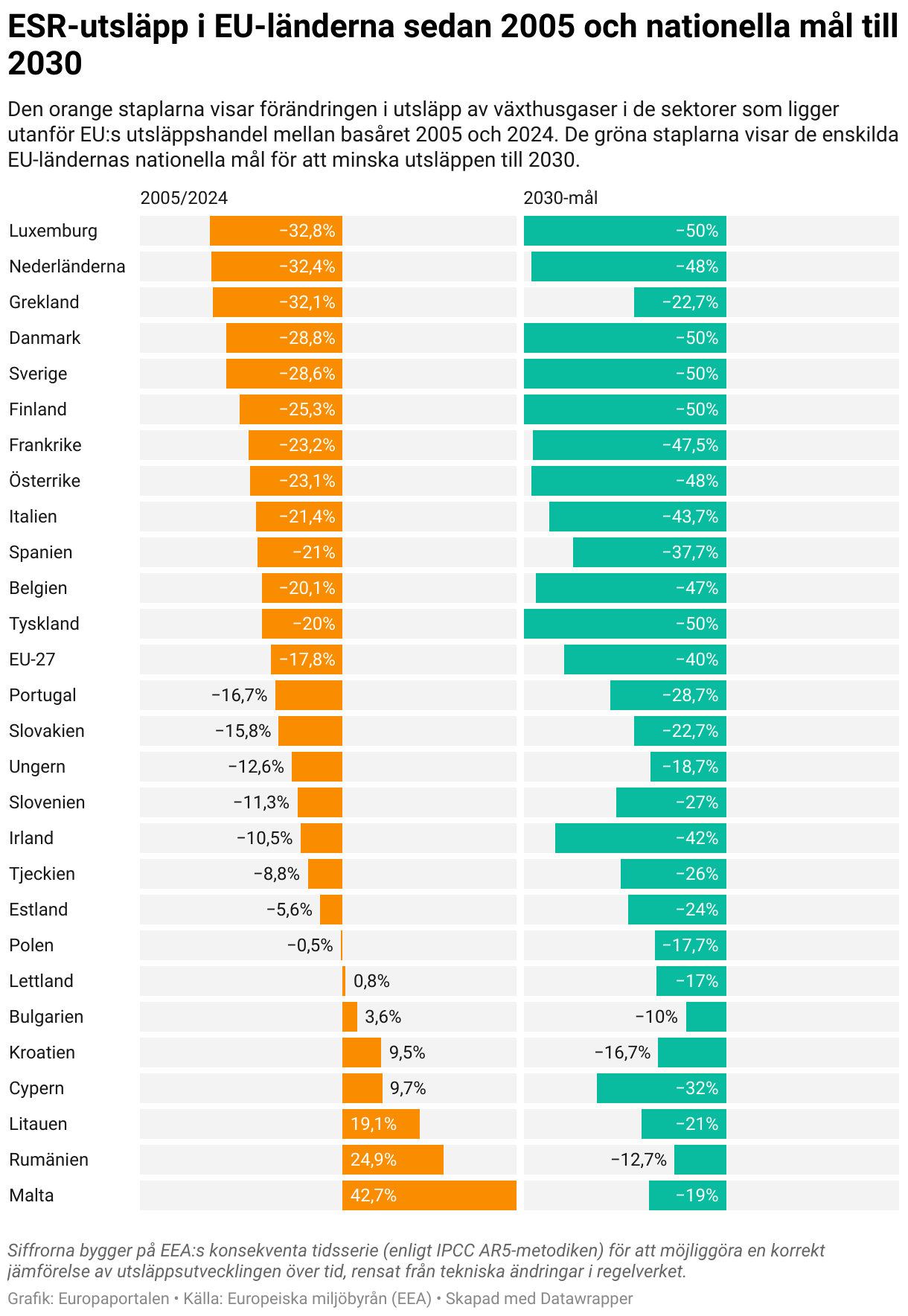
Despite the recent increase, Sweden has made substantial progress in reducing emissions over the long term. Since 2005, the country has decreased its emissions within the ESR sectors by 28.6 percent, making it the fifth-highest emitter reducer in the European Union.
Slowdown at the EU Level
Across the EU, emissions from the ESR sectors remained largely unchanged between 2023 and 2024, with a marginal decrease of 0.1 percent. This means emissions in 2024 slightly exceeded the permitted level for the year.
Since 2005, EU countries have reduced emissions within these sectors by 17.8 percent. Achieving the EU’s target of a 40 percent reduction by 2030 will require a significantly faster pace of emissions cuts in the coming years. Current strategies, however, are insufficient to reach that goal.
Member state forecasts for 2025 indicate that existing policies are projected to deliver a 29.7 percent reduction by 2030, with planned additional measures increasing that figure to 38.1 percent – still short of the 40 percent target.
Low Emissions Per Capita
Despite the overall increase, Sweden still had the second-lowest emissions per capita in the EU in 2024, at 2.9 tonnes of carbon dioxide equivalents per inhabitant. The EU average stood at 4.5 tonnes per person.

Effort Sharing Regulation
The EU’s Effort Sharing Regulation (ESR) governs emissions from domestic transport (excluding aviation), buildings, agriculture, small industry, and waste. These sectors collectively account for more than 60 percent of the EU’s total greenhouse gas emissions.
The regulation complements the EU Emissions Trading System (ETS) and the Land Use, Land Use Change and Forestry (LULUCF) regulation, forming the three core pillars of the EU’s climate action framework.
Binding Annual Targets
The regulation establishes binding annual emission allocations for each member state for the period 2021–2030. National targets range from a 10 percent to a 50 percent reduction compared to 2005 levels.
Sweden’s goal is a 50 percent reduction by 2030, one of the most ambitious targets in the union. With a reduction of just over 28 percent achieved so far, a substantial further reduction will be needed in the years ahead.
Looking Ahead
Preliminary data for 2024 indicated that 17 member states, including Sweden, were at risk of exceeding their annual emission allocations, compared to six countries in 2023. These countries will need to utilize the flexibility mechanisms within the regulation to meet their commitments.
Forecasts suggest that only six member states – Greece, Croatia, Bulgaria, Czechia, Denmark, and Portugal – are on track to meet their 2030 targets with current measures. With planned additional measures, that number increases to 14. Sweden is not among them, according to the European Environment Agency.
