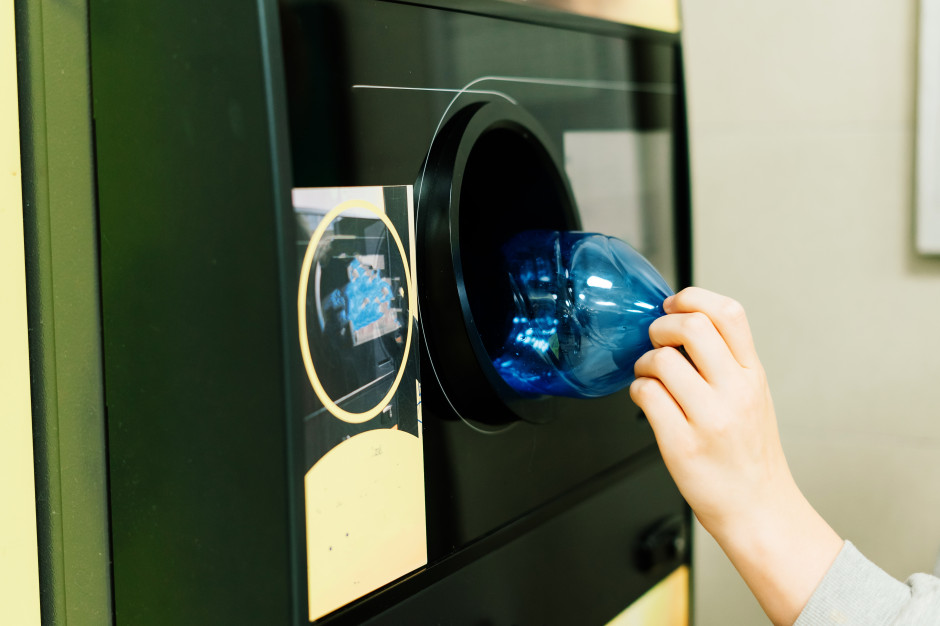
- The deposit return system – in theory – launched on October 1, 2025. But in practice, bottles and cans with the deposit mark only began to arrive in stores en masse at the beginning of the recent year. Customers are complaining about malfunctions in the machines accepting packaging.
- – In other countries, during the implementation of the deposit return system, failures and so-called bottlenecks also occurred. This is a matter of refining the system. What we can do on our part – and I assure you we will – is, of course, controls – says Anita Sowińska, Deputy Minister of Climate and Environment.
- Our interviewee declares that the ministry is intensively working on the extended producer responsibility act. We ask her about the announcement of sending the draft to the Sejm only in the second half of this year.
- – I do not confirm this version. We are doing everything to pass this act as soon as possible – replies Minister Sowińska.
The deposit return system launched on October 1 of last year. How do you assess the first months of its operation?
– I assess them well. We regularly receive reports from operators. By the end of last year, there were already 250 million packages in the system.
I am not only pleased with the number of packages, but also with the number of collection points that have been created. There are already over 40,000, including 15,000 small stores, i.e. Establishments exempt from the obligation to conduct collections. Of course, I receive information about minor malfunctions and errors. Such logistical inconveniences can occur. The most important thing is that operators are resolving them on an ongoing basis in cooperation with stores.
I have heard from entrepreneurs and traders that machine failures are quite frequent. As a consumer, I have personally seen a large “OUT OF ORDER” sign on bottle return machines several times.
– If a machine is malfunctioning, the store – and they are well aware of this – is obliged to accept the packaging manually. In other countries, during the implementation of the deposit return system, failures and bottlenecks also occurred. This is a matter of refining the system.
What we can do on our part – and I assure you we will – is, of course, controls – primarily in large stores.
We are not focused on imposing high penalties, but we desire the system to function efficiently, which is why the aforementioned controls are necessary.
Are machine failures a result of the existence of many operators and various IT systems?
– No, operators have a cooperation agreement and a common database. Differences between individual collection systems are not a bad thing. In fact, they can be an advantage, as they allow stores and operators to compete with each other.
The deposit return system is a field for competition between its operators
What can they compete on?
– For example, on the fact that customers consider one machine more efficient than another, or that it has additional options. We will not impose strict requirements as this would limit competition and block innovation. One retail chain already offers home pickup of empty bottles and cans… This is an example of positive competition and striving to attract customers.
Only large chains can afford to offer such conveniences. Meanwhile, small stores – theoretically exempt from the obligation to conduct collections – are already de facto forced to compete with large establishments on the principle of “you buy where you can return the bottle”.
– Small store owners realize that – by collecting deposit packaging – they are able to attract customers. This was also the purpose of the law, which we have clearly communicated from the outset.
Let’s not forget that installing a machine is not always the most environmentally and economically beneficial solution. In small stores, manual collections can be carried out.
The Polish Chamber of Commerce complains that the handling fee (i.e. The manipulation fee) offered to stores by operators is too low. Retailers have to subsidize the maintenance of the system.
– The amount of the handling fee is regulated in the agreement between the store and the operator. It is not our role to interfere in this process. The rates of this fee in other European Union countries are not significantly different from those in Poland.
“Monkeys” in the deposit return system
But perhaps the ministry’s role would be to establish an umbrella organization?
– We are in constant contact with operators – and this postulate is no longer at the forefront of their concerns.
Though, we are open to suggestions and – if necessary – I do not rule out changes in the future. In the next six months, we will decide on strengthening the presence of reusable bottles in the system and possibly including disposable glass in the deposit return system.
The Polish Chamber of Commerce responds that before the system started working properly, you want to add “monkeys” to it. Isn’t that too fast?
– Such a change requires consultation and a transition period. Guarantee that it will be adopted… Personally, I believe that such a change is necessary, because “monkeys” are a serious environmental problem.
When will disposable glass be included in the deposit return system?
– As I mentioned, this postulate must be subject to consultation. I do not want to declare a specific date. It is unlikely to happen before two years from now. It may coincide with the entry into force of the EU PPWR regulation (Packaging and Packaging Waste Regulation, regulations adopted by the Council of the EU on December 16, 2024).
A rather unexpected effect of the deposit is the withdrawal of drinking bottled water from the assortment of some non-food stores and its replacement with water in cartons.
– We will motivate all producers, to join the deposit return system. We have the possibility of financial influence – the product fee is the tool here. I do not rule out including beverages in cartons into the deposit return system. Their producers themselves sought this during the legislative process.
Recycling of cartons coated with a thin layer of plastic is much more difficult than recycling PET bottles.
– That is true. However, there are companies in Poland specializing in this area. I can assure you that as the Ministry of Climate, we will promote packaging that is most environmentally friendly.
In social media, there is no shortage of posts from people who – to avoid paying the deposit – have switched to drinking filtered water (instead of bottled water). Was that a hidden goal of the ministry?
– No, although I am pleased with this development. I myself have been drinking tap or filtered water for years. I encourage everyone to do so.
Incidentally, by 2030, we must reduce the pool of packaging waste by at least 5 percent. This is a big challenge, because although slowly, the amount of waste is still growing. Drinking tap water may curb these increases.
Producers and traders have reservations about the educational campaign regarding the deposit return system. They say it started too late and was poorly visible.
– I completely disagree! The campaign started at the right time. We are now preparing for its next phase. I would like to point out that – according to the law – operators are responsible for educating consumers.
Just a few months ago, the ministry declared that there would be no changes to the rules of the system. In January, however, the Sejm adopted an amendment prepared by MP Gabriela Lenartowicz regarding reusable glass. Isn’t that a discredit to the ministry?
– Voices about the possibility of temporarily excluding reusable packaging from the system have reached us for a long time. I believe that the largest producers had enough time to switch from their own systems to the statutory system. Smaller producers may have had some problems in this regard.
we supported MP Lenartowicz’s initiative – on the condition that individual deposit systems (i.e. Earlier ones – ed.) expire by 2028.
Ideally, I would like to spot one system managed by operators operating throughout the country. This would offer small and large enterprises equal opportunities – due to economies of scale and the ability to use a standard bottle. However, implementing such a solution will take more time.
What is happening with the EPR Act?
Let’s change the subject. What is happening with the EPR Act (Extended Producer Responsibility)? Has it disappeared?
– We are working on it. Over the past months, we have intensively responded to comments submitted during the consultations and prepared draft implementing regulations. Everything is now at the final stage and the draft will soon be submitted to the Standing Committee of the Council of Ministers.
Comments were received by the ministry in September…
– I assure you that work is ongoing and intensive. It is not a discovery that systemic solutions are processed for a long time – if we want a high-quality law. We must approach this responsibly, so haste is not advisable.
Is it true that the act will not reach the Sejm until the next half of the year?
– I do not confirm this version. We are doing everything to pass this act as soon as possible.
Has the model of the EPR proposed by the ministry been revised?
– The main assumptions remain the same. We have taken into account some comments – where it was possible.
Not only producers, but also more and more local government officials do not fully believe that the National Fund for Environmental Protection and Water Management is the best institution to manage the EPR system.
– I fundamentally disagree. It is a very good institution with many years of experience in managing large projects. Local governments support the choice of this solution.
An institution that recorded huge delays in the payment of funds under the “Clean Air” program.
– The “Clean Air” program is implemented by the National Fund for Environmental Protection and Water Management together with the Voivodeship Funds for Environmental Protection and Water Management (WFOŚiGW). However, the WFOŚiGW, i.e. Organizations at the voivodeship level – separate institutions from the NFOŚiGW – are responsible for assessing applications and paying out these funds.
there were numerous irregularities inherited from the previous government – correcting them took time. We could not thoughtlessly pay money to those who were not entitled to it.
Local governments are counting on the rapid adoption of the EPR. As they claim, the introduction of the deposit return system deprived them of part of the income from the sale of raw materials from waste and forced them to raise fees for waste collection.
– The deposit return system itself does not increase waste collection costs, but it may actually reduce revenue from the sale of raw materials. In the long run, everyone will benefit from this – environmentally and economically.
What will the cost be of transitioning to EPR? Has the ministry calculated it?
– An economy based on disposable packaging also costs money. Today, we all pay for it – including in waste collection fees. We are not the ones paying for it, but the producers of these packaging. This is a model that does not strongly motivate producers to design products with sustainability in mind.
Are climate regulations an opportunity for business?
Since climate regulations are good for business in the long run, why are so many entrepreneurs protesting against them?
– As people, we are very different from each other – some are more progressive, others more conservative… From the latter, I often hear the argument that “if it has always been this way, why introduce changes?”. I then ask: “what does ‘always’ mean?”. After all, just 30 years ago, disposable packaging did not dominate the market at all, and reusable containers were in mass circulation.
Recently, the world has begun to turn away from caring for the environment. Is the Ministry of Climate analyzing how individual climate regulations affect the competitiveness of the Polish economy compared to the USA or China?
– There are many myths in this area. In reality, China is investing a lot in renewable energy sources, but also in nuclear energy.
It is worth using a systemic approach, taking into account our own strengths and weaknesses. Europe does not have vast resources of oil or rare earth metals, so it would be unwise to base the economy on them. Dependence on imported raw materials also affects our security.
Moreover – comparing the economies of the USA and Europe – although GDP per capita is higher in the USA than in Europe, life is better in the EU.
The competitiveness of the European economy will grow if we base it on knowledge, not on linear consumption of resources, because that is a dead end.
Do you see the EU abandoning some of its climate ambitions?
– What we are seeing is rather a process of rationalizing previous assumptions. I myself belong to the more progressive people, but I understand that environmental policy cannot be pursued completely detached from the political and economic situation. The “Green Deal” announced in 2019 has been replaced by the “Clean Industrial Deal”.
The goal remains the same: climate neutrality of Europe by 2050. However, the emphasis has been shifted – greater emphasis is placed on the EU’s independence in terms of raw materials and competitiveness than on strictly environmental issues.
The EU is also working on a package of deregulation of some climate regulations. I understand the need for such a sensible revision, but it is important that the loosening does not go too far. The Ministry of Climate is concerned about this.