
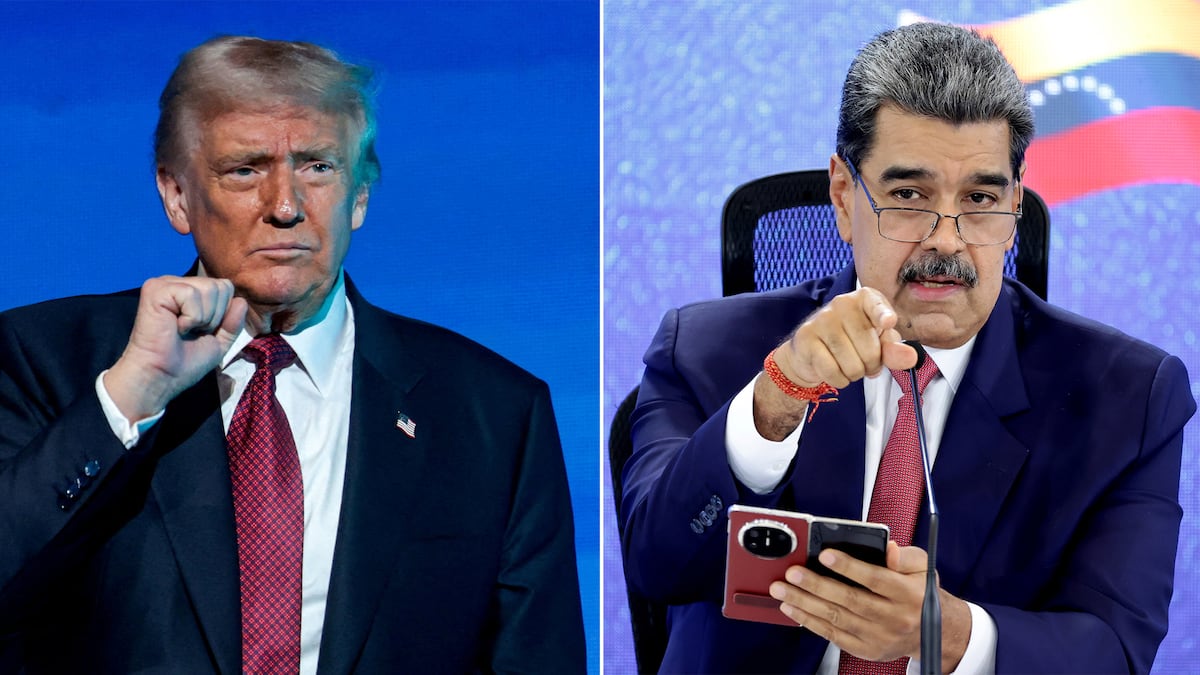
Amidst escalating tensions and a significant U.S. military buildup in the Caribbean, former President Donald Trump is reportedly considering direct talks with Venezuelan President Nicolás Maduro, a move that contrasts sharply with the Biden administration’s recent designation of Maduro as a foreign terrorist. The surprising advancement comes as Washington continues to pursue options regarding Venezuela’s political and economic crisis, including increased pressure related to alleged drug trafficking [[1]]. Sources indicate a willingness to explore diplomatic channels even as military operations persist, signaling a complex and perhaps shifting U.S. strategy toward the South American nation.
Former President Donald Trump is considering direct talks with Venezuelan President Nicolás Maduro, even as the Biden administration has officially designated Maduro as a leader of a foreign terrorist organization amid escalating tensions between the two countries. The potential for dialogue comes as the U.S. military presence in the Caribbean continues to grow, raising concerns about a possible intervention in Venezuela. This development signals a possible shift in approach toward Venezuela, potentially prioritizing diplomatic solutions alongside ongoing pressure tactics.
According to sources familiar with the matter, Trump has discussed the possibility of speaking directly with Maduro with his team. The news emerged on Monday, the same day Washington formally labeled Maduro as the head of what it calls the “Cartel of the Suns,” a network of corrupt Venezuelan officials allegedly involved in drug trafficking. The designation is seen by some within the Trump administration as justification for further military action in or near Venezuela.
While a firm date for any conversation has not been established, a senior official, speaking on condition of anonymity, indicated that a military strike or attempt to capture Maduro is not currently planned. “Nobody is planning to go and shoot [Maduro] or kidnap him – not at the moment. You never say never, but right now that’s not in the plans,” the official said. “In the meantime, we will continue to sink narco-boats. We’re going to stop the drug traffic.”
The U.S. military’s “Operation Southern Lance” has reportedly destroyed at least 21 vessels and killed at least 83 people since September 2, in operations that have drawn criticism from experts, lawmakers, and human rights advocates who allege extrajudicial killings. Tensions in the Caribbean have been steadily increasing as the U.S. has amassed military resources in the region.
The possibility of talks with Maduro emerged as the Chairman of the Joint Chiefs of Staff, General Dan Caine, visited a base in Puerto Rico to meet with soldiers and officials from the U.S. Southern Command, which oversees military operations in Latin America. Approximately 15,000 troops are believed to be mobilized for Operation Southern Lance, with the majority stationed on the island. Caine is also scheduled to travel to Trinidad and Tobago on Tuesday.
Trump himself hinted at the possibility of negotiations earlier this month, stating, “It’s possible we’re going to talk, we’re going to have conversations with Maduro. We’ll see how it goes. They’d like to talk.” He made the comments on November 16 while speaking to reporters at an airport in West Palm Beach, Florida.
Recent reports indicate that a back channel for communication between the two countries has been reopened. Maduro reportedly offered to step down within a couple of years through this channel, a proposal the U.S. rejected, according to The New York Times.
An advisor to Trump, quoted by Axios, said, “I see a diplomatic solution as quite likely.” The advisor added, “Donald Trump hasn’t said it directly, but he wants his presidential legacy to be that he did everything he could to stop the flow of illegal drugs into this country.”
During the early months of Trump’s first term, Richard Grenell, then the White House envoy for Venezuela, engaged in preliminary talks with the Maduro regime, traveling to Caracas and securing the release of six Americans detained in the country, as well as facilitating repatriation flights for deported U.S. citizens. The potential for renewed diplomatic efforts underscores the complex and evolving situation in Venezuela and its relationship with the United States.
