
As President Donald trump enters the one-year mark of his second term, his management is dramatically reshaping U.S. foreign policy through aggressive trade measures and direct military intervention. The implementation of sweeping tariffs – and a controversial military action in Venezuela resulting in the capture of President nicolás Maduro – signals a departure from traditional diplomatic norms. These actions, coupled with a defiant stance toward international law, have formalized what is being called the “Donroe Doctrine,” raising significant questions about the future of the global order and America’s role within it.
U.S. President Secures Investments Through Global Tariffs, Formalizes ‘Donroe Doctrine’ with Venezuela Intervention
“International Law is Irrelevant,” Trump Declares as New Year Brings Military Action
U.S. President Donald Trump speaks at the Detroit Economic Club event on January 13 in Detroit, Michigan. Detroit=AP Newswire
“International law is irrelevant. My own morality, my own mind, is the only thing that can stop me.”
U.S. President Donald Trump
President Donald Trump revealed a starkly independent worldview in an interview with the New York Times published January 8, asserting that only his own judgment could constrain his authority as commander in chief. The nearly two-hour conversation offered a candid glimpse into the President’s approach to foreign policy and the use of American power.
As President Trump approaches the one-year anniversary of his return to the White House on January 20, his administration has been defined by an “America First” agenda, unilateral actions, and increasingly assertive foreign policy. The past year has seen the U.S. leverage tariffs and military strength to project influence globally, often disregarding established international norms and legal principles. This shift in U.S. policy has raised concerns among allies and prompted a reassessment of the global order.
“Day of American Liberation” Marked by Sweeping Tariffs
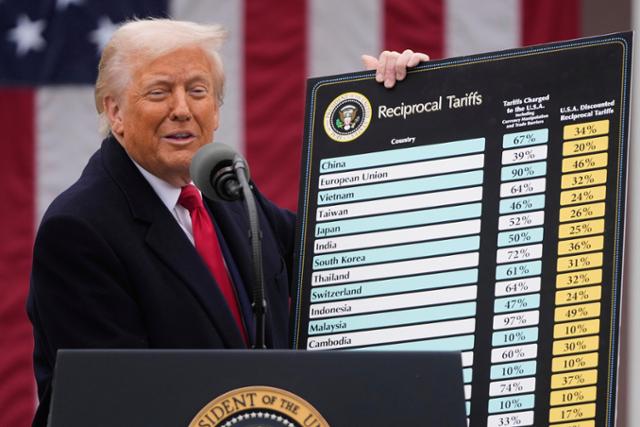
U.S. President Donald Trump announces reciprocal tariffs on various countries during an event titled “Make America Wealthy Again” in the Rose Garden of the White House on April 2, 2025. At the time, the U.S. imposed a 25% tariff on goods from South Korea. Washington=AP Newswire
The Trump administration’s first major move sent shockwaves through the global economy: a series of sweeping tariffs. The U.S. argued that several nations were engaging in “unfair trade practices” by selling products cheaply in the American market while erecting trade barriers to U.S. exports. Less than a month into his second term, on February 1, 2025, the U.S. imposed unilateral tariffs on Canada, Mexico, and China, initiating a trade war.
Three months later, on April 2, the U.S. extended the tariffs to 57 economies, including allies like South Korea, the European Union, and Japan, adding a base tariff of 10% plus country-specific levies. Trump bypassed congressional approval with an executive order, declaring the day “the Day of American Liberation.” Countries around the world responded by pledging large-scale investments in the U.S. and opening their markets in an effort to avoid the tariffs.
A particularly contentious trade dispute unfolded with China, escalating into a tit-for-tat tariff battle. At one point, the U.S. imposed tariffs as high as 145% on Chinese goods, prompting reciprocal tariffs of 125% from Beijing. The escalating tensions were temporarily eased on May 15, 2025, with a “90-day tariff truce.” China’s leverage in the dispute stemmed from its control over the supply of rare earth minerals, essential for U.S. automotive and high-tech industries, ultimately prompting a partial U.S. retreat.
Assertive Moves in Venezuela and Greenland

U.S. President Donald Trump posted an image on his Truth Social media account on January 3 showing Venezuelan President Nicolás Maduro after his arrest and purported transport to the United States. News1
With a full-scale confrontation with China deemed too risky, Trump’s attention shifted towards the Americas and Greenland, signaling a renewed focus on the Western Hemisphere. While 2025 saw economic pressure as the primary tool, the new year brought a more direct application of military force, reminiscent of 19th-century “gunboat diplomacy.”
The White House unveiled its comprehensive strategy in the 2025 National Security Strategy (NSS) report released January 5, explicitly stating that “President Trump’s foreign policy is based first and foremost on American interests.” The report also asserted that “non-Western Hemisphere competitors have economically disadvantaged us” and that “we must maintain a dominant position in the Western Hemisphere.” This articulation effectively formalized the “Donroe Doctrine”—a synthesis of Donald Trump’s policies and the Monroe Doctrine—prioritizing U.S. interests without reservation.
The first concrete manifestation of the Donroe Doctrine was the intervention in Venezuela. On the night of January 3, U.S. forces raided the presidential safety residence in Caracas, Venezuela, capturing President Nicolás Maduro. The de facto abduction of a sovereign nation’s leader to the United States has sparked international condemnation. The U.S. subsequently announced plans to administer a transitional government in Venezuela and seize control of the country’s oil reserves, openly demonstrating its pursuit of regional influence, containment of Chinese interests, and economic gain.
Trump’s ambitions extended even to allies. From the outset of his administration, he has expressed interest in Greenland, stating on multiple occasions that “we have to control it” for international security. On January 9, amid the fallout from Maduro’s capture, he reiterated his desire to acquire the Danish territory, warning that he would pursue it “by any means necessary,” even if it meant challenging a long-standing alliance with Denmark, which has a defense agreement with the U.S. dating back to 1951.
From WTO to “Trump Round”

A woman clears snow from a car in Nuuk, Greenland, on January 12. Nuuk=AP Newswire
As the U.S. pursues a course of extreme unilateralism and power projection, the value of alliances and the international order has diminished. On January 7, Trump signed an executive order authorizing the withdrawal from 66 international organizations, including UN agencies. Two days later, in his interview with the New York Times, he dismissed the importance of alliances, stating that “if the United States isn’t at the center, the so-called ‘Atlantic Alliance’ with Europe is essentially useless.”
The liberal international economic order has suffered a similar fate. Jamieison Greer, U.S. Trade Representative, declared the World Trade Organization (WTO) system “unsustainable” in August 2025, signaling the end of U.S. leadership in multilateral trade. He announced a shift towards bilateral and plurilateral trade agreements, dubbed the “Trump Round,” moving away from the principles of multilateralism.
Son Seong-won 기자 [email protected]
관련 이슈태그
