
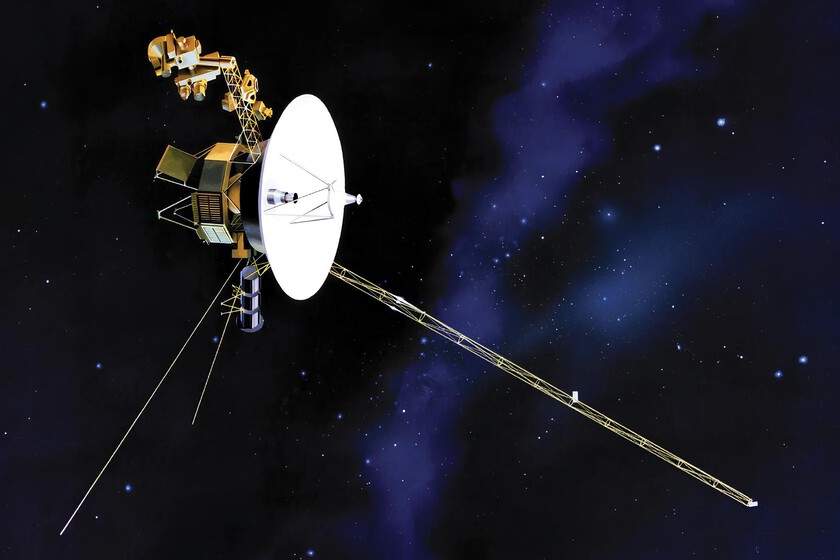
Nearly half a century after its launch in 1977, NASA’s Voyager 1 probe is on teh verge of reaching a historic milestone – traveling one light-year from Earth [[1]]. This unprecedented achievement marks the farthest any human-made object has ever journeyed, offering a unique outlook on the vastness of interstellar space and pushing the boundaries of our understanding of the cosmos. Despite its age, the spacecraft continues to transmit valuable data, a testament to its robust engineering and NASA’s ongoing efforts to maintain contact with the distant probe [[2]].
Nearly five decades after its launch, NASA’s Voyager 1 spacecraft is poised to reach a cosmic milestone: traveling a distance equivalent to one light-year from Earth. The achievement underscores the enduring legacy of the probe, a testament to both engineering resilience and the relentless pursuit of deep-space exploration.
Voyager 1 will be the first human-made object to reach this distance, defined as the distance light travels in 24 hours. This feat redefines our understanding of the vastness of space and the challenges of interstellar travel.
Onboard the spacecraft is the iconic Golden Record, a collection of sounds and images representing the diversity of life and culture on Earth. While the probability of another intelligent civilization intercepting the record remains extremely low, its inclusion symbolizes humanity’s ambition to connect with the cosmos.
Nearly Fifty Years of Continuous Operation
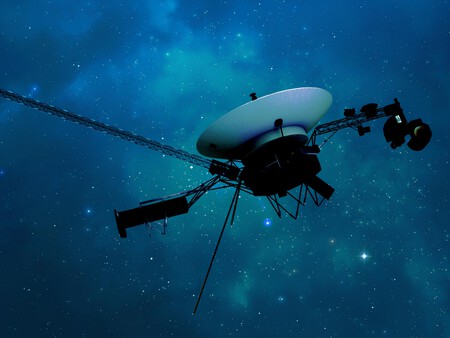
(NASA)
Launched in 1977, Voyager 1 was initially designed to study the outer planets – Jupiter and Saturn – taking advantage of a rare planetary alignment. The mission quickly evolved, driven by the discoveries the probe itself transmitted back to Earth. This adaptability has been key to its longevity.
A pivotal moment came in 2012 when Voyager 1 crossed the heliopause, the boundary where the sun’s solar wind is no longer dominant and interstellar space begins. This marked the first time a spacecraft had officially exited the solar system.
NASA reports that the probe is currently traveling at approximately 38,000 miles per hour (61,000 kilometers per hour). As of today, it has traveled over 16 billion miles (25.9 billion kilometers) from Earth, a distance that continues to grow. The probe’s continued operation demonstrates the potential for long-duration space missions.
The fact that Voyager 1 is still transmitting data nearly 50 years after launch is a remarkable feat of engineering, setting a benchmark for future long-range missions.
Scientists continue to receive information about magnetic fields, energetic particles, and plasma waves present in interstellar space. This data fuels research into the structure of the nearby galactic environment and the physical limits separating our solar system from its stellar neighbors.
Cosmic Scale Measured from a Single Object
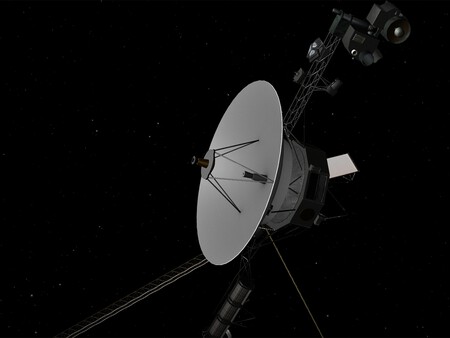
(NASA)
The distance Voyager is about to reach helps to contextualize the scale of the cosmos. Light takes just eight minutes to travel from the Sun to Earth, but requires 24 hours to cover the distance that will separate the probe from our planet. This difference illustrates the challenges of communicating and operating missions at scales beyond human reference.
NASA details that the probe is traveling at approximately 38,000 miles per hour. At that speed, it has accumulated more than 16 billion miles from Earth, a figure that will continue to increase.
The probe’s continued operation highlights the importance of robust design and long-term reliability in deep-space exploration.
This milestone will coincide with another significant marker. A couple of months after reaching the one-light-year distance from Earth, Voyager 1 will be the same distance from the Sun. This dual measurement will allow for more precise tracking of the probe’s trajectory within the interstellar environment and refinement of models regarding the shape and extent of the heliosphere.
The question of where the solar system truly ends remains open for debate. Definitions vary depending on the criteria: it could be the orbit of the known planets, or the theoretical edge of the Oort Cloud, a collection of icy bodies surrounding the solar system at extraordinary distances. Another option is to consider the limit where the Sun’s gravity no longer dominates over neighboring stars.
Regardless of these interpretations, Voyager 1 has yet to reach the true edge. Researchers estimate that it will take approximately 40,000 years for the probe to reach the region where the Sun’s gravitational influence balances with that of other stars. This figure reveals that even a mission as long-lived as Voyager is only taking its first steps toward that remote environment.
Technology from the 1970s Still Delivering Data
(NASA)
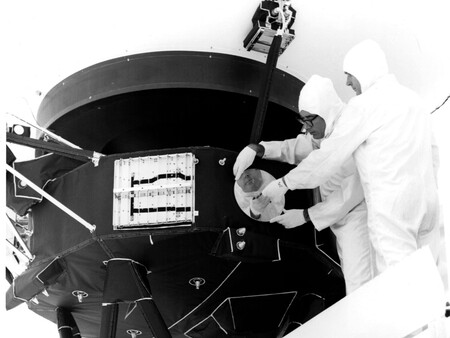
One of the most striking aspects for engineers and astronomers is the resilience of its technology. Built with components from the 1970s, without the ability for remote updates, the probe is still transmitting information with enough power to be detected on Earth.
The continued flow of data allows for ongoing studies of the interstellar medium, although NASA warns that the energy available to power its instruments will decrease in the coming years.
The design of the spacecraft and its communication systems has become a reference for new projects seeking to operate at great distances. A 2022 study by NASA’s Advanced Concepts Institute highlighted that any attempt to travel at speeds approaching the speed of light will require new propulsion technologies, very different from current chemical or nuclear methods.
That report put into perspective the difference between Voyager’s speed (approximately 38,000 miles per hour) and the nearly 621,000 miles per hour equivalent to the speed of light.
