As Warsaw’s main railway hub prepares to officially open its renovated facilities this November, a look back reveals a long and complex history for Warsaw West station. For decades, travelers navigated a makeshift transportation center-one frequently described as “temporary”-while contending with crowded platforms and a labyrinthine network of tunnels. This article explores the station’s evolution from its pre-war origins, through its wartime use and post-war neglect, to the present day, offering a glimpse of what passengers endured before the completion of the extensive modernization project.
500 wydań Muratora – świętujemy wyjątkowy jubileusz!
A Commuter’s Memory: Life Before the Warsaw West Station Transformation
Table of Contents
- A Commuter’s Memory: Life Before the Warsaw West Station Transformation
- Warsaw West: Poland’s Busiest Rail Hub
- A Brief History of Warsaw West Station
- The Long-Standing “Temporary” Station
- Plans for Reconstruction and the 1980s Bus Station Construction
- The Warsaw West Bus Station: A Look at the Existing Facility
For many, the pre-renovation experience at Warsaw West station is a vivid memory. Passengers once navigated a complex system of announcements and crowded tunnels, often seeking a quick bite from the nearby pastry stand while trying to decipher platform information. Lugging heavy suitcases up steep staircases was a common challenge, and finding the correct exit could lead you to open fields rather than the heart of Warsaw. Waiting on the platforms, often exposed to the elements, offered a dramatic view of the city skyline as a small consolation. This was the reality for travelers using one of the country’s busiest transportation hubs just a few years ago.
Dworzec Zachodni
Warsaw West station has long been criticized in Warsaw, primarily for the perceived inefficiency of the railway authorities. However, the problem is far more complex. It’s a true Gordian knot, involving the competencies of various public institutions,” wrote Grzegorz Stiasny for Architektura-murator several years ago.
Warsaw West: Poland’s Busiest Rail Hub
Warsaw West station is the busiest passenger rail station in Poland and the country’s largest railway node in terms of train traffic. Approximately 1,000 passenger trains – including commuter, regional, long-distance domestic, and international services – pass through the station daily, according to a report by Architektura – murator.
During peak hours, around 100,000 people utilize the station. Projections by PKP PLK estimate this number will double by 2030, necessitating infrastructure upgrades to accommodate increased capacity and passenger comfort.
With the official opening of the renovated Warsaw West station in November 2025, a look back at its history is warranted.
A Brief History of Warsaw West Station
The station was originally constructed before the war, during the development of the middle line and bridge (1919-1933). According to siskom.waw.pl, during World War II, crematoria associated with the Warsaw concentration camp may have been located in the nearby tunnels. During and after the Warsaw Uprising, the station was used by the Germans to deport Warsaw residents to camps in Pruszków and Ursus.
After the war, the station did not develop and played a secondary role. It wasn’t until the 1970s that the platforms were connected by an underground tunnel to the WKD (Warsaw Suburban Railway) stop, and in 1980 it was integrated with the Bus Station. Currently, the condition of both the railway and bus stations leaves much to be desired. It is one of the most neglected stations in Poland,” reads a statement on the website.
The Long-Standing “Temporary” Station
For years, Warsaw West, a key transit point for passengers traveling to the capital and connecting to trains such as the airport rail link, operated as a temporary facility.
In 2020, the industry portal Rynek kolejowy even identified Warsaw West as the most well-known temporary station in Warsaw.
Even today, it’s easy to spot temporary elements dating back to the 1930s. From the walls and platform surfaces to the pedestrian tunnels and the small architectural features supporting the canopies over the platform exits (similar features can also be found at the Eastern Station), these elements are slowly becoming relics of railway architecture,” commented the authors of the report.
Plans for Reconstruction and the 1980s Bus Station Construction
Reconstruction plans were initially discussed as early as the 1960s (April 1965), with a competition announced for the redevelopment of the station area. The original plan involved renovating the existing structures, constructing a new bus station, and creating a major transportation hub with an underground road tunnel and a tunnel for trams.
“Looking at the plans for the station and its surroundings, the creators were ambitious. On the Aleje side, a large commercial and service complex with hotels and shops was envisioned, along with bus loops for public transportation. The station, connected by numerous tunnels and overpasses to facilitate passenger flow, was intended to be an example of a future understanding of what a transportation hub should be within the city’s entire transport system,” reads a report on rynek-kolejowy.pl. “In 1971, an impressive model of the future station was presented, which, in addition to serving over 1,000 PKS buses and approximately 800 PKP trains daily, was even designed to accommodate light helicopters.”
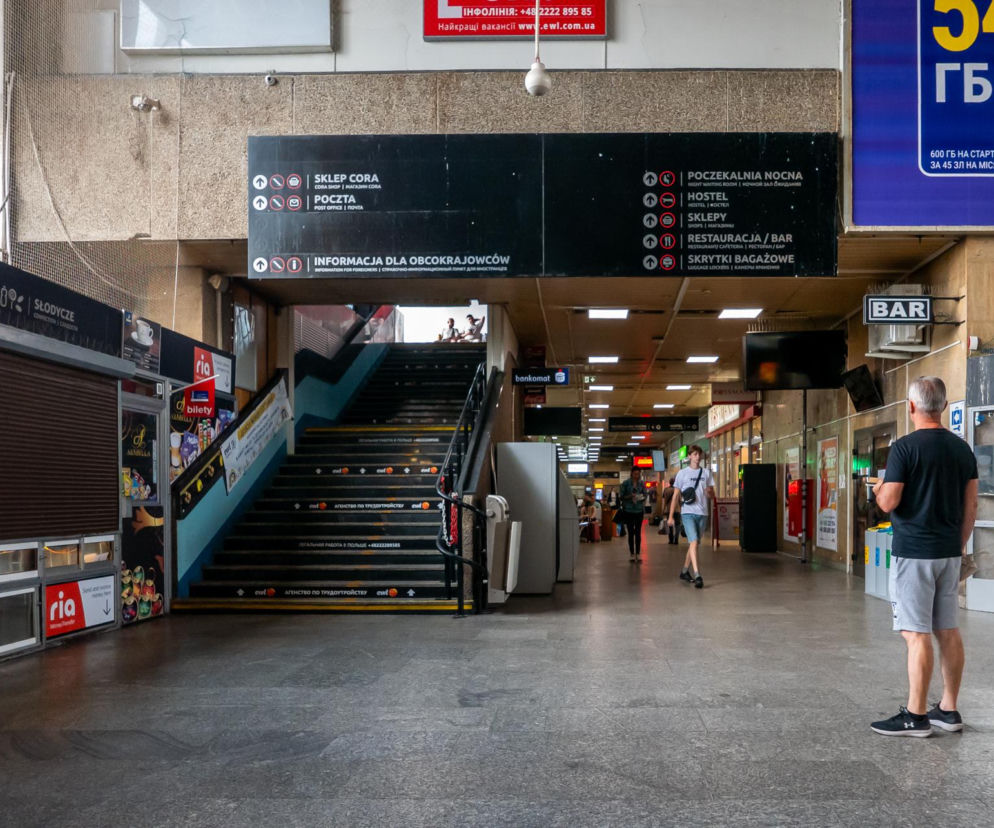
Construction began in 1972, with an anticipated completion date of 1975, but the project was delayed. Ultimately, the PKS bus station opened in 1980 and remains largely unchanged to this day. As noted by editor Przemysław Zańko-Gulczyński in a recent article, stepping from the newly renovated PKP station into the bus station is like stepping back in time to the 1990s.
Since its opening in 1980, the station has never undergone a major modernization. Only minor repairs have been carried out, but it is clear that this is not enough. A visit to the underground pedestrian tunnel reveals empty storefronts and metal barriers blocking access to some passages. It is no longer possible to exit directly onto the bus platforms, although the tunnels and stairs still exist,” describes Zańko-Gulczyński.
The long-awaited modernization is now complete for the rail portion of the station, though the aging bus station remains.
The Warsaw West Bus Station: A Look at the Existing Facility