
Okay,here’s a short introductory paragraph based on the provided (very long!) string of HTML div tags. It’s a bit of a challenge to infer meaning from just the structure, but I’ll assume it’s meant to represent a deeply nested, potentially empty, document or layout:
“The provided code snippet showcases an exceptionally deep nesting of HTML div elements. This structure,while syntactically valid,suggests a layout or document potentially lacking considerable content within its layers. It’s an captivating, though unusual, presentation of hierarchical HTML construction, raising questions about its intended purpose and rendering.”
“The Golden City,” a new production now playing at Prague’s Divadlo v Dlouhé, premiered last Saturday, November 15th. The play unfolds within a futuristic vision of 2039, inspired in part by Georgi Gospodinov’s novel Time Shelter. The story centers on characters longing for “a normal world” who retreat into a stylized recreation of 1930s Vienna, a supposed “golden age” where things felt more orderly.
Director Ivan Buraj brings characters from Ödön von Horváth’s plays – Marianna from *Tales from the Vienna Woods* and Elisabeth from *Faith, Hope and Love* – into this meticulously crafted world. He sees a mysterious spiritual connection between these young women, both searching for love and the freedom to be themselves. They are surrounded by a gallery of nostalgically grotesque figures – small shopkeepers, police officers, and employees of an anatomical institute – lifted directly from the original texts.
Déjà vu 99.8
Table of Contents
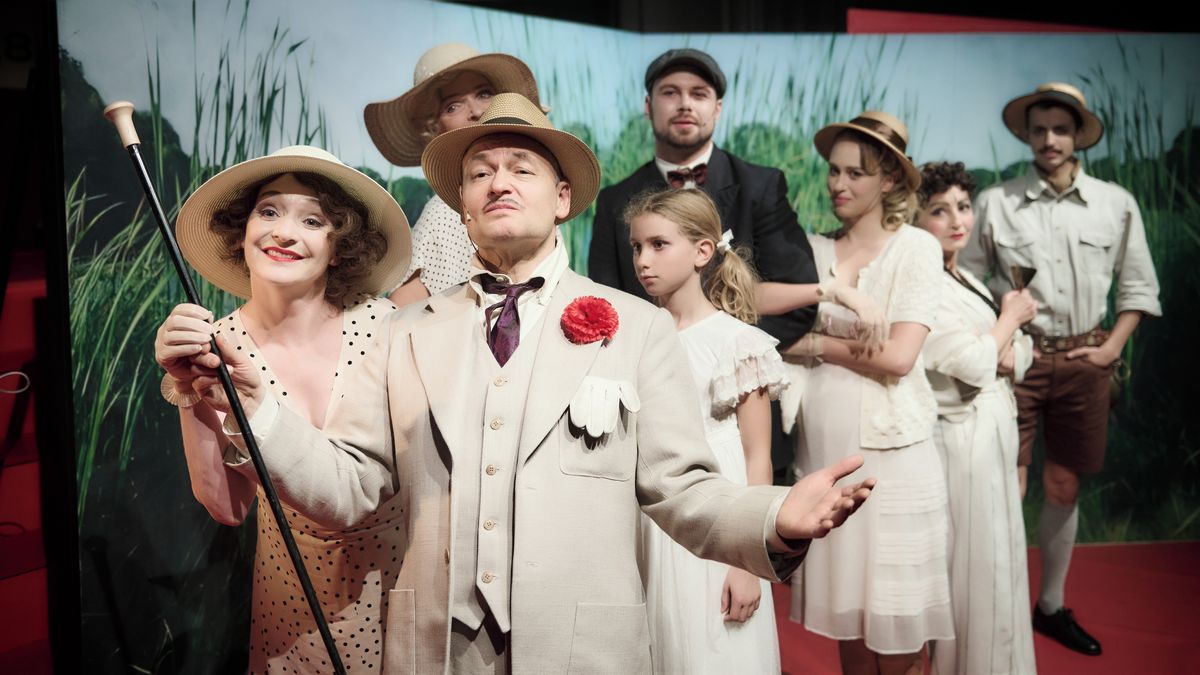
The red buildings on stage resemble the backdrop of a retro mechanical theater. Jakub Kudláček’s music, reminiscent of a barrel organ, and the jerky, repetitive movements of the actors at the beginning of the performance evoke puppets brought to life by an unseen force.
As the play progresses, the actors shed this stylized movement, and everyday neighborhood life awakens in the city’s corners. Marianna, the daughter of a toy shop owner, arranges skeletons in the shop window. Her father, the Magician, angrily shouts from the window, searching for stockings. Valerie, an aging and lustful newsstand vendor, argues over money with her rabbit, Alfred. Butcher Havlitchek gorges himself on sausage while his assistant, Oskar, courts Marianna, whom he’s known since childhood and hopes to marry.
Photo: Martin Špelda
Naive Marianna encounters the world-weary con man Alfred. Their fateful eye contact is presented as a close-up on a screen that descends from the top of the stage. Horváth often included the stage direction “silence” in his scripts, indicating moments where characters’ fates are sealed. Buraj emphasizes this with a camera shot, capturing and projecting the action in real time, sometimes including glimpses behind the scenes.
The small-town community gathers by the Danube to celebrate Marianna’s engagement to Oskar. But Alfred is also present. In a scandalous move, the lovestruck Marianna leaves her fiancé, and the Viennese idyll darkens.
Even before this, warnings and revealing subtexts seep into the superficially light, sometimes playfully erotic conversations. Grotesque specters, dark allusions to war, and the baser instincts of human nature – elements Horváth brilliantly employed in his “folk plays” – are all present.
If this were simply a staging of *Tales from the Vienna Woods*, the production would feel promising. What doesn’t quite work is Buraj’s invented framework of a near future and the fleeting references to the supposed year 2039, the nature of which remains largely undefined throughout the play.
Posters with the inscription “Déjà vu 99.8” hang casually on the houses, and there are occasional mentions of someone being punished by being sent back to reality. Why everyone is escaping into the illusion of the past century, as if it were a Disneyland, isn’t clear. And, crucially, Horváth’s plays are powerful statements about the present day on their own; connecting them to a near-future setting doesn’t add anything, and may even detract from their impact.
The Inescapable Stupidity of Humanity
Central European Horváth lived from 1901 to 1938, between the World Wars. In the less than two decades he spent writing his 17 plays, he observed the traumatic aftermath of World War I, the frustration and poverty of the economic crisis, and the rise of Nazi ideology based on the lowest human impulses – suppressed aggression, rootlessness, and sexual complexes. He witnessed the collapse of democracy.
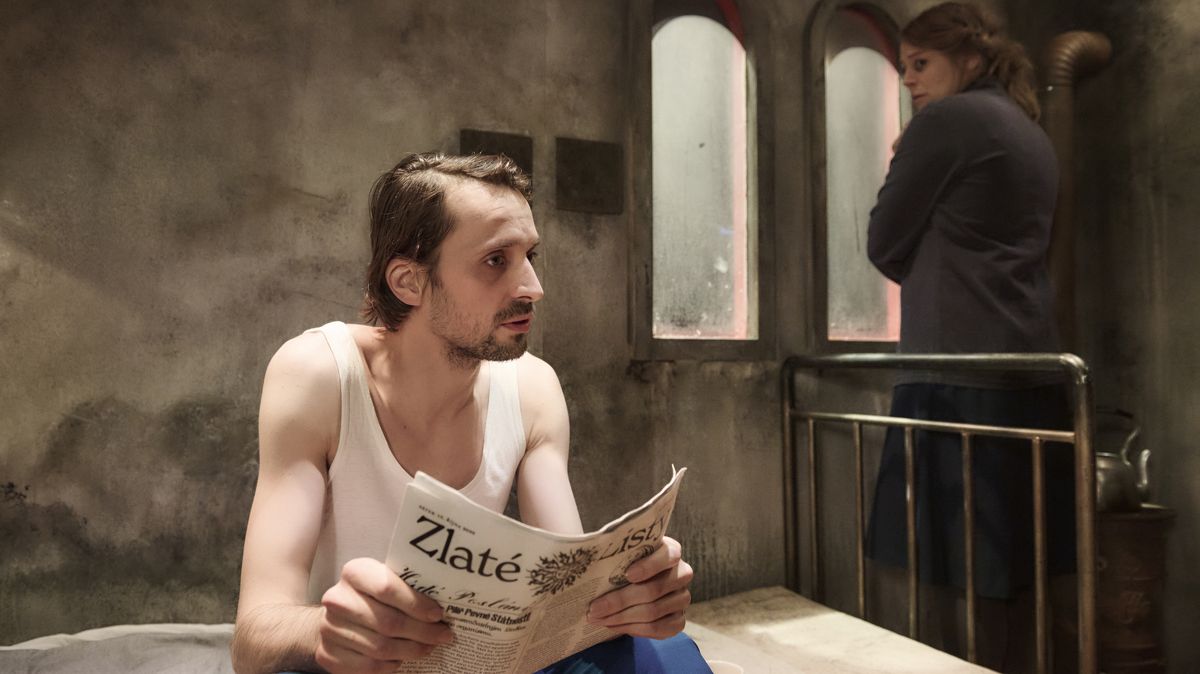
Photo: Martin Špelda
A well-known quote by Ödön von Horváth, that “nothing evokes a feeling of infinity as strongly as stupidity,” is still relevant, the production reminds us. In the photo are Matyáš Řezníček and Veronika Lazorčáková.
He embodied his experiences with people and history in the stories of his “folk plays,” often inspired by court records and local chronicles. Beneath a light, entertaining surface, he explored the tragic fates of “ordinary” people confronting the antisocial nature of society, revealing the inherent cruelty of human nature, selfishness masked by sentimentality and lies.
Ivan Buraj took over as artistic director of Divadlo v Dlouhé this season after a decade of successfully shaping the identity of Brno’s HaDivadlo. He has previously expressed his views on contemporary society through interpretations of classic plays – earning acclaim for his direction of *The Lower Depths* by Maxim Gorky and *Uncle Vanya* by Anton Chekhov. His original projects, *Our People* and *Perception*, sharply and unexpectedly reflected the atmosphere and mindset of today’s society, particularly its suicidal inclination towards the environment.
Buraj most comprehensively demonstrated the current “spiritual climate” in his production *Humanism 2022*, which he co-created with filmmaker and screenwriter Bohdan Karásek. That production, too, was essentially about banality, against which history and human stories unfold. Former classmates from drama school spend a vacation in Venice, discussing their personal lives, professions, and relationships in the context of COVID-19, the war in Ukraine, and European history and culture. Buraj’s fascinating, hyperrealistic direction worked with unspoken motives and editing in a way similar to Ödön von Horváth’s use of “silence.”
Lost in the Golden City
In *The Golden City*, the director seems to have lost his way in his reflections, references to philosophical thinking about the present, and the mysterious connections between the visible and the hidden – elements that have always been strengths of his theatrical work.
He experiments with various techniques: choreographic stylization, live cinema, realistic detail, and exaggerated grotesque expression. When he encounters their limitations, he simply abandons them. As a result, the production falls apart into individual scenes – some of the stronger ones correspond to the language of Horváth’s texts, while others contradict the author and devastate the source material.
In the scenes from the bawdy cabaret, where the unfortunate Marianna performs to earn a living, the human dimension and the tragedy of the situation are completely lost. In the final moments, the spiritual weight of Elisabeth’s silent death is drowned out by the endless coughing and shouting of the police officers who pulled the suicide from the river.
The actors’ performances, shifting between genres, are often brilliant shortcuts and overblown illustrations. A notable exception is Veronika Lazorčáková’s consistently compelling portrayal of Elisabeth. Despite everything, she manages to convey the horror of her fate and the irony with which it is fulfilled, echoing the Christian motto of faith, hope, and love.
Production: Ödön von Horváth, Ivan Buraj – The Golden City
Cast: Kristýna Jedličková, Veronika Lazorčáková, Magdalena Zimová, Pavel Neškudla, Matyáš Řezníček, Pavel Tesař, Jan Vondráček, Samuel Toman, and others
Divadlo v Dlouhé, Prague, premiered November 15, 2025, with upcoming performances on November 21 and December 8.
