
The generative AI boom continues to reshape the tech landscape, but the financial benefits aren’t being shared equally. While Nvidia and TSMC are seeing ample gains from the surge in AI demand, a new report indicates that many other players in the semiconductor supply chain are facing shrinking margins or outright losses. This analysis focuses on Broadcom‘s strategic response – a heavy investment in AI despite profit dilution – and how the company is leveraging its established software business to navigate these turbulent market conditions.
The explosive growth of generative artificial intelligence (GenAI) is reshaping the technology industry’s supply chain and profit structures. While the AI boom has captured global attention, data indicates that only Nvidia and Taiwan Semiconductor Manufacturing Company (TSMC) have so far realized substantial revenue increases, expanded gross margins, and improved operating profits from the trend. Other participants in the supply chain, including chip suppliers, original equipment manufacturers (OEMs), and original design manufacturers (ODMs), are largely operating at a loss or are diluting overall profitability through expansion into AI businesses.
According to a report by Nextplatform, even chip giant Broadcom is not immune to this dynamic. While the company demonstrates strong performance in data center networking and switching with healthy operating margins, Broadcom is actively investing in GenAI to avoid falling behind, accepting a resulting dilution of profits. Financial markets are characterizing this as an increase in operating profit coupled with a dilution of operating margin.
Balancing Strategy with Software to Offset AI Margin Pressure
For Broadcom, participation in the GenAI market is seen as unavoidable. Remaining on the sidelines would not only mean missing out on the current wave but also potentially losing a significant portion of chip sales within its data center product line. To mitigate this, Broadcom is relying on its legacy enterprise software business – built through past acquisitions – to maintain overall financial health. Previous acquisitions of Symantec, CA, and VMware have created a highly sticky and profitable business within data centers, effectively offsetting the lower margins associated with AI-related business due to the nature of the market. Broadcom’s infrastructure software group has become a key profit center over the past decade.
Despite some skepticism from Wall Street regarding its AI-related revenue performance in the fourth quarter of fiscal year 2025, Broadcom CEO Hock Tan emphasized the company’s strong accumulated order backlog in the AI space. Broadcom currently has $73 billion in AI orders on hand, expected to be fulfilled over the next six quarters, and Tan anticipates further orders will arrive before the existing backlog is completed.
The report details that $53 billion of the $73 billion AI backlog is attributed to XPUs (accelerated processing units). A significant portion of the remaining orders likely stem from Tomahawk 6 switch ASICs. Tan noted that the Tomahawk 6 is the fastest-growing switch ASIC in Broadcom’s history. This AI order volume also includes digital signal processors (DSPs), lasers, PCI-Express switches, and potentially storage controllers.
However, actively pursuing AI business is driving a shift in Broadcom’s business model and further diluting profits. Large customers – including hyperscalers, cloud infrastructure builders, and model developers – are demanding complete system delivery from their chip suppliers, pushing Broadcom towards a role as an AI system integrator. This requires Broadcom to take on responsibilities typically associated with original design manufacturers (ODMs), demanding greater scale but yielding lower margins. One of Broadcom’s four XPU customers is already purchasing fully assembled rack-scale machines, and a fifth customer has begun procuring rack-scale equipment directly.
Regarding customer orders, Tan confirmed that Anthropic was the customer who previously placed an approximately $10 billion order for Google TPU racks. Anthropic has since issued a new order for $110 billion worth of TPU racks, scheduled for delivery by the end of 2026. While Broadcom’s fifth XPU customer is not believed to be OpenAI, they have placed an order valued at $1 billion for XPU systems, slated for delivery in 2026.
Broadcom’s partnership with OpenAI has also been clarified. The OpenAI deal, spanning 2027 to 2029, is expected to help OpenAI process approximately 10GW of capacity. Tan confirmed that this OpenAI transaction is separate from the XPU program currently under development with the company. The latter is believed to involve Broadcom assisting OpenAI in developing and manufacturing its in-house “Titan” inference XPU.
Software Segment as a Profit Pillar Supporting Strong Financial Performance
Despite the margin pressure from its AI business, Broadcom’s overall financial performance remains strong, reflecting its strategic agility. In its most recent quarter, ending November 2nd, Broadcom reported revenue slightly above $18 billion, a 28.2% increase year-over-year and a 12.9% increase sequentially. Gross profit increased by 62.3% to $7.51 billion, and net income grew 97% to $8.52 billion, partially attributed to a $1.65 billion tax benefit.
For the full year, Broadcom’s revenue reached $63.89 billion, a 23.9% increase. Net revenue reached $23.13 billion, a multiple of 3.9 times the previous year, representing 36.2% of total revenue. As of the end of the quarter, Broadcom held $16.18 billion in cash and $65.14 billion in debt, indicating a slowing debt trend and rapid cash growth. 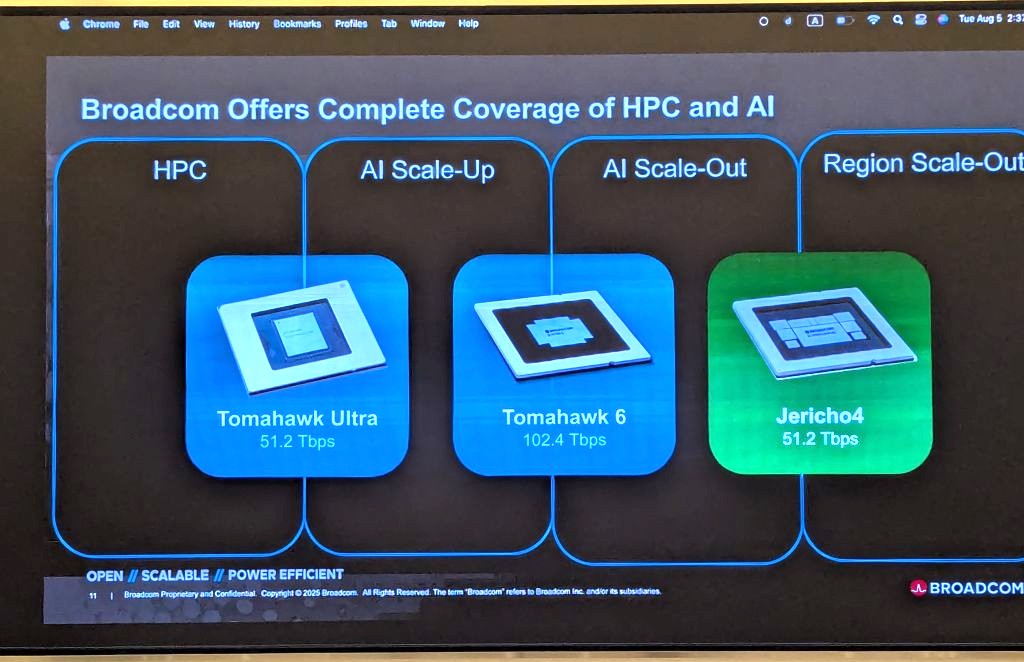
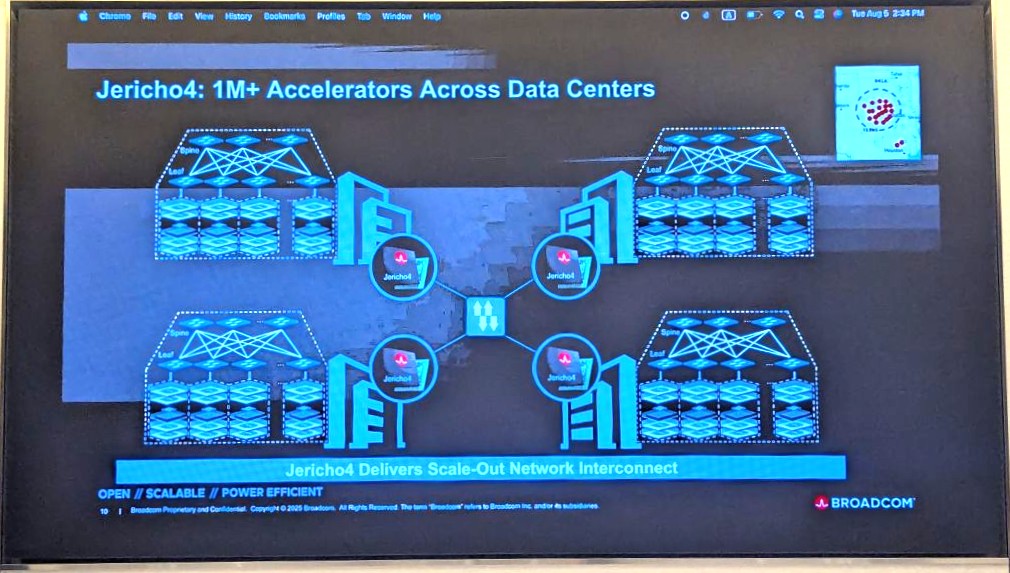
AI XPU sales were relatively modest during the quarter, at approximately $765 million, but represented a 2.2x increase year-over-year. However, the majority of AI sales came from AI networking, estimated at $5.74 billion in revenue, driven by the launch of the 102.4 Tb/s Tomahawk 6 and, to a lesser extent, Jericho 4. Combined, AI contributed $6.51 billion in revenue for the quarter, a 74% increase year-over-year.
Looking ahead to the first quarter of fiscal year 2026, Broadcom forecasts total revenue of approximately $19.1 billion, representing 28% growth. AI chip revenue is expected to double to $8.2 billion, while non-AI chip revenue is impacted by wireless…
Ultimately, Broadcom is pursuing an “eat or be eaten” strategy in the GenAI market, safeguarding its market position and future growth despite profit dilution. Hock Tan is likely to leverage pricing power within its software businesses, such as CA and VMware, to bolster overall profitability when necessary. Broadcom is, therefore, utilizing its acquired market power to navigate the increasingly challenging realities of the modern chip market.
(Lead image source: LinkedIn)
jQuery(document).ready(function(){
jQuery('iframe').each(function(i){ var $this = jQuery(this); if ( $this.attr('data-src') ) { var data_src = $this.attr('data-src'); data_src += '&v=' + (new Date()).getTime(); $this.attr('data-src', data_src); } });
setIframe();
//lazy-iframe jQuery(window).scroll(function(){ setIframe(); }); });
